Sunday, August 8, 2010

Story of an Old Negro Settlement, on the Edge of Indian Territory


Negro Settlement 1885
Source: Washington: U.S. Department of the Interior, General Land Office, 1885

While looking at a number of old maps of Indian Territory recently, a good friend and colleague, author Art Burton pointed out an historic African American settlement on Indian Territory and Oklahoma Territory maps. Now this is not unusual for Oklahoma's history especially since Oklahoma has had more all black towns than any other state in the country.   And about 8 of those towns still exist today. However, this section of the Territory was not one of those historically black  towns.

I looked at a map  and found that "Negro Settlement".  At first I assumed that this might have been a small group of people who were simply on route to another community, and then I began to look at additional maps over the next 20 years.

As early as 1879 the Negro Settlement began to appear on maps:
Source: U.S. General Land Office Indian Territory Pocket Map 1879


The settlement appeared again in 1887, northwest of Paul's Valley and appeared to be in, or near the Chickasaw Nation.  The actual community was in the southwestern corner of what would eventually become Cleveland county, Okahoma. So here, two years later, this community had no name, but was still reflected on local maps.


1887 Map reflecting Negro Settlement
Source: Chicago: Henry S. Stebbins, 1887; From Crams Universal Atlas of the World

Then, in 1889, came a more direct illustration of where this settlement was.  At the very end of the old Cheyenne Agency Road.
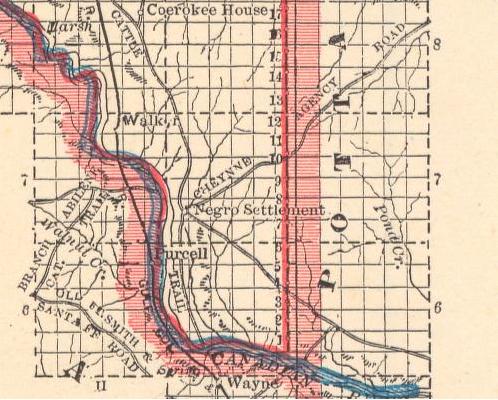
1889 Image of Negro Settlement
Source: Chicago: People's Publishing Co., 1889

 The presence of a cattle trail that ran southeast of the community suggests that this settlement might have been a place where some of the black cowboys may have encamped.


1891 the settlement was still present
Source: Chicago: George F. Cram, 1891


In 1893, there may have been a shift in the population, for the settlement was now reflected on historic maps as merely "huts".

"Huts"  described the community in 1893.
Source:Chicago: Rand McNally and Company, 1893; 
from Rand McNally and Company's Enlarged Business Atlas and Shippers Guide


In 1901 the settlement was still there, and now also called, Negro Huts
1901 Map reflecting settlement as 
Negro Huts

BUT----Interestingly, by the time of statehood, they were gone.  No maps represented them, and this settlement that lasted more than 2 decades, was now gone without a trace. It never had a name, and nothing in the current Oklahoma local history represents the presence of this black community.  No name---just a reflection of a settlement. My questions is now----where would this settlement be today?

Current maps represent an area not far from the Canadian River, near the point where Walnut Creek flowed into the Canadian River. 

The settlement was below Noble Oklahoma and above Purcell, Oklahoma. It was a community to the east of what is now I-35.  And---it was at the very endpoint of the old Cheyenne Agency Road.  

The problem is today's maps do not reflect the old Cheyenne Agency Road. But thanks to Google Maps one can look at the same area from several perspectives.

1) Several maps reveal that the settlement was near a bend in the Canadian River.
2) The settlement was below Noble, and above what would be come Purcell, Oklahoma
3) There was also the diagonal road coming from a northeasterly direction---the old Cheyenne Agency Road
4) The settlement was also to the east of the river, and to the east of a railroad track that ran directly along the edge of the settlement.

So, using Google Maps I decided to see if I could find a place that met all of those conditions and zoom in .

I could see the bend in the Canadian River.
I could see the bend that was below what is now Noble Oklahoma, and yet above Purcell.
I could see the railroad via a satellite image, and see the area east of the railroad.  But---I could not see a road---at least not a current road

However aerial satellite images on that exact same image, do reflect a path of some sort---perhaps an old abandoned trail, coming diagonally from the Northeast that did stop at a point in the same vicinity.  The question whether this is the old Cheyenne Agency Trail comes to my mind.  And if so...........could this possibly the old Negro Settlement?

Studying the old maps again, the settlement was clearly southeast of Noble, but above Purcell.  It appeared to be near a bend in the Canadian River.  Today's maps reveal that the settlement was probably west of what is now Slaughterville Oklahoma and Noble.  

First, by using Google maps I zoomed  in on what might be near that same community.


Then I looked via satellite image also reflects this same area:


I noted on one of that 1889 maps that reflected a point at the end of the old Cheyenne Agency Road.

Could I find that road today coming from a 45 degree angle and ending at the settlement?  And if the road no longer exists is it now just an old abandoned trail? I decided to compare the old map with a satellite image of today.  I also noticed on the old maps there was a railroad that also ran alongside the settlment.  

I needed to find a point alongside the railroad where an old road or trail ended--coming from a 45 degree angle.  And it had to be someplace in or near the bend in the Canadian River, and above the town of Purcell.

So looking at an old map, next to a satellite image I studied more:


Then I zoomed in on the same area, inside of the bend of the Canadian River, to the east of the railroad, and at what appears to be the end of a road or trail coming at a 45 degree angle:

The railroad is visible on the left. Two roads intersect--- Banner Road and Burkett Road  This area is south and west of Noble Oklahoma, and north and west of Purcell..  Right where the two roads intersect--one can see that the trial did continue a few yards, towards the railroad.  Could that possibly be the old Cheyenne Agency Trail?  If it is, then the old Negro settlement might have been right there.   On some of the maps it also appeared to be a stop of some sort for the railroad.

Looking more closely at the satellite image I zoomed in for a closer look:


Areal view of Burkette and Barnett Road.  
Source: Google Maps Satellite Image

Could this be near the old settlement?  
(Is the diagonal path on the landscape coming from the northeast a remnant
of the old Cheyenne Agency Road?)

Of course I cannot say with certainty that this is the site of the old settlement---but just in case it was, I wanted to have a look at the site.  

So with Google Street View, I decided to take a look and descended through the wonderful technology that exits, to see what was there. At the intersection of Burkett and Banner Road. One can see traces of an old road.  Is this possibly the end of the old Cheyenne Agency Road?


                  Looking North on Burkett Road at intersection 
of Burkett and Banner

About 100 feet from the same intersection on sees a small oil pump, and nothing else.
Oil well pumping on near Burkett and Banner Road in Pottawatomie County
between Noble and Purcell Oklahoma
Source: Google Street View Image


Did I really find the remains of the old Negro Settlement?  Who were the people who lived there for almost 30 years?  Where did they go?  What were their stories?

I have no way of really knowing. And unless a team of specialists in land topography, as well as archeologists explored the area, there would be no way of ever knowing the real answer of where the old settlement was.

However, I still appreciated exploring the landscape, with maps and images, and I found that the act of even just searching for remnants of the past, to be one that was humbling nevertheless. Somewhere in this vicinity I can say that there was a community of people of African descent that lived for almost  3 decades near the banks of the Canadian river. Though this was a community that was short lived, it was there, nevertheless.  

Who knows what stories came from that old settlement, and whatever happened to the people?  

I like to think that perhaps on warm Oklahoma summer evenings, when the wind blows softly, whispers of the ghosts of those long gone, tell their sweet secrets to the breeze and the trees.

Whatever happened to them, may they rest in peace, and may history still tell their story. I was compelled to write a small haiku about this long lost place.

The Old Settlement
Only maps show they were there.
Ghosts now tell the tales.
©Angela Y. Walton-Raji

Wednesday, August 4, 2010

Choctaw Nation & African Inter-Marriage Prohibition


In the years after the Treaty of 1866, there were many issues facing the former African slaves in Indian Territory.  In the Choctaw Nation there were concerns that the many Freedmen who were  of mixed Choctaw & African Ancestry would have an effect on the larger community.

At the time of the adoption of the Freedmen into the Nation finally as citizens in 1885, there was a direct effort to prevent further contact between the African Choctaws and those Choctaws who were either full blood or mixed with white ancestry.

Among a box of letters at the National Archives in College Park Maryland (Archives II) one document was found coming from the Executive Office of the Choctaw Nation in 1885.  This explained a new law being passed as the Freedmen were adopted officially into the nation.  The law made inter-marriage with persons of African Descent a felony, and punishment to be delivered with 50 lashes, if found guilty of the crime of inter-marriage.  The goal was to prevent further increase in the population of persons of Negro blood having a claim of Choctaw blood ties to the nation.

100 years later in the 1980s when the Choctaw Nation made revisions, in the constitution, like the other former slave holding tribes, the descendants of Freedmen were excluded from the nation officially.  A policy that continues to this day.

Thursday, July 15, 2010

Old Newspapers Tell The Stories


Researching ancestors and their stories requires utilizing resources that come from the region where our ancestors lived. In other words----study the community.

Having ancestors who were slaves in Indian Territory has its challenges, since few books and texts even reflect the fact that black chattel slavery took place in Indian country.  Furthermore, can details be learned about the lives of the ancestors who were enslaved prior to the removal of the Five Tribes to the west?  

What were their lives like?  
Were they treated the same way other slaves in the deep south were treated?  
Did they flee from bondage?
Were they often sold from each other?  
Were there such things as slave auction blocks in Indian communities before removal?

And what about the slaves themselves? Did they practice the traditions of their slave holders? Did they speak the language and practice their customs?

Some of these answers might never be known---however, there are a few glimpses into the lives and the fate of those enslaved, that can be found in early newspapers.

In Georgia, the Cherokee Phoenix was the first American Indian newspaper, and it was published in the years prior to the removal of Cherokees to the west.  A few of those issues can be found, online, and I located several issues on the University of Georgia website, particularly for the years 1828-1833.

Glancing through each issue of the newspaper, one can learn a lot about the many issues facing the Cherokee citizens at that time.  While I was looking at the images I began to notice that a series of small announcements of local interest, on the pages of the Phoenix, that described estate sells, marriages, deaths and other announcements. It was in that section that I saw them. They were small announcements, but they were there, nevertheless -- notices pertaining to Africans within the Cherokee communities.

Some of the answers to the questions that I had, were found in those small announcements.
The one that was the most sobering----stood out:


Announcement for the sale of slaves of Thomas B. Adair


There they were, listed just above bushels of corn, and horses and cattle. The estate was being sold---and among the "items"---were three people, Joe, his wife Nelly and their child.  


More questions arose for me--with no answers to be found.  

Were they sold together as a family?  
Were they separated from each other?  
Did Nelly lose her child to a high bidder?  

One can only hope that they may have been fortunate to remain together as they had no choice in their fate.

Did some of those enslaved men and women ever resist enslavement by fleeing on their own? Or-- were there any abolitionists to assist them?  

Again, I found some answers by looking at other issues of the same publication.

In January 1832 an announcement appeared pertaining to a woman called Lucy.


Ad for runaway slave Lucy

It is noted that Lucy was raised in the Cherokee Nation, and she was spoke Cherokee better than she spoke English--which was described as being broken English

Some slaves were seized by others.  But---it is not clear if they were being assisted by abolitionists or by others seeking to take them into bondage elsewhere.


Jack, a slave was said to have been seized by Jesse Anderson  

Were Jesse Anderson's aliases part of a network to assist slaves fleeing from bondage?   Or was Jesse Anderson a slave trader?


Ad for the recapture of the slave Eliza and Michael Doudy, said to have assisted her escape.


Was Michael Doudy, who assisted Eliza, working with a network and if so, could that network have been possibly a southern branch of the Underground Railroad?  She too, was fluent in Cherokee. It is suggested however, that there was some willingness on her part in her leaving her master.

I noticed that some did runaway with a companion:

Ad for 2 runaway slaves in Cherokee Phoenix


Although the specific answers to my questions remain unclear--what can be learned in general about slaves in Indian communities before the Removal?

It is clear, that like all people---those enslaved, longed to be free. It is also evident that they resisted. 

Although these persons cited above are not people in my own family I still learned a great deal from reading these small announcements about slaves in Indian communities in the early 1830s.  Even though there were many who would never escape and never live to see freedom, one can definitely determine, that those who did not run away---still felt the same drive, the same passion for freedom, athough the opportunity was not there for them to leave. 

And some, it is known---would also feel the pain and sorrow, if any of these runaways been caught---for their punishment would probably be metered out in view of the other slaves. 

Most punishments for runaways consisted of public whippings and rubbing salt into lacerated skin. Few men or women survived such punishments. Those who remained behind would have the emotional scars of seeing these punishments, to captured runaways.  Reading these ads one can only hope that some were successful in their quest for freedom.

So through the newspapers that came from the regions where our ancestors lived---we can read and learn about the political and social climate that surrounded them.

As we seek to reconstruct the stories of what happened to the ancestors, some small glimpses of their lives can be found in the old newspapers such as the Cherokee Phoenix.  

We know, as genealogists to study the community, and I am humbled by the strength shown by my ancestors who survived the horrors of slavery, who who had endured so much.  

To them I owe great respect. 

In their honor, I shall continue to seek and to tell their stories 

Friday, July 9, 2010

Photo of Two Original Dawes Enrollees Found in Arizona

Thomas Stevenson with son Houston and Grandsons, Jessie & Sylvester
( The elder gentleman Thomas (2nd from Left and son Houston 2nd from Right are both
Chickasaw Freedmen Dawes Enrollees)

One of the lessons I have learned over the years is the value of interacting and sharing what you do with other researchers.  An example of this came from a conversation in one of the daily chats on AfriGeneas during the Lunch Bunch daily chat.  While sharing with each other, a fellow researcher who lives in Phoenix Arizona,  was aware that Oklahoma is one of my states. In that chat, she mentioned that she knew some people from Oklahoma and knew one man, now deceased who was a Stevenson. I remarked that I know that the Stevenson line was a very large family clan among Chickasaw Freedmen.  The man whom she knew was Leonard Stevenson who was deceased.  However,  she knew a member of the family who lived nearby.  As our online conversation continued she decided to phone her friend, and to ask a few questions.  The Stevenson family member said that there were a few old photos that she could look at if she wished. 

Well------that is all I needed to know----I urged my friend to please take advantage of the generous offer to look at whatever photo that she had to share.  She promised to do so, when she returned from an upcoming trip.  (Well---patience is important for those of us who pursue family history.)  However, I was able to convince her to take a look at the photos as soon as possible, since her friend was generously offering to allow her to see them.  

Last night---I received a phone call from my Phoenix friend, (Vicky Daviss-Mitchell)  This is the same Vicky who runs Mariah's Zepher blog. She called to let me know that she had sent me some email.  I was anxious to see what she had sent (hoping that a photo was in that email.)  Well----to my delight---a wonderful photograph of 4 handsome men---two of whom were original Dawes Enrollees--Thomas and Houston Stevenson.  The photo was a 3 generation image of this particular Stevenson family, and it was a wonderful image!!

Of course----I had to explore their history.  

This particular Stevenson line lived in Katie, I.T. in Pickens County. The old man in the photo above was Thomas Stevenson. At the time he enrolled, he was a young man 26 years old.


Thomas Stevenson was a young man, with a wife Alice and several children.  The youngest child in the household at that time, was Houston Stevenson, who was an infant of 3 months at the time the family applied for enrollment.

Thomas Stevenson's father was Dud Stevenson who was deceased at that time, but his mother Georgia Ann Stevenson was still living.


I decided to pull the Dawes packet and noticed that like many Chickasaw Freedmen---their interviews had been cut from their packet and replaced with summaries.  This practice was later noticed and addressed when it appeared that some on the Dawes Commission had been purging pertinent data on Freedmen and replacing them with summaries instead of the actual testimony. Such a "summary" was in the file of Thomas Stevenson.


However, the good news is that on this summarized interview---was a reference to the fact that Thomas's mother---Georgia Ann----there was an interview for her on another file---the previous file--Chickasas Freedman Card 422.

I decided to look at the records pertaining to Thomas's mother Georgia Ann Stevenson.

On her enrollment card I learned that she had been born a slave of Chickasaw Indians.By examining the card of his mother Georgia Ann, additional information was learned about the family of Thomas Stevenson, including the names of his siblings: Benjamin, Robin, Levy, Carrie (who married a Butler), Malsy, & Ida.  Thomas's sister Carrie married Charley Butler who was a Choctaw Freedman.

Front side of Enrollment card for Georgia Ann Stevenson, mother of Thomas Stevenson

It was noted that Georgia Ann, was at one time a slave of Chickasaw David Burney.   One the reverse side of  the card, her parents were listed:

Reverse side of enrollment card for Georgia Ann Stevenson, Chickasaw Freedwoman

Her parents were Ceasar and Leah James, both of whom were slaves of Chickasaws. Her father was enslaved by Holmes McLaughlin, and her mother was enslaved by Chickasaw David Burney.

Since Thomas's file mentioned the mother's testimony, I decided to examine her Dawes application packet.
She too had one of the summarized interviews, but a bit more information was provided there.


In her interview, she mentioned that Thomas's wife Alice was a daughter of Viney Stevenson, another former Chickasaw slave. She also provided the names of her own children, including some that had married.  These other children are actually the siblings of Thomas pictured in the photo above.

From the one photo and learning their names, I was able to obtain some interesting information on this branch of the Stevenson line.

Plus photos of two original Dawes enrollees--Thomas and his son Houston, are among the faces seldom seen when Freedmen are spoke of.

Close up of Thomas and son Houston Stevenson,Chickasaw Freedmen

Though the interview was summarized the packet there is a gem in the packet! In addition, to the info from the cards, in the packet of Thomas and Alice Stevenson, was a rare birth affidavit!  Note that Oklahoma did not become a state until 1907.  Thomas was born in 1901. So this is one of those precious birth certificates found in a Dawes application packet, that predated statehood. Not only is the infant child Houston presented on this certificate---but the attending midwife's name was included.  In this case, Georgia Ann, Thomas's mother was the midwife and listed as such.


A quick glance at Carrie's husband's file, from the Choctaw Nation, he was connected the Butlers to the powerful Pitchlynn family in the Choctaw Nation. Charley Butler's father Dove Butler was a slave of Thomas Pitchlynn, as were both of his parents.


The lesson here is two-fold----always tell others what interests you. 

In this case, mentioning Oklahoma as an area of research, and mentioning the Stevenson surname, led to the wonderful photo above, and the interesting history of this branch of a very large clan of Stevensons from Oklahoma to Arizona.  

The second lesson is to exhibit some curiosity about those who come from the area where you family lived.  I am not related to the Stevensons, but knowing that they were such a large family among Chickasaw Freedmen, interests me, and exploring this small piece of their history was a delightful experience

Thank you Vicky Daviss Mitchell for going to look at the  photo and a special thank you to your friend for sharing the image!

Saturday, July 3, 2010

Earliest List of Slaves from Indian Territory Found in Rare Letter


Heading of letter written to the Ft. Smith, Arkansas Freedman's Bureau October 1865


Intro to Letter of October 1865, seeking help for loved ones still held in bondage in Indian Territory

In October 1865 a group of black men--once held in bondage in Indian Territory--wrote a series of letters to the Freedman's Bureau asking for help.  Their families were still being held in bondage by Indian slave holders, many months after the war had ended. The letters were sent to the Freedman's Bureau in Ft. Smith Arkansas, and they were seeking assistance in the release of their loved ones from the painful yoke of slavery.

These letters are poignant and sobering.  Any individual who appreciates the spirit of Freedom, will find these letters touching, sobering and a reminder that slavery---no matter where---was a horrific condition to impose upon others.

Following a tip shared by a colleague to look at Freedman's Bureau letters, I sought a reference to a letter from former slaves from Indian Territory.

One letter in particular stood out---it was written by former slaves of the Five Slave Holding Tribes in Indian Territory.   The men writing the letter spelled out in detail what was happening to their families still not freed--and this was in October of 1865 six months after the war had ended. Following their request for help was a list of names----the names of their particular loved ones.

Few lists of names of people exist that mention slaves by names WHILE they were held in bondage.  What followed the letters indeed was a list of the families of these particular men. This is quite possibly the very first list of names of enslaved people from Indian Territory---prior to their release from bondage.

(It should be mentioned here, that the Treaty of 1866 eventually abolished black chattel slavery in Indian Territory.)  

Therefore, considering that slavery was not yet abolished---this could possibly be the very first list of slaves by name to come from the Territory and considering that slavery had ended in the United States by this time---this letter is even more significant.

One page of the letter states:

"But to our sad disappointment, the war is now apparently ceased and a general peace among the white and red man is agreed upon, and generally adhered to, by those two races, and yet our dear ones are still held and tyrannized ever in a most cruel manner, by their former masters. Since the right of property in our race has been abolished by the US Government the masters have become brutal in their treatment of our color......."


The letters are heartfelt and reflect strong feelings for their loved ones still held in bondage.  Though the signers speak mostly of Choctaw and Chickasaw nations, but one of the names of the signers (Bushyhead) reflects some Cherokee heritage as well.  Several of these men had served in the Union Army, including the Indian Home Guards and the US Colored Troops.

Signers of the letter

The signers were: Buck Bushyhead, Watson Brown, Grundy Thompson, Wilson Thompson, Isaac Kemp, Andrew Chief Watkins, Ben Colbert, Randolph Gardner, Jerry Kemp, Henry Kemp, John Fisher


Remarkably the names of the families were also included in their appeal, and so this small collection of names represents possibly the very first list of names of enslaved families, still held in bondage in 1865.  Though small, this may also possibly be t:he earliest list that could be described as a  small "census" of black families from Indian Territory.

I have decided to share these names here:

Exhibit A
A List of Freedmen from Choctaw&Chickasaw Nations (October 1865)

Family of Buck Bushyhead (US Soldier) Nancy & Lucyann & Josephine & Margaret & Narciss Bushyhead.
Family of Charles Perry (A Discharged Soldier)  Agga & Simon & George & Sanders Perry
Family of Andrew Chief Watkins 3 sons James, Jacob & Charles Watkins.


Family of Watson Brown (Interpreter) Wife Harriet Brown, Child Minny(?) Brown
Family of Daniel Loman, (Farmer) Wife Sophia, 1 child Robert Loman. Also sister and four children:
 Sister's name Nancy Harrison children's names: Isaiah & Sary & Lisa & Buck
Family of Ben Colbert  Has mother and two brothers.  Mother's name Rachel Colbert. Bros names July & Mobeal Colbert. One sister Nancy Colbert.


Family of Grundy Thompson (Blacksmith)  Wife Rachael Thompson
Family of Hanson Thompson (Blacksmith) Five Children Mahaly, Henry, Angeline, James and Rachel.
Family of Willson Thompson (Farmer) Wife Elizabeth, one child (Infant) Mother Jane Thompson and two brothers William and Pompey Thompson


Family of Randolph Gardner (Boarding House Keeper)  Mother, 3 nieces 1 nephew. Mother's name Tennessee Gardner, Nieces names Laury, Missa & Jane Gardner. Nephew's name John Gardner
Family of Isaac Kemp Wife and one child. Wife's Name Susan Child's name Elizabeth. Also Mother Frances Kemp and her children 4 in number: Frances, Mary, Charles & Elijah
Family of Jerry Kemp, (Blacksmith)  Wife and 4 children. Wife's name Frances Kemp.  Children's names: Francis, Mary, Charles and Elijah


Family of Henry Kemp Wife and 3 children.  Wife's name Caledonia. Children's names Leroy & Leander & Infant.
Family of William Fisher  Wife Ellen and child names Alexander. One sister named Emily Fisher. Two nieces named Isabella & Prly(?) Fisher. Also Father and Mother names John & Nancy Kemp and their children Moses, Dickson Betty Adeline,  (?) and Francis Kemp. And a sister and her child Frances Kemp, and her children Mariah and Iverson and Ben (?) and Thomas and Johnny Kemp and infant.

It is not known when these families eventually got to breathe their first breath of freedom, but many of these persons remained in Indian Territory---which was their home, and 30 years later, many of them and their children were later enrolled by the Dawes Commission and received land allotments.

Buried in the hundreds of letters sent to the Freedman's Bureau was this wonderful piece of  history from Indian Territory and I was blessed with the opportunity to find their names and to share them here.


Tuesday, June 29, 2010

High School Life in Oklahoma Black Communities

 
Pages from Souvenir Booklet from combined 
school event from participating black high schools in
1950, Muskogee County, Oklahoma

When we speak to our elders, asking them about details from their own life and their youth can sometimes bring out wonderful artifacts from their lives.  These artifacts are more than just mere souvenirs, for they are reflections of the times.

I had a chance to look at such artifacts from a cousin who lived in Muskogee Oklahoma when a young girl, and she shared a booklet from her youth.  Though a this might appear to be a mere senior prom book---it told a greater story.

It must be pointed out that Indian Territory, now Oklahoma is seldom mentioned as part of the south, but southern it was. In the early days of Indian Territory there was slavery, slave rebellions, the Civil War, Reconstruction, and then legalized segregation. Freedmen struggles, and the struggles of blacks who fled the deep south----all led to circumstances that made the lives of our ancestors in the Territory and later in the new state of Oklahoma very challenging.

But this was also felt among those of the next generation, who became our parents,  Although the 20th century for many brought a degree of stability,  hundreds of black families at the very least, saw a system that would provide mandatory education for their children, though segregated. Thus, children of  Indian Freedmen from the Slave holding tribes as well as "state Negroes" both became victims of a well entrenched system of exclusion that would last for 6 decades. But----they coped within the system.

Their schools did not have much funding individually to hold their own events such as proms. And many had senior classes that were extremely small---in some cases less than 10 graduating students. So---to provide some social outlets for the students, the segregated schools decided to hold a combined senior prom, incorporating the black schools in the area.  Most were from Creek communities, including towns such as Tullahassee, Rentiesville and Summit.

From my recent visit to Reno Nevada, and spending time with my father's first cousin who attended such a segregated school in Oklahoma-- she brought out some wonderful old photos and souvenirs from her high school days in Muskogee Oklahoma. She graduated from the well known all black high school in Muskogee, Muskogee Manual and Training School.   One of her mementoes was a souvenir book from her Senior Prom in 1950.
Cover of Souvenir Booklet from Senior Prom 1950


The prom was a collaborative effort between the black high schools in the nearby black towns and settlements, and all celebrated together.  The booklet reflected the communities where mostly Creek Freedmen resided, and the names of the seniors from each participating school was listed. They were listed as "Special Guests."

Though the booklet could simply be described as a souvenir from an event in the life of a teenage girl, it is more than that.  The families living in a segregated south, did carve out meaningful lives for themselves. They thrived and shared events and they too, holding on to precious memories of the days of their youth.

The booklet reflects the fact that even where some of the graduating classes were notably small, such as Ft. Gibson, they were segregated and would not be merged into the larger school systems till the late 1960s, when integration came. So their schools, though separate and not equal to the schools of their neighbors--persevered, by merging events and social activities and they interacted within a larger community where residents of the small black settlements cooperated to provide a social network for their children.


Many of these students attending this senior prom in 1950 are now in their 70s, and thankfully time has changed somewhat---even in Oklahoma.  Though struggles still continue especially for those seeking more information on their history in the historical black communities---it is through the artifacts of our families that we can obtain interesting glimpses into the past.


The greater lesson is for us to inspect the items from the past and to place them in the historical context from which they came. 

These schools no longer exist and the children and grandchildren of these students now attend integrated schools, with exposure to the same curriculum, textbooks and opportunities.  We must also appreciated how our parents and grandparents coped within a world that put so many obstacles in their paths for success. Our own appreciation for their accomplishments should therefore enlighten us and inspire us all to tell their stories.

Thursday, June 10, 2010

Let My People Go! An Appeal to the Ft. Smith Freedman's Bureau Field Office

Old Commissary Bldg.
Ft. Smith Arkansas Field Office Freedman's Bureau
(Library of Congress)

A good friend and colleague of mine from Hampton Virginia, was going through a publication that she had pertaining to records of the Freedman's Bureau.  Known officially as the Bureau of Refugees Freedmen & Abandoned Lands, this bureau worked as an agency providing services to newly freed slaves. Selma Stewart, Hampton AAHGS president shared with me a series of documents that she saw indexed, and that they contained references to Indian Territory Freedmen.  She thought that I would be interested.  Indeed, she was right. 

Some background----

The Freedman's Bureau had a field office in Ft. Smith Arkansas. Among the many tasks at the Ft. Smith Freedman's Bureau office, was also to serve as an office that assisted with the needs of Freedmen from Indian Territory. These were those enslaved by the Indian tribes that had held families of African descent in bondage. 

Freedom had already come to Ft. Smith by late 1863, when a combination of abolitionist activities, and the occupation of the Ft. Smith fort by Union soldiers, occurred, and many once enslaved black people inhaled their first breath of Freedom. In nearby Indian Territory--in both the Cherokee and Choctaw Nations, many men got the word that if they could make their way to either Ft. Gibson, or Ft. Smith---they too, would be free.  Some took their chance and escaped, mostly in the dead of night. They would eventually find their way to the Federal line---and if able bodied, they enlisted. 

After the war, many wished to return to Indian Country---but several indicated that they had been prevented from returning----as slavery had not yet ended. 

They had but once choice---to appeal to the US Government for assistance to set their people free.  These letters were retained by the Ft. Smith Field Office, and they provide a glimpse into the days after the war, when in late 1865 and 1866--some of these individuals wanted to be reuninted with their loved ones.

They wrote for assistance under the leadership of Daniel Loman, a Choctaw Freedman. They also compiled a list of names of some of the families still being held in bondage.  

The letter pertaining to their suffering right after the war, depicted a time in which though the war had ended, the plight of slaves held in bondage in Indian Territory--was a dangerous one.

Daniel Looman was a leader among a group of other men, who wrote to the Bureau asking for assistance.  He was among a group of men who had escaped from bondage, who still have loved ones remaining in bondage towards the end of 1865.  They wanted to be reunited with their loved ones, and they were in fear of losing their lives.


Letter sent to Freedman's Bureau

Thanks to Selma Stewart a devoted Virginia genealogist, these documents were brought to my attention.  Filed among a series of over 70 reels of microfilm---these precious pages reflecting the letters and some of the names are a wonderful find. They tell another part of this long over looked history.  I present a one of those pages here. 


A Partial List of Freedmen still held in bondage
included in appeal to the Freedman's Bureau in Ft. Smith, Arkansas


Once received, this letter was directed to the national headquarters of the Freedman's Bureau in Washington DC.


Cover Letter sent to Washington DC seeking
relief for families still held in bondage, October 1865

Let us hope that the wait to be reunited with their families was not too long. 

The Treaty of 1866 eventually abolished slavery in the Indian Tribes, and although many today, would like to see this never mentioned again, thankfully, some of  the stories of these forgotten people have been found, and can be told.