Sunday, December 16, 2012

The Value of Sound Genealogical Methods in Native American Research

The Freedmen Series: Cherokee Freedmen Research
Source: Personal Video Channel

The recent decision by the US Court of Appeals that came out on Friday indicates that the Descendants of Slaves of the Cherokee have the right to sue the current administration for citizenship rights. However, many who will read the story have no idea who the Cherokee Freedmen are, and how one who is a descendant can document this history.

It is important that one uses standard genealogy methodology to document this unique history. Beginning with the family history, examining family artifacts, and using standard records, are important first steps. If one's family is part of the Indian Territory Freedmen--then they will have family history that will be located on the Oklahoma, and Indian Territory census, as well as numerous specific Freedmen Rolls from Indian Territory.

If your family did not live in Oklahoma simply finding a name on the Dawes Rolls does not connect one to the Freedmen.  There are many names that are common names that can be found in other states, so without a real connection from vital records, and census as well as the records from Indian Territory, avoiding the standard methods of collecting data, could lead to an incorrect conclusion that one has "Cherokee ties" or ties to other tribes as well. It must be pointed out that the researcher who goes to Dawes Records, right away, in spite of a family history found in other states, will possibly be derailing the accurate history of their family, in an effort to connect to a tribe. Hopefully this is not the case.

I created the video above for those who are seeking methods of documenting their ancestors who are indeed, Cherokee Freedmen, and am sharing it here for others. To see the video simply click on the image above.

This video is part of another series of videos produced on my YouTube Channel. See The Freedmen Series for Part I which introduces the series to viewers.

Saturday, November 17, 2012

1880: From Choctaw Nation to the US Government: A Bill to Adopt the Freedmen


Choctaw Memorial of 1880
Source:  University of Oklahoma:  Western History Collection, Native American Collections
Box 12, Folder 15


On November 2, 1880 a memorial was sent to the US Government from the Choctaw, proposing to adopt the Freedmen of the Choctaw and Chickasaw nations as citizens. The language says both Choctaw and Chickasaw Freedmen but the origins of the record is the Choctaw Nation. The bill was passed and approved on November 2, 1880.

The document in its entirety is presented below.


Sunday, November 4, 2012

Choctaw & Chickasaw Freedmen Civil War Soldiers

From the Service Record of Simon Clark, from the Choctaw Nation and who served in the 83rd US Colored Infantry

The Civil War in Indian Territory was complicated. There were many critical battles fought in the Territory, and like other parts of the south, among the issues that prevailed was the issue of black chattel slavery. Close to 10,000 slaves were held in the Territory by 1860, and many of those men who were enslaved enlisted in the Union Army when opportunity presented itself.

It is known that in early 1861, many people from the Creek and Cherokee Nations fled northward into Kansas. By 1862 several black men had joined the Union Army as part of the 1st and 2nd Kansas Colored Infantries. Those regiments would later be re-designated as the 79th and 83rd US Colored Infantries, respectively.  Many of the men in those two regiments were slaves from Indian Territory. Most were known to be either formerly Creek or Cherokee slaves.

However, little is known of the Choctaw & Chickasaw ex-slaves who also enlisted. They were far fewer in number, partly because they were geographically not as close to Kansas where they could have freely enlisted. There were a few who did however, manage to escape to Kansas and to join  the Union Army and join the same regiments as their comrades from the Creek and Cherokee Nations. But there were also a few Choctaw and Chickasaw slaves who had access to nearby Arkansas. When recruitment was at its heaviest in Ft. Smith, a few of those men from Indian Territory also managed to get across the border and enlist. They  joined the 11th US Colored or the 54th US Colored from Arkansas.

A friend and colleague Terry Ligon, host of the Black and Red Journal blog recently began posting a few names of Choctaw and Chickasaw black men, who were Civil War soldiers several days ago. He started sharing these names in the Facebook group Oklahoma/Indian Territory Reader. Now I have seen a few Choctaw and Chickasaw Freedmen who were Union soldiers, but I decided to take a closer look to see if there were additional names that could be found. Although they were scarce they were still there and I am glad to share a few that have been found from the Choctaw and Chickasaw Nation.

54th US Colored Infantry

Boynton Colbert of the 54th US Colored, was later known as Bynum Colbert, 
who also served as a US Deputy Marshal under Judge Isaac C. Parker.
Source: NARA M2000. Compiled military service records of volunteer Union soldiers who served with the U.S. Colored Troops (USCT): Infantry Organizations, 47th through 55th.


79th US Colored Infantry

Isaac Alexander, from the Chickasaw Nation
Source: (for all images) Compiled military service records of volunteer Union soldiers belonging to the 56th through 138th infantry units, United States Colored Troops (USCT), 1864-1866.


 83rd  US Colored Infantry

Simon Clark, Choctaw Nation


Phillip Fulsom, Choctaw Nation


Austin Geary, Choctaw Nation


Ceasar Hall, Skullyville, Choctaw Nation


William Hall, Skullyville, Choctaw Nation


Aaron Newberry, Choctaw Nation


Richmond LeFleur, Choctaw Nation


Duncan Walker Choctaw Nation


(As more men from these two nations are identified, their names will also be shared.)

Sunday, July 29, 2012

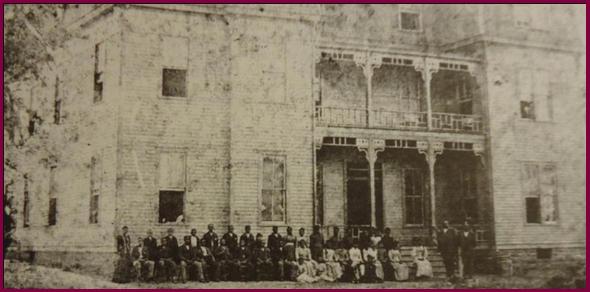
Tushka Lusa Academy - The Staff & The Students


Tushka Lusa Academy Part 2

The first administrator of  the Choctaw Freedman school of Tushka Lusa Institute that became known as Tushkalusa Academy was Henry Nail. Not much is known about his background, but he was a Choctaw Freedman, and he lived in the same Talihina Community where the school was established. 

The academy was located 3 miles southeast of Talihina Indian Territory, and although there were other schools for Freedmen in other parts of the Choctaw Nation, it apppears that Tushka Lusa was the premiere school. The enrollment was never more than 40 nor was it intended for any larger number, so selection and admission to the school would clearly have been viewed as a special privilege. 

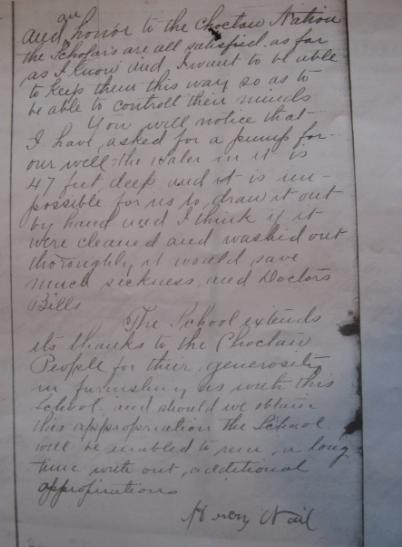
Tushka Lusa Academy provided basic education and was not a secondary school. However, many of the students were actually in their teen years. The school was divided into five grades and the basic subjects of Reading, Arithmetic, Geography, Spelling, Writing and Phonics were taught. This was clearly outlined in the annual report sent by Henry Nail to the officials of the Choctaw Nation.

Page 1 of Annual Report from Tushka Lusa Academy by Henry Nail to the Choctaw Nation

For third and fourth graders, Grammar was added and for the Fifth Grade History and Dictionary were added to their course of study. 

2nd Page of Annual Report from Tushka Lusa Academy by Henry Nail

The enrollment however was always small and it was always planned to keep the number of pupils at Tushka Lusa at 35-40 students. This issue was of great concern to many of the parents wishing to have their children enrolled at this tribally funded institution. The schools for Choctaws "by blood" had an enrollment of 100 students each. A group of Choctaw Freedmen who lived in various parts of the Choctaw Nation from Atoka, to Stringtown to Tushkahoma, were very interested in having their children given the opportunity to attend the academy. They wrote a letter in 1893 to the Choctaw Nation, requesting that the enrollment be increased so that their children could also attend. A copy of the letter appears below.

Request from Choctaw Freedmen parents to the Choctaw Nation 
to increase student enrollment at Tushka Lusa Academy. ( Written in September 1893)

Names of parents requesting increase in enrollment for their own children

The Staff:
It is not known how many teachers were at Tushka Lusa, however these few names are known: Henry Nail, Superintendant; Dora E. Johnson, Principal; Julia Coleman, 1st Assistant.

Henry Nail was a well known and respected Choctaw Freedman, and Dora Johnson had formerly been a teacher. Dora E. Johnson was a teacher who lived at one time in South Central Texas in Luling Texas as a teacher. In the early 1890s she was a teacher there.

The Students
One of the most exciting thing about locating school records is the possibility that names of students can be found. I was fortunate that when I examined the papers from Tushka Lusa,  there were lists of students who attended the academy. The lists are only from the early years of the school, but they are nevertheless significant and they are lists from which we can see and to learn.

1894 Students
This is a list of the students recorded in 1894. The lists were prepared by Mrs. Dora E. Johnson as part of official reports that were eventually sent to the Choctaw Nation.


List of Girls attending Tushka Lusa Academy in 1894


Girls
Sarah Butler
Mary Butler
Julia Coleman
Jane Garrett
Emma Gross,
Sarah Gross
Berda Howell
Lucey Hunter
Mumbra Humbes
Sophia James
Dicie Nail
Annie Nail
Amelia Nail
Amanda Peachlyn (sic)
Eliza Riley
Martha Rodgers
Tena Shoals
Lucretia Shoals
Emma Thompson


Male Students Tushka Lusa Academy 1894

Boys 
Miles Burras (sic)
Nathan Davis
Caesear Eubanks
Ben Nail
Lee Nail
Walter Pickens
Mariod Reed
John Richards
John Stanley
Walton Shoat (sic)
Solomon Sexton
Israel Tyms

 (Note the name Burras was most likely Burris, a surname still found in the LeFlore County  and McCurtain County areas by Choctaw Freedmen descendants. The name Shoat was most likely Choate, which is also a surname found in the same community among Choctaw Freedmen. The name Peachlynn [see names of Girl students] was most likely Pitchlynn, a prominent name in the Choctaw Nation.)

 So little is known about the experience of the students and the eventual fate of this little known Freedman school. By the mid 20th century, the school had ceased to exist. Very few residents of Talihina even recall the presence of a black population in the town let alone a boarding school . Sadly all traces of Tushka Lusa Academy are now gone. There are so many stories hidden in the trees southeast of this small Oklahoma town, and hopefully someday more will be known of this school. 

I was happy to have found these records of Tushka Lusa and hope that someone with a strong sense of curiosity and history will begin to explore the outskirts of the town, and may someday find that remnants of the school and lives of those who were once a part of this forgotten community.


* * * * *

(Special thanks to Eric Standrige of Wister Oklahoma 
for sharing the long lost image of Tushka Lusa Academy.)


Sunday, July 8, 2012

Tushka Lusa Academy - A School For Choctaw Freedmen

Tushka Lusa Academy, Talihina Choctaw Nation
Courtesy of: Eric Standridge of Wister Oklahoma

Part 1 The Establishment of Tushka Lusa Institute

Six miles east of Talihina Oklahoma, buried somewhere underneath a century or more of brush an overgrowth, the foundation of Tushka Lusa Academy lies. Tushka Lusa, whose translation means "black warrior" can be called one of the long forgotten schools on the western frontier. This school was the one institute established by the Choctaw Nation for the children of their former African slaves.

Freed in 1866 and formally adopted as citizens into the tribe in 1885, the former slaves would wait many years before their final fate would be decided and major changes brought to their lives. It would be almost a decade before steps to begin formal education for Choctaw Freedmen children would unfold. But in the years after the Civil War, the Freedmen remained in the nation with no legal status, but most chose to live where their parents and grand parents had lived and died because it was the only place that they knew as home. There was no place in the United States to go, and Indian Territory was what they knew and it was where they remained.

In May 1883, the Choctaw Nation passed the law that finally made the Choctaw Freedmen legal citizens, and in the summer of 1885, the actual process of registration began. This was met with great concern, as many Freedmen had begun farming and cultivating dozens of acres of land individually, and there was great fear that their land would be reduced to a mere forty acres. And they wanted education so badly for their children. Neighborhood schools had begun to appear, but these schools provided basic education. A high school was strongly desired by the Freedmen, so that their children could also have a chance to grow and prosper.

Historian Angie Debo noted that in 1891, the Choctaw Nation "went beyond the obligation assumed by the act of adoption, by establishing a colored boarding school." (1) (See footnote below)

The original name of the school was Tushka Lusa Institute, and was called such when it was originally approved by the Tribal council to establish the school. Provisions were made however to only allow for thirty or so students at Tushka Lusa. The other officially sponsored schools in the Choctaw Nation allowed for 100 students at Jones Academy for boys and 100 students at Tushka Homa Female Institute.  


Once approved funds were set aside, and a superintendent was appointed for the new school.

Document from Choctaw Nation approving funds for Tushka Lusa Institute

Over seven thousand dollars were approved in early 1892 for the new school.

Receipt reflecting payment of initial funds to establish the new school for Choctaw Freedmen


Henry Nail a Choctaw Freedman was appointed to run the school in the spring of 1892 and he submitted the first report to the Choctaw Nation in the fall of 1892.
First Page of Tushka Lusa School Report by Henry Nail, sent to Choctaw Nation

Second Page of Tushka Lusa School Report by Henry Nail sent to Choctaw Nation

The general sentiment was that the school was progressing well, and that students were pursuing in earnest their studies.  

Close up of some of the text about the status of Tushka Lusa Academy

In his report, Henry Nail was gracious and was certain to express appreciation to the officials of the Choctaw Nation for going beyond was was expected in providing this school for Choctaw Freedmen. 

Henry Nail showed his appreciation for the generosity of the Choctaws for the establishment of the school.

Henry Nail quickly settled into his roll as the superintendent of Tushka Lusa and frequently sent letters and reports to the school. When fund were needed for additional provisions, he also sent additional requests to the Nation. From the tone of his letters he was given the necessary provisions to run the school efficiently. The relations between the school administration and the Choctaw Nation, also appear to have been amiable. The reports submitted by Henry Nail were accepted and approved without dissension.

Report on Tushka Lusa Accepted by Choctaw Nation


(1) Debo, Angie, The Rise and Fall of the Choctaw Republic. Norman Oklahoma: The University of Oklahoma Press 1934, 1961,  Print p. 109

(End of Part 1)

Monday, May 14, 2012

Politics of 100 Years Ago Addressed the Disenfranchisement of Chickasaw Freedmen

Source: Muskogee Cimeter, August 30, 1907 p. 1

A 1907 article written in an issue of the Muskogee Cimeter reflected an issue that still has ramifications today. The article addressed the challenges and issues facing the Chickasaw Freedmen over 105 years ago.

During an election year, C.D. Carter who was a candidate for Congress at the time, addressed head one the issues as they affected several thousand disenfranchised Chickasaw Freedmen. 

The passage of time, of course has come to bring about the disenfranchisement of the Freedmen of all of the Five Slave Holding tribes and their alienation, from the tribe into which the Freedmen of 100 years ago were born. But thankfully the records remain however to research and keep alive the history of thousands of people enslaved in the Territory and who helped to create the state of Oklahoma in many ways.

The challenges that they faced are found in many records, some tucked away in archives and yet to be digitized or published.

The politics of 1907 Oklahoma have the same vocabulary of 2012. However, the difference, is that through isolation and alienation, descendants of many of the Chickasaw Freedmen have waned, when time itself presented the challenges of each new decade--of segregation, of a national depression, and of two world wars. The most critical impact of the more permanent aspect of disenfranchisement come from the effects of the Great Migration that took many Freedmen and their children away from their native Oklahoma soil, to places northward, eastward, and westward.

Though the words spoken during a political campaign addressed the issues of the Chickasaws and their former slaves, time would eventually allow their indifference to become official policy and a people were forever cut off from the nation that was part of their family history.

 But today the effort begins to not only tell the story, but to find the original family story from which the family emerged. Thankfully, there are records that remain.

The challenge is to identify them, share them and embrace the spirit of survival and resilience of the ancestors.

Monday, April 16, 2012

Abolitionist Newspapers Discuss Slavery in the Cherokee Nation

The Liberator was one of several Abolitionist Newspapers
Image accessed through Accessible Archives.

Those who study pre-Civil War America know that there were many people working towards the eradication of the horrific and cruel practice of chattel slavery in the United States as well as in the Territories. However, for many scholars the concerns of the abolition of Black chattel slavery practiced by Indian Tribes is somehow overlooked. The publishers of the antebellum newspapers however, were fully aware of slavery, or runaway slaves and of the efforts of resistance in the Territory among those held as slaves.

As early as 1842 there were efforts among the slaves held by Cherokee Indians, to resist. The most daring effort was the Cherokee Slave Revolt of 1842. Dozens of slaves held by wealthy Cherokee Joseph "Rich Joe" Vann, who lived near Webber's Falls had a major revolt, when slaves locked the Vann family in their homes, seized all horses, mules and weapons and made an effort to make it Mexico. After several days and a fierce battle, the fugitive slaves were overtaken and returned to bondage. However--runaways were still reported and ads for the capture of slaves continued.  In 1856, William Lloyd Garrison, editor of The Liberator published two front page articles about slavery in Indian Territory, and specifically among Cherokees.  In the first article he described the difficulty for Cherokee slave holders in retaining their slaves due to the presence of both abolitionists, and of course continued resistance of the enslaved in their quest to be free.

The Liberator September 26, 1856 p. 1

Transcription:
A letter from the Catholic Mission in the Osage Nation, dated the 26th ult., gives us the following information:
'Our Osages, in returning from the summer hunt, found in the vicinity of the Arkansas river some few deed bodies, say three colored and one half red. A patty of Cherokees were here in pursuit of runaway negroes, well provided with arms, and we suppose they overtook them in the plains, and had battle.'

So it goes. Not only the Territories of the United States, but the Indian Territories , are invaded by Abolitionists, and mischief and murder follow. The Cherokee Nation of Indians , at in well known, are owners of large numbers of slaves, and are the cultivators of large plantations. A year ago, certain Abolition preachers of the church, located in that Nation, commenced tampering with the slaves, and the Indian owners became indignant at it, and remonstrated against their conduct. They were invited to quit the Nation, if they could not desist from these mischievous practices; and we recollect that their conduct was brought before some of the church assemblies North, but of the result we are not so well satisfied—whether they left the Cherokee Nation or not. But the legitimate teachings of the Abolitionists are seen in the brief record, which we have made above.

After the foregoing was written, we received the following in the Van Buren (Arkansas) Intelligencer :  We have been handed the following extract from a letter from a gentleman in the Cherokee Nation, to one of our citizens, for publication:—

* * * * *     * * * * *     * * * * * 

Another article describes a very dramatic confrontation between Cherokee slave holders and their slaves who were resisting and who were armed:


The Liberator September 26, 1856 p. 1

Transcription: 
We had quite a fracas on Verdigris river a short time since, Four negroes ran away, two of them belonging to Lewis Ross, and two to Mrs. Wright. They were and rifled and mounted; had two pack horses, flour, meat, coffee, and all the necessaries for a camp life, Seven Cherokees followed, and overtook their, one hundred and fifty miles from where they started, high up on the Verdigris. The Cherokees got upon them before they were discovered; the negroes were dismounted, and at a spring drinking water. The Cherokees ordered them to lay down their arms, and give up. The negroes replied, they would be d—d if they would do it; and at the some time, one negro fired both barrels of his at Lynch's son, riddling his shot-pouch, and a handkerchief that he were around his neck. Strange to say, it did not wound him. Another negro first, and shot Pins England in the thigh. At that the Cherokees fired, and killed two of the negroes dead, and wounded the other two. One of the wounded negroes died the next morning, and it is supposed the other is tally wounded. So ends the first chapter.

A few days ago, a negro named Ike (you will probably know as the Hamilton negro) was met in the road by four Cherokees, who tried to arrest him. He drew a revolver, and shot a horse from under the Cherokee who was nearest to him, grazing the Indian' s knee, and shot afterwards at the Indian, and then galloped off. The country is full of runaway Negroes.


* * * * *     * * * * *      * * * * *

These two articles both appeared in William Lloyd Garrison's newspaper The Liberator, in 1856, several years before the Civil War. It would be a full ten years however, before the slaves would be completely free in Indian Territory, when the Treaty of 1866 finally abolished the practice of chattel slavery in the Territory.

Stories such as these are not often mentioned in American history, but several thousand people descend from those held in bondage in Indian Territory. They too longed like all men, like all women to live as free people. And when opportunity came, they too resisted and fought for their freedom. Some won, and others lost the battle, but their stories deserves to be told.