Sunday, April 28, 2013

Wallace Roll Affidavits: Additional Resource for Indian Territory Research - Part 1

National Archives Record Group 75 Entry 578 Box 5
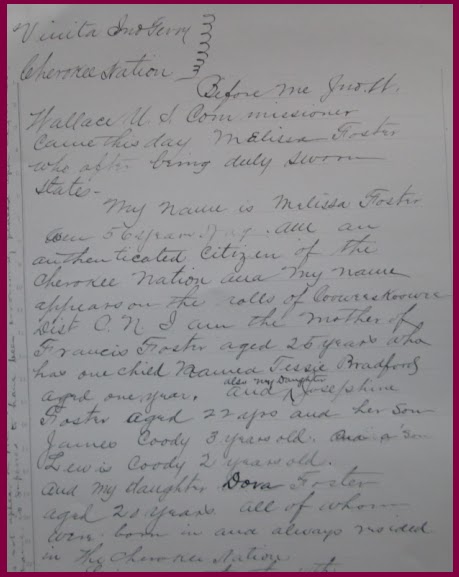
Testimony of Melissa Foster

* * * * *

Many who research Freedman records are familiar with the Dawes Records and have used the enrollment cards and the accompanying application jackets as part of their collection of family records. (The Dawes records are part of National Archives Publication M1186 and M1801 respectively.)

But it is not widely known that prior to the compilation of the Cherokee Dawes Rolls were the records created in 1890 by John Wallace. His data eventually consisted of the series of names that are now referred to as the Wallace Roll, of 1890. But few researchers are even aware of the fact that there are affidavits which contain some statements made by the  Cherokee Freedmen and as well as other groups.

It should be mentioned that the Wallace Roll Affidavits contained data also pertaining to Shawnee, and Adopted Delawares, in addition to Cherokee Freedmen. The work conducted by John Wallace resulted in rolls for all three of these groups, and the work was undertaken in 1889.  It should be noted that there were other series of investigations taken as well, between 1889-1897, before the final enrollment process would lead to the Dawes Rolls. So in many cases---the data collected for the Dawes Rolls have additional pertinent data for the family researcher an entire decade earlier.

The Case of Melissa Foster

Looking at the image above, one sees an affidavit with a sworn statement was made before John Wallace, and Melissa Foster refers to herself as an authenticated citizen of the Cherokee Nation, and she makes a reference to three grown daughters and their children.

Melissa Foster lived for several years, and she was also enrolled on the Dawes Rolls. The front and back of her Dawes Cards appear below:


Front and Back of Dawes Cards for Melissa Foster
NARA Publication M1186, Cherokee Freedmen, Card #1001


In addition to the Enrollment Cards, one will also utilize her Dawes Commission interview found in the Applications jackets. For Melissa Foster there was a one page interview where she was enrolling herself and an adult son who suffered from a physical disability.


Dawes Application Jacket for Melissa Foster
National Archives Publication M1301, Cherokee Freedmen, #1001

In the case of Melissa Foster, compare the first interview taken by John Wallace (at the top of the page) with the data collected by the Dawes Commission.  One might not even be aware of her grown daughters and their children if one did not have the Affidavit from the Wallace Roll to enhance this family information. It is clear that there is some significant data about Melissa Foster's descendants that might be missed if one did not use the Wallace Roll Affidavits. 

I had an opportunity to explore some of the Wallace Roll Affidavits recently and was amazed at the amount of data, that many of the files contained.

Location of Wallace Roll Affidavits
Although one can easily see the Wallace Roll and access it online, the affidavits are not digitized. They are located at the National Archives in Washington DC, at the main facility on Pennsylvania Avenue. One must request Record Group 75 Entry 578.

There are 30 boxes of Wallace Roll Affidavits toe explore. The first 17 boxes are of greatest value for genealogists. It should also be pointed out that the records contain data for Cherokee Freedmen, for Shawnees, and also for Adopted Delawares as well.

I decided to take a look at these affidavits and spoke with the archivist and had them pulled. Although I knew the index said there were boxes of them to examine I was still amazed at this under utilized set of documents.

Boxes of Wallace Roll Affidavits

Most of these boxes have never been opened and some amazing data can be found inside of each box and each file. 

Data in Wallace Roll Affidavits (30 boxes)Boxes 1-4 All Shawnee
Box 5   Some Admitted Shawnees, Rejected Cherokee Freedmen, & Admitted Cherokee Freedmen
Box 5   Surnames A-B
Box 6   Surname B only
Box 7   Surnames B-D
Box 8   Surnames D-H
Box 9   Surnames H-K
Box 10 Surnames K - McN
Box 11 Surnames M
Box 12 Surnames M-T
Box 13 Surnames P-S
Box 14 Surnames S-Th
Box 15 Surnames Th-W
Box 16 Surnames W 
Boxes 17-21 Authenticated Freedmen
Boxes 22-30 Rejected Cases (arranged by Case)

Clearly the volume of records should be considered valuable for Cherokee Freedmen research, as well as for research of Shawnees and Adopted Delawares. Contained in many of these family documents are written chapters in the history of these three communities. And for any scholars who have a strong interest in the history of Indian Territory, these affidavits should be as essential as the Dawes Records in the effort to document the stories of these families.

(Part 2 of this information on Wallace Roll Affidavits will reflect additional kinds of records found in the files.)


Tuesday, April 9, 2013

Old Muskogee Newspaper Reveals Indian Freedmen Population. Greater Need for Study Emerges

Source of article: Muskogee Cimeter, Muskogee, I.T., January 4, 1906 p. 2


How many Freedmen from the Five Civilized Tribers were there?  A few hundred? A thousand?
Officially, 91, 637 members of the Five Tribes were enrolled. So how many were Freedmen from the various nations?

Well, while looking at old newspapers an article in a 1906 edition of the Muskogee Cimeter, one of the many Black newspapers of the day, a question I am often asked, was answered.


During the years when the Dawes Commission was winding down the process of enrolling all of the citizens for the Five Civilized Tribes, thousands of families had gone through the enrollment process.  As the rolls were about to close in 1906 prior to statehood, a thorough assessment was made of the population within each tribe. (The process would actually continue until 1914 when minor children who were born after the initial process began would be later added and then all would close.)

However, when many people speak of the Dawes Rolls it is not fully known what the actual numbers of people were, including the Freedmen of the Five tribes.

While looking at old newspapers online an article in a 1906 edition of the Muskogee Cimeter, one of the many Black newspapers of the day, the actual numbers were presented.

Officially, 91, 637 members of the Five Tribes were enrolled.

Source: Same as listed above

Source: Same as above

Indian Freedmen Population in 1906:

Cherokee Freedmen 3982
Choctaw Freedmen 5254
Chickasaw Freedmen 4995
Creek Freedmen 5585
Seminole Freedmen 857 (+ 93 children born later)
Total number of Freedmen from Indian Territory:  20,766

An opportunity for scholars

Twenty thousand people! The number of Freedmen from Indian Territory is an impressive number and clearly this is a population that deserves to studied from every academic perspective. Historians have at least made efforts to document the history in the past 50 years. But academicians  have much work that can be done within their discipline.

Sociologists can study how the Freedmen of these Five Indian Tribes fared and how eventually their status and recognition would change as the decades of the 20th century passed.

Psychologists can pursue issues of identity and self definition by analyzing the many oral histories and working with those who embrace this identity today.

Anthropologists have yet to begin to study the cultural norms and language, a burial practices of Freedmen and how they have changed over time.

Archeaologists have much to explore---to find the remnants of the slave dwellings of Robert Jones, wealthy Choctaw who had over 500 slaves and who is known to have been the largest Indian slave holder.

 The schools built by and for Freedmen are mere memories. From Tushka Lusa, to Oak Hill Academy, to Dawes Academy, to the Cherokee Colored High School, to the Tullahassee Mission School--all are gone and the locations of most of these schools are now forgotten. There is much to do from the academic community and hopefully the lives of 20,000 people, all citizens of the Five Civilized Tribes, will stimulate the interest of scholars from the Dubois Institute, to the Smithsonian.  

Legal scholars have many avenues to explore, for each tribe had their own relationship with their Freedmen. Some were inclusive and some were continually exclusive and distant.

But all deserve to be studied.

Many of us were proud of the work of scholar and friend Tiya Miles who receieved a Macarthur Award for her work on Cherokee and the African Cherokee experience. And she is part of a small group of scholars who have explored the history of Freedmen, but we need more. Most of the activity involving exploration of Oklahoma Freedmen history revolves around the efforts of a handful of researchers and community preservationists. Such much more needs to be done and hopefully more scholars will respond to the call for more study and research.

Monday, April 8, 2013

The Forgotten Black Hospital of Oklmulgee


Image from: Abandoned Oklahoma


Many landmarks in Indian Territory are long forgotten, abandoned and in some cases lost to erosion, time and neglect. But a few still stand, including the old building seen in the above film footage, which was once the Okmulgee City Colored Hospital.

I often write about the old schools, and cemeteries, and recently an Oklahoma history colleague who recently assisted me in locating the old Tushka Lusa Academy, he just shared some film footage of the Black hospital of Okmulgee, Oklahoma.

The hospital building (located on Wood and 3rd Street)  was one of the first in the state of Oklahoma to serve exclusively African American patients. Considering the history of the city of Okmulgee, and the region, chances are that a majority of those served by this hospital were most likely Creek Freedmen. The short video appears to be one of the videos that were made in the early 1920s in Oklahoma, depicting many aspects of life in communities where both Freedmen and "state Negroes" as they were once called, lived in the newly formed state of Oklahoma.

This hospital was certainly one of the oldest in the state of Oklahoma. This small facility joined a long list of hospitals that were created to treat African American patients around the nation. (The oldest known hospital was Provident Hospital of Chicago that opened its doors to Black patients in 1891.)

However, this structure is significant nevertheless, and seeing the footage taken when it was in its prime as a hospital makes one wonder about the hundreds who must have come through the doors of that hospital.

Apparently there are several sites that also document the history of this treatment facility and they have some clear images of the building in various states of abandonment and decay. One website is called AbandonedOK.com  which is a website devoted to significant Oklahoma landmarks that are abandoned and no longer in use, and this site has a page devoted to the Oklmulgee Colored Hospital. Also some very sharp clear images taken several years ago reflect the many dimensions of the hospital.

Plans have been also underway for many years to make this a multicultural center, although plans appear to have been stalled. Thankfully however, the building still stands and speaks to its legacy as a place one's loved ones could receive care.

I became  curious and wanted to see how the hospital building looks today. I did not have an exact address and was not sure of where in Okmulgee the old hospital was located, but thanks to Google Street View, and I found it!

Image from Google Street View, Okmulgee Oklahoma
Corner of 3rd and Wood Street.

So many of our landmarks are gone, but when I saw the remarkable footage of the old hospital, shared on Facebook, I realize that this is a piece of the state's segregated past, whose stories are whispered within walls of the building itself. Hopefully more lives were saved than were lost in the hospital, and this place provided a place where they could be treated and in some cases leave this world, in dignity and peace.

Many thanks to Eric Standridge, aka the Oklahoma Traveler for sharing the film footage and bringing the history of this building to my attention.


Sunday, December 16, 2012

The Value of Sound Genealogical Methods in Native American Research

The Freedmen Series: Cherokee Freedmen Research
Source: Personal Video Channel

The recent decision by the US Court of Appeals that came out on Friday indicates that the Descendants of Slaves of the Cherokee have the right to sue the current administration for citizenship rights. However, many who will read the story have no idea who the Cherokee Freedmen are, and how one who is a descendant can document this history.

It is important that one uses standard genealogy methodology to document this unique history. Beginning with the family history, examining family artifacts, and using standard records, are important first steps. If one's family is part of the Indian Territory Freedmen--then they will have family history that will be located on the Oklahoma, and Indian Territory census, as well as numerous specific Freedmen Rolls from Indian Territory.

If your family did not live in Oklahoma simply finding a name on the Dawes Rolls does not connect one to the Freedmen.  There are many names that are common names that can be found in other states, so without a real connection from vital records, and census as well as the records from Indian Territory, avoiding the standard methods of collecting data, could lead to an incorrect conclusion that one has "Cherokee ties" or ties to other tribes as well. It must be pointed out that the researcher who goes to Dawes Records, right away, in spite of a family history found in other states, will possibly be derailing the accurate history of their family, in an effort to connect to a tribe. Hopefully this is not the case.

I created the video above for those who are seeking methods of documenting their ancestors who are indeed, Cherokee Freedmen, and am sharing it here for others. To see the video simply click on the image above.

This video is part of another series of videos produced on my YouTube Channel. See The Freedmen Series for Part I which introduces the series to viewers.

Saturday, November 17, 2012

1880: From Choctaw Nation to the US Government: A Bill to Adopt the Freedmen


Choctaw Memorial of 1880
Source:  University of Oklahoma:  Western History Collection, Native American Collections
Box 12, Folder 15


On November 2, 1880 a memorial was sent to the US Government from the Choctaw, proposing to adopt the Freedmen of the Choctaw and Chickasaw nations as citizens. The language says both Choctaw and Chickasaw Freedmen but the origins of the record is the Choctaw Nation. The bill was passed and approved on November 2, 1880.

The document in its entirety is presented below.


Sunday, November 4, 2012

Choctaw & Chickasaw Freedmen Civil War Soldiers

From the Service Record of Simon Clark, from the Choctaw Nation and who served in the 83rd US Colored Infantry

The Civil War in Indian Territory was complicated. There were many critical battles fought in the Territory, and like other parts of the south, among the issues that prevailed was the issue of black chattel slavery. Close to 10,000 slaves were held in the Territory by 1860, and many of those men who were enslaved enlisted in the Union Army when opportunity presented itself.

It is known that in early 1861, many people from the Creek and Cherokee Nations fled northward into Kansas. By 1862 several black men had joined the Union Army as part of the 1st and 2nd Kansas Colored Infantries. Those regiments would later be re-designated as the 79th and 83rd US Colored Infantries, respectively.  Many of the men in those two regiments were slaves from Indian Territory. Most were known to be either formerly Creek or Cherokee slaves.

However, little is known of the Choctaw & Chickasaw ex-slaves who also enlisted. They were far fewer in number, partly because they were geographically not as close to Kansas where they could have freely enlisted. There were a few who did however, manage to escape to Kansas and to join  the Union Army and join the same regiments as their comrades from the Creek and Cherokee Nations. But there were also a few Choctaw and Chickasaw slaves who had access to nearby Arkansas. When recruitment was at its heaviest in Ft. Smith, a few of those men from Indian Territory also managed to get across the border and enlist. They  joined the 11th US Colored or the 54th US Colored from Arkansas.

A friend and colleague Terry Ligon, host of the Black and Red Journal blog recently began posting a few names of Choctaw and Chickasaw black men, who were Civil War soldiers several days ago. He started sharing these names in the Facebook group Oklahoma/Indian Territory Reader. Now I have seen a few Choctaw and Chickasaw Freedmen who were Union soldiers, but I decided to take a closer look to see if there were additional names that could be found. Although they were scarce they were still there and I am glad to share a few that have been found from the Choctaw and Chickasaw Nation.

54th US Colored Infantry

Boynton Colbert of the 54th US Colored, was later known as Bynum Colbert, 
who also served as a US Deputy Marshal under Judge Isaac C. Parker.
Source: NARA M2000. Compiled military service records of volunteer Union soldiers who served with the U.S. Colored Troops (USCT): Infantry Organizations, 47th through 55th.


79th US Colored Infantry

Isaac Alexander, from the Chickasaw Nation
Source: (for all images) Compiled military service records of volunteer Union soldiers belonging to the 56th through 138th infantry units, United States Colored Troops (USCT), 1864-1866.


 83rd  US Colored Infantry

Simon Clark, Choctaw Nation


Phillip Fulsom, Choctaw Nation


Austin Geary, Choctaw Nation


Ceasar Hall, Skullyville, Choctaw Nation


William Hall, Skullyville, Choctaw Nation


Aaron Newberry, Choctaw Nation


Richmond LeFleur, Choctaw Nation


Duncan Walker Choctaw Nation


(As more men from these two nations are identified, their names will also be shared.)

Sunday, July 29, 2012

Tushka Lusa Academy - The Staff & The Students


Tushka Lusa Academy Part 2

The first administrator of  the Choctaw Freedman school of Tushka Lusa Institute that became known as Tushkalusa Academy was Henry Nail. Not much is known about his background, but he was a Choctaw Freedman, and he lived in the same Talihina Community where the school was established. 

The academy was located 3 miles southeast of Talihina Indian Territory, and although there were other schools for Freedmen in other parts of the Choctaw Nation, it apppears that Tushka Lusa was the premiere school. The enrollment was never more than 40 nor was it intended for any larger number, so selection and admission to the school would clearly have been viewed as a special privilege. 

Tushka Lusa Academy provided basic education and was not a secondary school. However, many of the students were actually in their teen years. The school was divided into five grades and the basic subjects of Reading, Arithmetic, Geography, Spelling, Writing and Phonics were taught. This was clearly outlined in the annual report sent by Henry Nail to the officials of the Choctaw Nation.

Page 1 of Annual Report from Tushka Lusa Academy by Henry Nail to the Choctaw Nation

For third and fourth graders, Grammar was added and for the Fifth Grade History and Dictionary were added to their course of study. 

2nd Page of Annual Report from Tushka Lusa Academy by Henry Nail

The enrollment however was always small and it was always planned to keep the number of pupils at Tushka Lusa at 35-40 students. This issue was of great concern to many of the parents wishing to have their children enrolled at this tribally funded institution. The schools for Choctaws "by blood" had an enrollment of 100 students each. A group of Choctaw Freedmen who lived in various parts of the Choctaw Nation from Atoka, to Stringtown to Tushkahoma, were very interested in having their children given the opportunity to attend the academy. They wrote a letter in 1893 to the Choctaw Nation, requesting that the enrollment be increased so that their children could also attend. A copy of the letter appears below.

Request from Choctaw Freedmen parents to the Choctaw Nation 
to increase student enrollment at Tushka Lusa Academy. ( Written in September 1893)

Names of parents requesting increase in enrollment for their own children

The Staff:
It is not known how many teachers were at Tushka Lusa, however these few names are known: Henry Nail, Superintendant; Dora E. Johnson, Principal; Julia Coleman, 1st Assistant.

Henry Nail was a well known and respected Choctaw Freedman, and Dora Johnson had formerly been a teacher. Dora E. Johnson was a teacher who lived at one time in South Central Texas in Luling Texas as a teacher. In the early 1890s she was a teacher there.

The Students
One of the most exciting thing about locating school records is the possibility that names of students can be found. I was fortunate that when I examined the papers from Tushka Lusa,  there were lists of students who attended the academy. The lists are only from the early years of the school, but they are nevertheless significant and they are lists from which we can see and to learn.

1894 Students
This is a list of the students recorded in 1894. The lists were prepared by Mrs. Dora E. Johnson as part of official reports that were eventually sent to the Choctaw Nation.


List of Girls attending Tushka Lusa Academy in 1894


Girls
Sarah Butler
Mary Butler
Julia Coleman
Jane Garrett
Emma Gross,
Sarah Gross
Berda Howell
Lucey Hunter
Mumbra Humbes
Sophia James
Dicie Nail
Annie Nail
Amelia Nail
Amanda Peachlyn (sic)
Eliza Riley
Martha Rodgers
Tena Shoals
Lucretia Shoals
Emma Thompson


Male Students Tushka Lusa Academy 1894

Boys 
Miles Burras (sic)
Nathan Davis
Caesear Eubanks
Ben Nail
Lee Nail
Walter Pickens
Mariod Reed
John Richards
John Stanley
Walton Shoat (sic)
Solomon Sexton
Israel Tyms

 (Note the name Burras was most likely Burris, a surname still found in the LeFlore County  and McCurtain County areas by Choctaw Freedmen descendants. The name Shoat was most likely Choate, which is also a surname found in the same community among Choctaw Freedmen. The name Peachlynn [see names of Girl students] was most likely Pitchlynn, a prominent name in the Choctaw Nation.)

 So little is known about the experience of the students and the eventual fate of this little known Freedman school. By the mid 20th century, the school had ceased to exist. Very few residents of Talihina even recall the presence of a black population in the town let alone a boarding school . Sadly all traces of Tushka Lusa Academy are now gone. There are so many stories hidden in the trees southeast of this small Oklahoma town, and hopefully someday more will be known of this school. 

I was happy to have found these records of Tushka Lusa and hope that someone with a strong sense of curiosity and history will begin to explore the outskirts of the town, and may someday find that remnants of the school and lives of those who were once a part of this forgotten community.


* * * * *

(Special thanks to Eric Standrige of Wister Oklahoma 
for sharing the long lost image of Tushka Lusa Academy.)