Wednesday, January 29, 2014

Basic Census Documents for 20th and 19th Century Native American Research

A 1940 Federal Census Record Reflection Indian Family in Adair County Oklahoma
Source Citation: Year: 1940; Census Place: Wauhillau, Adair,Oklahoma; Roll: T627_3274; Page: 1A; Enumeration District: 1-10.

The image above is a sample of a record from the 1940 Federal Census. It is reflecting a family in eastern Oklahoma and it is the first of series of images that reflect how Native families were enumerated over the years in the Federal Census. All of the documents in this article are 20th and 19th centuries and are from multiple states.


1930 Federal Census Record Reflecting a Family of Mixed Ancestry in Robeson County NC
Source Citation: Year: 1930; Census Place: Philadelphus, RobesonNorth Carolina; Roll: 1716; Page: 2A; Enumeration District: 0037; Image: 856.0; FHL microfilm: 2341450.


1920  Federal Census Record from Banstable County, Massachusetts reflects a blended family
Source Citation: Year: 1920; Census Place: Mashpee, Barnstable,Massachusetts; Roll: T625_679; Page: 2B; Enumeration District: 15; Image: 378.

1910 Special Indian Census from Suffolk County NY Reflection a Shinnecock Indian Community

A Close Up of the Bottom Half of Preceding Document. Note that this is a Bi-racial community and that this some of those enumerated were also graduates from the Indian School at Hampton Institute
Source Citation(for both images): Year: 1910; Census Place: Southampton, Suffolk, New York; Roll: T624_1082; Page: 4B; Enumeration District: 1391; FHL microfilm: 1375095.


1900 Federal Census of a Nansemond Virginia Community

Close Up of portion of Preceding document. 
This census year only inquired about white blood of Indian enumerated on record.
Source Citation for both Images: Year: 1900; Census Place: Deep Creek, Norfolk,Virginia; Roll: 1719; Page: 17A; Enumeration District: 0034; FHL microfilm: 1241719.


1880 Federal Census record from Texas, San Jacinto County reflects an interesting blended family. Mingo is from Florida, while his wife and son in law are from Louisiana. Note that the son in law is enumerated as Mulatto, suggesting a mixed ancestry for him.
Source Citation: Year: 1880; Census Place:  , San Jacinto,Texas; Roll: 1325; Family History Film: 1255325; Page: 340C; Enumeration District: 150.


1870 Federal Census Record from Giles County TN shows a small blended family.

Close up of an unusual notation made at the bottom of the preceding document.
Source Citation: Year: 1870; Census Place: District 10, Giles, Tennessee; Roll: M593_1529; Page: 205B; Image: 415; Family History Library Film: 553028.

* * * * *          * * * * *          * * * * *

It is sometimes assumed that Native Americans were not captured in the Federal Census until 1930 or even later. However, nothing can be further from being accurate. The mid 19th and 20th centuries left an amazing trail of census records. Communities were not always treated in the same method from state to state. However, it is worth taking note that American Indians were indeed captured in census records in multiple states. And I have shown some samples above of communities reflecting Indian communities and blended families from New England to Texas. Multiple states are presented here, to illustrate how widespread the enumeration of native communities actually was and how they can be found in standard records.

These records should be used as part of  standard genealogy research when documenting ancestors who may have been of Native ancestry. In other words--use these standard records before going to look at Indian rolls. It is imperative that the families are studied closely to make sure that you are on the right track with the right children and siblings. Some eager researchers will examine records such as Dawes rolls before concluding that their ancestors even resided in the communities where the Dawes interviews were conducted. Therefore standard genealogy methods should be employed throughout this process. There are some unique Indian records that will be discussed in a future article.

Sunday, January 19, 2014

Sarah Rector - A Creek Freedman Story Unfolds in New Book


At last a book about the story of Creek Freedman child Sarah Rector has been told! 

Award winning author Tonya Bolden has researched and documented the life of the child described 100 years ago in the press as the "Richest Colored Girl in America". This newly published book describes the story of the child Sarah, and how her life was changed after oil was discovered on her land allotment. The book discusses efforts of the child and her parents to control their own lives, steering clear of land grafters, self appointed "guardians" and others who hoped to put their hands on her oil money from her land allotment near Muskogee Oklahoma.

Her story was an interesting one, and it is set against a fascinating backdrop of Oklahoma, of Indian Territory, and of the Creek Nation. The story unfoldds of this young girl, and her fate and her determination to survive.

In 2010 I wrote an article about Sarah Rector depicting her life that emerged after oil was discovered on her land. I followed her case in the press, including the reaction of the community to her new found wealth, the efforts to control her money, and even her enrollment at the preparatory school on the grounds of Tuskegee Institute. I also wrote about her later move to Kansas City, and her emergence into adulthood.

But now, in 2014, acclaimed children's author Tonya Bolden captivated by Sarah's story, took the charge to find out more and she has succeeded in telling more of Sarah's story. Through Bolden's work, her research and investigative skills, more of Sarah's life has been eloquently told in called  "Searching for Sarah Rector, The Richest Black Girl in America". The author places the story in the proper historical context, providing Indian Territory and Creek Nation history as the landscape upon which it occurred. 

In the book one will find maps, illustrations, and photos which all reflect the historical landscape, from which Sarah's story came.

Colorful maps such as this one are found in Tonya Bolden's book.

Author Tonya Bolden's research was so thorough to also point exactly to the land where Sarah Rector's allotments were located.

Sarah's property was located in Township 18 North. 
Her property was located on the banks of the Cimarron River.

Ms. Bolden was also so resourceful, that she even found an image of the Sarah Rector Oil wells. A postcard image of the land owned by Sarah, was located and she included it in her book.

Postcard image shown in "Searching for Sarah Rector"

Details about Sarah's early life were often depicted in the news articles of the day, including many from the Chicago Defender. And articles about Sarah would appear for the years many of which were focused on the concept of such wealth belonging to a black child. Many of the articles in the white press were derogatory about this young girl, some even calling her a "pickaninny" as was often done during those years. The constant attention on the child, the effort to have her parents declared incompetent by many whites in the community, and efforts for guardians to put their hands on her money clearly frightened the young Sarah, and Bolden points out how she shunned the attention that she received so much. After so many years and struggles of Miss Rector and her parents to fight back against so many seeking to control her wealth, time became her ally, because when she came of age, the young Sarah was finally able to control her own funds and have control over her life. 

The author included an interview from 1916 where her father Joe testified in court where he spoke about having their own chosen representative purchase property in Sarah's name. The hearing covered the purchase of about five hundred acres of land in Muskogee and Wagoner Counties. A simple purchase of property was not conceivable in a community that viewed them as inferior and incompetent.

Author Bolden provides insight into the issues of control of land, and she finally takes the reader to the years that would eventually bring an end to Sarah's battles. As she turned eighteen, she was finally able to take more control of her own life. 

By 1922 she had moved to Kansas City, and was able to make decisions that would allow her to live her own life as she chose.
Epilogue

In September in 1922, Sarah married Kenneth Campbell and from that marriage three sons came. I found an article in the Chicago Defender about her marriage:


Chicago Defender November 4, 1922 page 1

It was also a pleasure to see a photo of Sarah Rector Campbell and her husband Kenneth, in the book as well. 
Sarah and Kenneth Campbell from the book by Tonya Bolden

It is not known how long Sarah was married to Kenneth Campbell, but by 1930 she was living with her children and family, apart from Kenneth. Living with her were other relatives including her grandmother Amy McGilbray, who were also Creek Freedmen each, once awarded their own land allotments.

Sarah Rector Campbell in 1930 in Kansas City Census

Sarah Rector Campbell, remarried in 1934 to William Crawford. Sarah spent the rest of her life with her second husband William. Her name gradually faded from the newspaper headlines over the years and she was able to enjoy the peace and solace of family and loved ones and the turmoil of her early life faded away. She no longer had to hide from hostile and sinister reporters who did not wish her well, nor from those who might attempt to take her life, and so, her life was able to unfold without drama. 


In the 1940 Federal Census Sarah is living with second husband William. Youngest son Clarence was still in the household with her at that time. Source: 1940 Census, Kansas City Missouri

Author Bolden note that years later, in the 1990s Sarah's son Clarence was interviewed and he also spoke about his mother's desire for peace and that she was for most of her life "a very private person."

Sarah Rector's story is one of success. She managed to eventually control her own assets and live a full life. She was vulnerable, but did not succumb to the efforts of many to seize her holdings. She got her education, married, raised her family and lived to see her children and grandchildren. 

She was also successful in that she escaped the dangers of the era and there were many dangers, for Sarah was not the only child of her day, whose allotment yielded oil. Danny Tucker and two other children, Herbert and Stella Sells had their home dynamited in an act to seize their land. These heinous acts were surely acts that fed the fears of the young Sarah, and one can almost understand the sadness in the eyes of the child seen in the now famous photo of her. She was afraid and she only wanted to live and be the child that she was.

Sarah Rector (Image from Cover of Book by Tonya Bolden)

In 1967, Sarah Rector Campbell Crawford died on July 22, after suffering a stroke. The Campbells many of whom still live in Kansas City and Independence Missouri, were with her when she died, and attended her funeral in Kansas City. She was and is still known by many simply as Sarah Rector. After her funeral in Kansas City,  her body was taken home to Oklahoma and she was buried in Black Jack Cemetery, in Taft Oklahoma. A modest stone marks her grave.

Headstone is found at Black Jack Cemetery and is shown on USGennet cemetery page Shared by Lynne Milton

The story of Sarah Rector is an amazing one, and thankfully, her relatives including her children, grandchildren, nieces and nephews who knew and loved her in Kansas City have preserved her history and legacy. 

Author Tonya Bolden has done a beautiful job in telling this story, and her work with the family as well as with the many resources that she obtained, has preserved the history and legacy of this young girl, whose family emerged from obscurity in the Creek Nation, and who survived the pursuits of many who tried to derail her from living a rich full life. 

Thankfully they did not succeed and she lived to see generations follow her. Thank you Tonya Bolden for telling the story of Sarah Rector with the dignity that is so well deserved.


Sunday, December 22, 2013

A Review of the Dawes Records: Cards, Applications, & the Final Roll


Frequently when the issue of having Indian ancestry comes up, I often see questions from researchers seeking information about families who may have been on the Dawes Rolls. While hoping to determine if an ancestor was part of a Native American community, or had "Indian blood" I often hear that the person has looked for the family on the Dawes Roll. Many people from multiple states often turn to the Dawes Roll, to prove their Indian ancestry.

But in some cases, I have noticed that there is a basic misunderstanding about what the Dawes Roll is, and the history of the large record set known as Dawes Records.

First things first
It should be pointed out that these records created by the Dawes Commission, between 1898 - 1914 represent applications made by individuals who were living in Indian Territory in the latter half of the 19th century. The applications were being made to determine who was eligible to receive land allotments prior to the admittance of Oklahoma to the Union. The only exception is that of the Mississippi Choctaws, in which several thousand people in that state also applied under Article 14 of the Treaty of Dancing Rabbit signed in 1829.

But before using the Dawes records, it is necessary to gain a basic understanding of these records, because one must understand the purpose of this record set, to be able to use them correctly. Therefore, I wish to point out some basic facts before looking at the various categories.

Understand the Purpose of the Rolls Before You Look
The Dawes Commission, named after Henry C. Dawes who chaired the commission, consisted of a process that would lead to a redistribution of land to those who already owned it among the Five "Civilized" Tribes. Understand that land was held in common by the Five Civilized Tribes. The Dawes Enrollment process was created to determine who would be eligible for allotted parcels of land. Eligibility involved providing "proof" that one had been a part of the tribe for several decades, and especially in those years immediately following the Civil War. So one had to prove that one had been a part of the Indian Community since 1866. For those whose ancestors were enslaved by members of the Tribes, (the Freedmen)  they had to often provide proof that their former enslaver was a member of the tribe.

Don't Be Distracted by Tribal Enrollment
Unfortunately, many begin the search of the Dawes Rolls to "prove" something and the hope is that the "proof" will bring rewards. 

Far too frequently people end up searching the Dawes Records because they only want to enroll in on of the Five Tribes of Oklahoma. The tribes require finding an ancestor on the Dawes Rolls as a step stone to membership in the current tribe today. However, for the genealogist--it is imperative that you separate your genealogy search, from the issue of tribal enrollment. The genealogy research is the key to a unique history and whatever the outcome of the family's application---the history of all persons who went through the process are important, are significant and are equally of value.

If one begins the family history process and then stops searching because you find that can't enroll in the tribe, you are possibly missing critical data on your history. If you stop researching because you can't join a tribe, you might end up short changing your history,  missing your knowledge of your family's resilience, and you might end up neglecting the rest of the story. So, if you are one who has a true interest in your family's history, and you have ties to Indian Territory, and/or Mississippi, these records can open doors to an amazing history for you.

Regardless of what category your family had after the process ended--your history is important, and whether your ancestors were listed as citizens "By Blood", "Freedmen" "Inter-married whites", "Newborns", or "Minors". All of these categories reflect a rich history that should be embraced as being significant, as being noteworthy and should be embraced as being valuable. All of these categories put your family on a unique historical landscape on the western frontier and all provide fascinating glimpses into an under-studied and under researched history.

Study the Records and Not the Rolls
The Dawes Rolls were the final part in a process that took many years. The document was eventually presented to Congress as a Senate Document. However, the critical records are not the family's name on a list. The critical records are the Enrollment Cards, and the Application Jackets. The National Archives Publication Number for the Enrollment Cards is M1186.  The Application Jackets publication number is M1301, and the Final Roll publication number is T529.

Understand the Categories

The Dawes Records are divided in to several categories:
   -Records by Blood
   -Freedmen Records
   -Inter-Married Whites
   -Minors
   -New Borns
   -Doubtful Records
   -Rejected Records

At the same time, it should be noted that the names of the various categories can often be misleading. For example, if one had ancestors who had been enslaved, chances are that they may have been eventually been placed on the Freedmen Rolls. This ancestor might have had blood ties, to the tribe as well, but during that era, having a once enslaved parent often put applicants on the Freedmen Roll, no matter what the ties were to an Indian parent. Thus being on the Freedmen Roll did not necessarily mean that there was no Indian ancestor.

Another example is that of Minors and Children. Minors and children rolls were created as a way to add children to the rolls of admitted citizens who were born after the parents initial interview, but who were determined to also be eligible for enrollment. Note that this was before the process had closed. At the same time, there were thousands of children who were on the regular cards, who were born before the family went through the enrollment process, so their names are not on the Minors or New Born cards. They are on the initial cards with their parents.

Example of Categories: 

I am presenting one family to show how the data is reflected in the various records. The sample family is the family of William Folsom, found on Choctaw Freedman Card #729:

Enrollment Card of William Folsom

(Front side of Freedman Card)
Image Source: National Archive Publication M1186
Choctaw Freedmen, #729
Image also found on Fold3.com

(Back Side of Freedman Card)
Image Source: National Archives Publication M1186
Choctaw Freedmen #729 side two
Image also found on Fold3.com

It should also be noted that a line has been drawn through the name of Annie Folsom, the wife of William. She was alive at the time the time of the initial application. Thus her name was placed on the enrollment card, However, before the final decision was made by the Dawes Commission, her name was removed as can be noted on the card, where her name appears with a line drawn through it.

With those whose ancestors were enslaved, the name of the former slave holder is noted on the card. This was essential for the proof that one was enslaved by a member of the tribe. On the front of the card, William Folsom identifies his slave holder as Zed Harrison, But on the back side of the card, the person who enslaved his parents was Israel Folsom a leader in the Choctaw Nation. Note also that Freedman Cards are double sided, while other categories are not double sided cards.


Israel Folsom held Williams parents in bondage.

* * *

Application Jacket of William Folsom


The application jacket contains a very brief  1 page interview with William Folsom. Note that it is more common for application jackets to consist of multiple pages with more in-depth interviews.


Brief Interview With William Folsom
National Archives Publication M1301
Choctaw Freedmen #729


Note that since Annie had died, a document reflecting her death was included in the file.

Death Record for Annie Folsom, wife of William Folsom
National Archives Publication M1301
Choctaw Freedmen #729


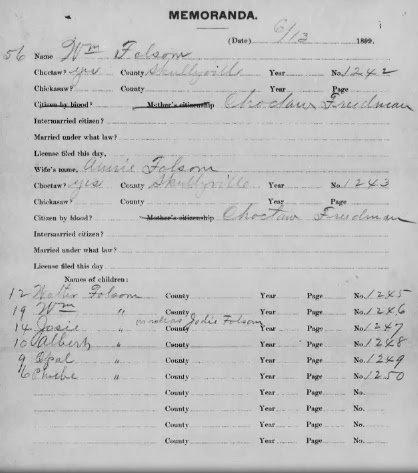
A memorandum was also included in the file of William Folsom, noting the family that would eventually end up on the Final Roll.

Memorandum found in file of William Folsom
National Archives Publication M1301
Choctaw Freedmen #729


William Folsom Family Names on Final Rolls

Arrow points to Wm. Folsom Family on the Final Rolls

Note that the Final Dawes Roll is a free standing document. In fact it is a 634 page book of all of the names of persons who were approved and who were determined to be eligible for enrollment. It is also categorized as National Archives Publication T529. Other records such as Enrollment Cards, Application Jackets and all of the many parts to those files are Dawes Records but the Dawes Roll. refers to the page where the family name actually appears.  


Allotted Land - The Final Part of the Dawes Process

Another set of useful documents is a record set known as Applications for Allotments, which were completed when approved citizens made the formal application for their land allotments and the tracts of land were assigned to them. Those records are now fully digitized and reside on Family Search. 

William Folsom applied for his own land allotment and then for each of the children whose names were also on his card. This record set provides the answer to the question that many Dawes enrollees descendants have wondered for many years. That question is "Where was the land that they received?" These previously un-digitized records now point the researcher to the exact spot of the ancestors' allotted land.


Land Allotment Records Made by William Folsom

The Dawes Records are rich and full of data. The stories to be told are there, and hopefully this brief description will provide an overview for those who have ties to Indian Territory and today's Oklahoma, and parts of Mississippi.

A follow up article will include samples of documents from all of the categories.

Friday, September 27, 2013

Plantation Excavation in the Choctaw Nation


Three years ago, I wrote an article about the Robert Jones plantation archaeological project. I have been talking about the project in recent weeks and what a surprise to see that there was an update yesterday of the excavation project on the Jones Plantation.

This is the largest slave plantation west of Arkansas and it is historically significant, although not widely known, and under studied and researched.

The home was the site of Robert Jones, a wealthy Choctaw Indian who owned more than 500 slaves before the Civil War.

Robert Jones and wife, Susan Colbert Jones

After the war,the home fell into disrepair and was burned in 1915. Now 98 years later an effort is being made to learn more about the estate, and the people who lived there.

The project I hope will begin to tell stories of the enslaved as well as the slave holders and reveal aspects about their lives that shall reflect more of the history lost to time, erosion and human memory.

As artifacts are pulled from the soil, I also hope that the project will expand, as there are so many questions to ask.

* Have remains of the slave cabins been found as yet? Robert Jones had at least 15 on his largest farm, and finding those will reveal a lot yet undiscovered about the lives of Choctaw slaves.

A small notation on the 1860 Slave schedule indicates that 
Choctaw slaveholder Robert Jones had 15 slave cabins on his property.
Source: Ancestry.com. 1860 U.S. Federal Census - Slave Schedules [database on-line]. 
Provo, UT, USA: Ancestry.com Operations Inc, 2010.


* Were slaves buried in any known place? 

* And what can be gleaned about their lives so far from the excavation?

The hard work continues, and I hope that there will be collaboration from many in the Oklahoma community. The Oklahoma Archaeology Society invites and welcomes assistance from the community on their excavation projects. This work is so important, and may someday lead to more facts about the lives of the much under studied enslaved Black men, women and children, of the Choctaw Nation.
 
* * * * *


Saturday, September 21, 2013

Negro Convention in the Creek Nation


Partial Image of Leading article from Muskogee Cimeter
September 27, 1907  p. 1

In September of 1907 Black Men who were known in the Creek Nation as leaders convened in Muskogee for a major meeting. The gathering was reported in the press simply as "the Negro Convention". The September 27 issue of The Muskogee Cimeter a Black newspaper in Muskogee provided a good listing of who the representatives were from various communities in the Creek Nation. Since the article described the convention as the "Negro" Convention, the list of dignitaries in attendance, provides the reader a virtual who's who among African Creeks.

The group was a temporary one at the time of the meeting, but permanent committees were developed at that meeting. An impressive list of names of various persons in attendance and appointed to new rols appeared in the article. This list is significant, as it provides an interesting glimpse in to pre-Oklahoma statehood society and culture among the "estelusti" of the Muscogee Creeks.

In addition, very little can be found in many current texts about this Muskogee convention in 1907
Since legibility is not sharp from the article, the names are transcribed below. (Note that on the Finance committee, the communities where the various member lived was included.)

Committee on Resolutions:
 Capt. A.V. Jones
 George Robinson
 P.A. Lewis
 J.A. Roper

Committee on Delegates
E.D. Nickens
P.A. Lewis
Steve Grayson
P.B. Hudson
L.A. Bell

Committee Finance:
Jake Simmons, Haskell
H.D. Reed, Lee
William James, Chase
J.H. Stevens, Beggs
S. L. James, Sapulpa
L.E. Willis, Tullahassee
E. L. McShann, Tullahassee
George Wade, Wybark
Dr. Evans, Ft. Gibson
Dr. Smith, Clarksville
P.B. Hudson, Gatesville
Alex Perryman, Gatesville
J.H. Reeves, Rentie
J.E. Thompson, Clearview
Mose Grayson, Henryetta
Frank Haygood, Sharp
R.J. Chatman, Bald Hill
Rev. N. A. Robinson, Rentiesville
F. P Brinson, Rentiesville
J.H. Lewis, Porter
E. L. Barber, Red Bird
John Simmons, Coweta
L.A. House, Coweta
O.W. Gurley, Tulsa
W. Watson, Grayson
J. F. Davis, Rex
J. Fonville, Rex
O. W. Bradley, Boley
Henry Taylor, Boley
F.M. Haynes, Boley
M. C. Perry, Checotah
Lone Landrum, Checotah
J. N. Jackson, Eufaula
G. P. Phillips, Eufaula
Wm. Vann, Newby
Frank Knolls, Bristow
Noah Alberty, Lonetia or Wagoner
A.R. Penn, Loetia or Wagoner
J. A. Roper, Okmulgee
Steve Grayson, Okmulgee
Felix Driver, Taft
W. B. Riley, Taft
John D. Phelps, Wagoner
W.D. Huggins, Wagoner
P.A. Lewis, Inola
L.E. Nero, Broken Arrow
Morris J. Sango, Muskogee
J. H. Smith, Muskogee
J.T. Trimble, Muskogee
L. W. Sango, Muskogee
L.W. Fue, Muskogee

Additional committees were formed and a vast array of speeches were made. The convention was also well attended by a large number of other members of the Creek Nation

"The entire Creek Nation was represented, and visitors from other nations present."

Excerpt from article from Muskogee Cimeter
September 27, 1907  p. 1

Not much is known what kind of impact that this convention had, and it has most likely faded from the historic memory of many who now reside in Oklahoma, as well as of those who have this fascinating history and heritage. Descendants of the Creek Freedmen, may also want to take note and quite possibly many of their ancestors were among those persons present at the big Negro Convention-a gatehring of African Creeks.

It is clear that the activities of persons living in Muscogee Creek country were vast, and this article is being shared so that more of that history can be uncovered, studied and appreciated.

* * * * *

Monday, September 16, 2013

Series: The First Freedmen Enrollees: Choctaw Freedman Card #1 Simon Clark

Choctaw Freedman Card #1
NARA Publication M1186  Record Group 75 Roll 49

As pointed out in the first post in this series, the first enrollees in each category were often persons of influence. We saw in the enrollment case of John H. Ross, from the Cherokee Nation, that a former slave of Chief John Ross was the very first case heard by the Dawes Commission among Cherokee Freedmen.

With Choctaw Freedmen, the process began in the Ada/Stonewall community for Choctaw Freedmen. However, it is fascinating to note that the persons enrolled on this card did not have the lowest roll numbers. Simon Clark applied on behalf of his family, but one will notice that the final numbers assigned to them were a much higher number, than the 1 through 5 respectively. That is because his case was contested for a while before a final decision was made on the enrollment of his family.
Notation made on Enrollment Card #1


Nevertheless, Simon Clark was a man of influence in the mostly Chickasaw town of Ada where he lived. Though his Dawes Application was that of a Choctaw Freedman, he lived in Chickasaw country in the years after the Civil War.  His influence and status in the community came from the fact that he was also a Civil War soldier.  He was a known freedom fighter, having achieved that status during the war, in the years before freedom was granted to slaves in both tribes, Clark had seized his own freedom and enlisted in the Union Army.

For Choctaw and Chickasaw Freedmen enlistment was not a common as it was for Cherokee and Creek Freedmen. That meant having to travel through hostile country before making it to Kansas to enlist. But Simon Clark, along with a cousin Aaron Newberry and others did make it to Kansas, an enlisted.

Enlistment data from Union Soldiers Service Record

Clark had enlisted in the 2nd Kansas Colored in Ft. Scott, Kansas. The unit was later re-designated as the 83rd US Colored Infantry.

Simon Clark's parents were Jacob Clark, and Tena Clark. Before freedom, Simon was enslaved by Jincy Cochran. His mother was also enslaved by Jincy Clark, but his father had been enslaved by John Newbury.

In his enrollment interview, Clark explained that he was originally enslaved by Bob Cochran and upon the slaveholder's death, he became enslaved by Cochran's widow, Jincy Cochran. Although his interview was one of those "summarized" interviews that occurred frequently in Chickasaw County, there is still useful data to be found in the small packet.

Interview found in Simon Clark Application Jacket
Choctaw Card #1
NARA Publication M1301

In the years immediately after the Civil War, Simon Clark moved around Indian Territory, before returning to his how in the Ada/Stonewall community. He lived near Skullyville and Ft. Coffee before returning to the Ada community.

In 1889, Simon Clark applied for and received a military pension for his service in the Union Army. After his death in 1901, his wife also applied for and received a pension.


 Source:  General Index to Pension Files, 1861-1934. Washington, D.C.: National
 Archives and Records Administration. T288, 546 rolls.

Clark died in April of 1901, verified by his daughter Cornelia Clark.


Death Record found in Simon Clark Application Jacket  Choctaw Card #1
NARA Publication M1301

There is more to be told about Simon Clark and an upcoming trip to the National Archives, will involve examining his Civil War pension file.

* * * * *     * * * * *     * * * * *