Monday, October 9, 2017

Family of Hester Murphy, Creek Freedmen


In 1899 Hester Murphy applied for herself and her family as citizens of the Creek Nation in front of the Dawes Commission. From the records reflect the Murphy family from Coweta, a family well documented and strongly connected to the community, the land and to the Muskogee Creek Nation. On the enrollment cards, Hester's name is found as well as those of her daughters Fannie and Ruth, her sons Fred and Walter, an associate Joseph Stephens who was not related. She was a member of North Fork Town, and prior to the war, was once enslaved by Moty Canard.


Creek Freedman Card #171
Source: The National Archives at Ft. Worth, Ft. Worth Texas 1868-1914

NAI Number: 251747 Record Group Title: Records of the Bureau of Indian Affairs, Record Group 75
(Color Image Accessed from Ancestry)


The enrollment card is full of genealogical data, reflecting not only their names on prior rolls, but also notes on the front of the card reflect other relationships, such as the spouses of Hester's children and subsequently, their children (Hester's grandchildren) also.

Joseph Stephens who was not related to Hester, did have a tie to the family. He was listed actually as the father to one of Fannie's children listed on another card.

(Source: Same as Above)

On the back of the card, it is learned that Hester's father was enslaved by Roley McIntosh, and her mother was enslaved by Moty Canard. Her father was Wm. Murphy who was not a Creek citizen


(same as above)


From the Application Jacket
This is one of the rare Creek Freedmen application jackets that is full of data and that contains a very detailed interview. 

In the interview attention was directed to her history, and how long she had lived in the Territory and whether or not she was always living in the Creek Nation. She pointed out that she left when "all the people went out". She was referring to the time during the Civil War, when many people left their homes to avoid being in the vicinity of the battles and skirmishes.

To verify her presence, several questions were directed to her about various payments made to Creek citizens. They discussed whether she was on the 1890 roll, and if she had received the $29 payment and if she had drawn the $14 that was also paid.

Also in the interview the voice of Freedman leader Sugar George was found. He was a major leader who served in the House of Warriors, the House of Kings, and he served as town king of North Fork Colored town.
National Archives Microfilm Publication M1301
Ancestry.com. U.S., Native American Applications for Enrollment in Five Civilized Tribes, 1898-1914[database on-line]. 
Provo, UT, USA: Ancestry.com Operations, Inc., 2013.

Sugar George had been town king for about 12 years at the time, serving in that capacity since the 1880s. Prior to that time he served in the House of Warriors. As questions were directed to him about the movement of Hester and her family, he pointed out that he knew with certainty that they were back in the Creek Nation before the 1866 treaty was signed. He pointed out that he know it, because he "took them into the yard" when they arrived, and that Hester's family was closely related to him.
>
>Hester took the stand again and when asked about who traveled and returned, she named her family members, including her siblings.
(same as above)

The third witness was Tacky Grason, a legislator at that time in the Creek Nation. He was also able to verify Hester's ties to the nation. He knew her parents Nero McIntosh, and Hester's mother Sarah. He also corroborated that not only Hester's parents left during the war, but that most people had vacated the area during the war as well. He also confirmed as did Sugar George that when peace was declared they were already back in the Creek Nation.


(same as above)


Land Allotments

The Murphy family did obtain their land allotments and the allotment records and interviews also tell more of the Murphy family story.

Provo, UT, USA: Ancestry.com Operations, Inc, 2014.


(same as above)

There is much to be learned from the Murphy family file. The relationships among the various "classes" of Creeks was a strong one, and the Murphys were viewed as Creeks and not as outsiders. Their status as "Freedmen" was outweighed by their simply being viewed and treated as Creek. In addition, the roll that "Freedmen" such as Sugar George was evident and his involvement as a ruler in the nation is verified, and undisputed.

The lives of the Freedmen from the Creek Nation were closely aligned to all Creeks and the culture of this family was without one that was strong and deeply rooted as Muskogee Creek people. 


(This is the 29th article in a 52-article series devoted to sharing histories of families once held as enslaved people in Indian Territory, now known as Oklahoma. The focus is on the Freedmen of the Five Civilized Tribes, and these posts are part of an ongoing project to document 52 families in 52 weeks.)


Monday, October 2, 2017

Fannie Ewing & Martha Moore, Two Chickasaw Women

The stories of these two women are presented here, because they could be forgotten in time. They were both born enslaved by Chickasaws and lived their entire lives as Chickasaws. By the time of the Dawes Commission, they appeared to have lived alone but both appeared in front of the Dawes Commission in the spring of 1899.

And both of their stories reflect how important it is to study the community where ancestors lived. By studying the community it is evident that these women were not living in isolation, and did have people within a social and family circle that were part of their lives. The actual residence of both of these women was in Red River County in the Choctaw Nation, but they lived full lives nevertheless as Chickasaws.

From the card of Fannie Ewing, it is learned that she was enslaved by Robert Jones, and Martha was enslaved by W. A. Welch. Fannie Ewing was born in the 1840s and the slave holder was Robert Jones, an extremely wealthy Choctaw Indian. Jones' wife Susan was Chickasaw, and it is through her that many slaves were held by Jones. But years later after the war and after freedom, by the 1890s Fanny  lived in Janis, Indian Territory in Red River County of the Choctaw Nation.

The National Archives at Ft. Worth, Ft. Worth Texas 1868-1914

NAI Number: 251747

Record Group Title: Records of the Bureau of Indian Affairs, Record Group 75
Fannie's parents were Jerry Graham and Daphne Jones, and both were deceased at the time of Dawes enrollment.
(Source: same as above.)
Living in the town of  Harris, I. T., was Martha Moore, once enslaved by W. A. Welch. (I recognized the name of W. A. Welch, because he testified on behalf of my great grandparents in June of 1899 in Skullyville when they appeared in front of the commission.) Like Fanny Ewing, she was in her 50s and seemingly alone when appearing in front of the commission.

The National Archives at Ft. Worth, Ft. Worth Texas 1868-1914
NAI Number: 251747
Record Group Title: Records of the Bureau of Indian Affairs, Record Group 75

Martha's parents were Daniel Mason and Charity Mason. Her mother Charity had been enslaved also by W. A. Welch.
(Source: same as above)


Application Jackets
Fannie's application jacket was slim offering a small interview. But in this case it was pointed out that Fannie's enslavement came to Robert Jones through his wife Susan. Susan Colbert Jones was a Chickasaw and she apparently brought some slaves with her into the marriage. In the interview one of the relatives of Susan Colbert testified that she had known Fannie since her birth and in fact had even known Fannie's mother before she (Fannie) was born. 

This is one of several cases where a relative from the slave owning family came to testify on behalf of their former slave in front of the Dawes Commission. Although many details are not revealed it is clear that some kind of relationship did exist with the former slaves even years after freedom had come. In this case, Lin Colbert was adamant that not only did he know Fannie but knew her mother as well.

Ancestry.com. U.S., Native American Applications for Enrollment in Five Civilized Tribes, 1898-1914[database on-line].
Provo, UT, USA: Ancestry.com Operations, Inc., 2013.


Martha Moore's Application Jacket
In the case of Martha Moore, this was the first time that I have seen a former slave holder from Indian Territory testify on behalf of one of the former slaves. 

In the 1-page interview from the application jacket, the witness was asked, "Was she a slave?" He replied, "Yes sir." Then when asked "who was her master?" He replied, "I was." He also admitted out that the Chickasaws never enrolled their former slaves, even though they had signed the treaty to do so. 

Ancestry.com. U.S., Native American Applications for Enrollment in Five Civilized Tribes, 1898-1914[database on-line]. 

Provo, UT, USA: Ancestry.com Operations, Inc., 2013.


Other Family
Living close by in Janis, I. T. was a young woman Mary Ewing. Mary was 25 years of age, not on any earlier rolls. Her father was Charley Williams and her mother turned out to be Fannie Ewing.

The National Archives at Ft. Worth, Ft. Worth Texas 1868-1914

NAI Number: 251747
Record Group Title: Records of the Bureau of Indian Affairs, Record Group 75

And also once again in the same community of Janis, I. T., in the household of Julia and Charlie Edd, another relation appeared. Julia Edd was another married daughter of Fanny Ewing.

The National Archives at Ft. Worth, Ft. Worth Texas 1868-1914
NAI Number: 251747
Record Group Title: Records of the Bureau of Indian Affairs, Record Group 75

Extended Family for Martha Moore
Likewise with the case of Martha, in the same community of Harris I.T., was the Cotton family. Mollie Cotton lived there with a fairly large family. She lived nearby with her husband Tom, her grown children and some grandchildren in the household. All of these were a part of Martha Moore's extended family. Mollie was the daughter of Martha Moore.


The National Archives at Ft. Worth, Ft. Worth Texas 1868-1914

NAI Number: 251747
Record Group Title: Records of the Bureau of Indian Affairs, Record Group 75

Though there is not a lot to go on with the actual application jackets of Fanny Ewing and Martha Moore, a bit more examination of the cards from the same community reflected other people who were indeed part of their familiar circles. They were survivors and there is no doubt that they influenced the lives of their families where they lived.

Small application jackets do not prevent the family story from emerging. These two Chickasaw Freedwomen who were registered alone, did have a thriving family life in their small corner of the Choctaw Nation where they lived, in Red River County. Their families, thrived and their names should not be forgotten nor overlooked.
**********
This is the 28th article in a 52-article series devoted to sharing histories of famlies once held as enslaved people in Indian Territory, nowknown as Oklahoma. The focus is on the Freedmen of the Five Civilized Tribes, and these posts are part of an on0going project to document 52 families in 52 weeks.

Saturday, September 30, 2017

The Family of Louisa Gibson, Choctaw Freedmen

Not far from the city of Idabel Oklahoma, one can find the family of Louisa Gibson. She was a citizen of the Choctaw Nation. Her family lived in the town of Shawneetown, in Red River County of the Choctaw Nation, in Indian Territory. Louisa appeared in front of the Dawes Commission submitting an application for herself and for her children. Her children were Geneva Shaw, Luanna Shaw, Perry Shaw, and Australia Gibson. The father of the first three children was Sandy Shaw, presumably a previous husband. Australia Gibson's father was Hiz Gibson.

Choctaw Freedman Card #1266
The National Archives at Ft. Worth, Ft. Worth Texas 1868-1914

Record Group Title: Records of the Bureau of Indian Affairs, Record Group 75


Louisa was born enslaved and was held enslaved by Susan Jones, wife of Robert Jones. Robert and Susie Colbert Jones were the largest slave holders in Indian Territory. Louisa's parents were Aaron Shoals, and Amanda Shoals. Coming from the largest slaveholder in Indian Territory, Louisa's parents clearly had chosen to have their own name, and never used the surname of their former enslavers. 

Reverse side of card.
Source: same as above image


Many members of the Gibson family were also listed on the 1896 Choctaw Roll.
1896 Roll, Choctaw Nation
Ancestry.com. Oklahoma and Indian Territory, Indian Censuses and Rolls, 

1851-1959 [database on-line]. 

Louisa had another daughter, Sallie who was married at the time of the Dawes Commission and she appeared in front of the commission on her own. Information on Sallie Wooten is found on Choctaw Freedman Card #1387, enrolling her own children Beatrice, Prentice and Everett Wooten. Her husband Garrett Wooten was not a citizen of the Choctaw Nation. Like her mother, she and her family also lived in Shawneetown.

Choctaw Freedman Card #1387
The National Archives at Ft. Worth, Ft. Worth Texas 1868-1914


Record Group Title: Records of the Bureau of Indian Affairs, Record Group 75


Reverse side of card.
Source same as for above image


The application jackets for Louisa revealed very little additional data on the Gibson family. The expected interview was not included in the file. Only a small memorandum was in the file reflecting the same data for the family.


Thankfully, the family members did receive their land allotments. The standard land allotment data was present including plat maps, and descriptions of the land that they received. One standard data set was collected from Louisa and put onto the pre-printed forms. Like all families admitted, a set of land records appeared for each person including the young children, so the family researcher will want to obtain the files for each family member.


Ancestry.com. Oklahoma and Indian Territory, Land Allotment Jackets for Five Civilized Tribes,
1884-1934
[database on-line]. Provo, UT, USA: Ancestry.com Operations, Inc, 2014

Source: Same as above image

Source: Same as above image


It was mentioned that the family was transferred to the roll of Choctaw Freedmen, from a roll of Chickasaw Freedmen. The same data appeared on the file and the application jacket contained only one document that was significant. Apparently Louisa had a son Mark, who died in 1900. A document reflecting his death appeared in that file.

So in spite of the few records, Louisa Gibson and her children by both Shaw and Gibson have a strong legacy left upon the soil where they lived. They were enumerated in the Federal Census in 1910, now living in McCurtain County of Oklahoma. The question arises whether they lost their land as so many tribal citizens did, or was land sold and they relocated or was this the same community where they had always lived? The old settlement of Shawneetown, where the Gibsons had lived during the Dawes era, was located near what is today's Idabel Oklahoma, and Idabel is in McCurtain County.

By 1910, Louisa had either been widowed, or her second husband Gibson had died, as she was now using the name of Louisa Shaw.


Four years later, her daughter Australia married F. J. McDonald in Idabel, Oklahoma.


Ancestry.com. Oklahoma, County Marriages, 1890-1995 [database on-line]. Lehi, UT, USA: Ancestry.com Operations, Inc., 2016

Not much more is known about the Gibson family of Choctaw Freedmen, however, their legacy continued in the same community for decades.

Hopefully the descendants of Louisa Gibson Shaw  will be known, honored and celebrated.

**********
This is the 27th article in a 52-article series devoted to sharing histories and stories of families once held as enslaved people in Indian Territory, now known as Oklahoma. The focus is on the Freedmen of the Five Civilized Tribes, and these posts are part of an on-going project to document 52 families in 52 weeks.

Monday, September 18, 2017

The Legacy of the Nero Family of the Cherokee Nation


Rev. Roger H. Nero

This family's story is not an unusual one, and the Neros lived a quiet life in the early 20th century. About  8 decades later, the child Roger whose name appears upon the family's enrollment card, would emerge as one not to forget when he became the first of many litigants that would initiate a fight for their birthright. He was one of many original Dawes enrollees, who would later find that racial prejudice and anti-black racism would prevail for many years within the arena where he lived and died.

In the 1980s, the case of Roger Nero vs. the Cherokee Nation would begin a 20 year saga reflecting the plight of the Freedmen of the Cherokee Nation. His story was one of disrenollment, disenfranchisement and racial bias against the descendants of those once held enslaved by Cherokees in the years prior to the Civil War. What eventually emerged was a battle of Cherokees against the descendants of those they once held enslaved. The Freedman case was lost, and Roger H. Nero, now an elderly man died, now experiencing in his final years, racial bias that would prevail in the nation in which he had for his entire life, lived, voted, obeyed the laws, and died.

However, in the past 20 years since the Nero case, there have been more court cases within the Cherokee Nation, with Bernice Rogers RiggsLucy Allen, and most recently Marilyn Vann to take up the mantel for justice once again. And most recently, the "Vann case" as some refer to it, was finally acted upon by Judge Hogan, on August 31, 2017.

Roger Nero died with the stain of a racially motivated bias hurled at him. He courageously fought against it, but never lived to see the victory of those who would carry on the fight for the birthright of all people within the nation where he was born--that of the Cherokee Nation.

In honor of the ruling and honoring the first litigant in this 20 year old saga, the legacy of the Nero family is shared in this post.


Nero Family History
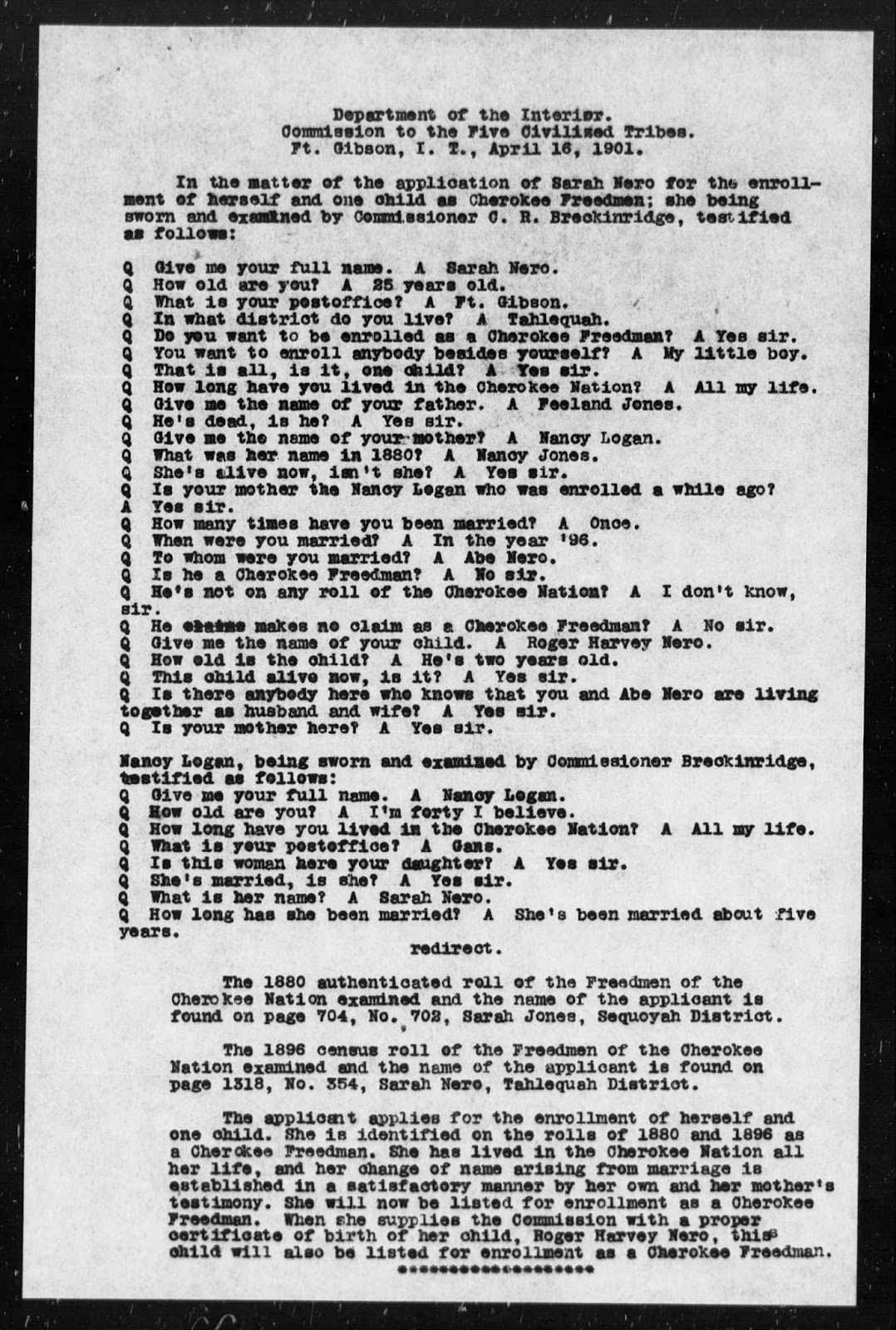
The Nero family of the Cherokee Nation has a deep history reflected on their family documents from the Sequoyah District of the Cherokee Nation. In April of 1901 Sarah Nero, a young woman married to a Creek citizen appeared in front of the Dawes Commission to enroll herself and her two children as Cherokee Freedmen. Her children were two year old Roger and three month old Jesse Corinne Nero.

Sarah, their mother was a  young woman of 25, and thus had not been enslaved. But on the reverse side of the card, her parents are identified and her mother had been enslaved by James Benge, a family well documented in the Cherokee Nation. The family of slave holder James Benge was on the roll of Old Settlers, and more Benge ancestors were on earlier rolls emanating from Georgia before removal to the west.

Cherokee Nation Freedman Card #500 (front side)
The National Archives at Ft. Worth, Ft. Worth Texas 1868-1914

NAI Number: 251747

Record Group Title: Records of the Bureau of Indian Affairs, Record Group 75

Sarah's father was Freeland Jones, and her mother was Nancy Logan. Her father was deceased at the time and he was once part of the Sequoyah district. It is not clear whether Freeland Jones was a slave or a free man. He died before enrollment so this may not be known. But Sarah's mother's history is reflected, and her mother Nancy was enslaved by James Benge.

(back side of same card)

For some reason there was doubt expressed in the initial application of Sarah and her children, for they had originally be placed on a roll where there was doubt concerning her status. A small note appeared on the lower left corner of the front of the card stating that the matter was later resolved.


Application Jacket
The application jacket for Sarah Nero, was rich with documents including an interview, a birth affidavit for her children, and a hand written letter. The interview though short


(Application Jacket for Cherokee Freedman Sarah Nero)
National Archives Publication #M1301 Cherokee Freedmen #500
Ancestry.com. U.S., 
Native American Applications for Enrollment in Five Civilized Tribes, 1898-1914
[database on-line]. Provo, UT, USA: Ancestry.com Operations, Inc., 2013.


(same as above)

(same as above)

(same as above)

(Hand-written letter from Sarah to the Dawes Commission)
 after seeing her own name in the newspaper, on a list of Cherokees who were unaccounted for or "missing". 
Her letter would eventually clear up what appears to have been a clerical error on someone's part.)

(same as above)

(same as above)


A Creek in the Household
Sarah Nero's husband was Abraham Nero. He was not Cherokee, but was, in fact a member of the Creek Nation. He was enrolled as A. L. Nero, and his enrollment card from the Creek Nation is #573.

Creek Freedman Card #573 (front side of card)
The National Archives at Ft. Worth, Ft. Worth Texas 1868-1914
NAI Number: 251747
Record Group Title: Records of the Bureau of Indian Affairs, Record Group 75

(back side of card)

A.L. Nero's father was Nero Irons, who was, in fact a Cherokee citizen. Irons had been enslaved by Annie Hynes. His mother Fanny had once been enslaved by Creek John Sella. It is not certain where the Nero surname was from, and why A. L. or "Abe" chose that name and not the name of either of his parents. Was there possibly a family tie to other Nero's in the Territory? (There was a Nero family that lived near Okmulgee, and are buried at the small Nero family burial ground near Eufaula but direct ties to that family are not known.)

The Nero family with ties to both Cherokee and Creek Freedmen lived most of their lives in Cherokee country, and the young child Roger as well as others would remain in the small community in and around Fort Gibson for most of their life.

This family profile reflects a family firmly confident of their identity, and hopefully, the recent case will finally put to rest an ongoing saga of identity, heritage and citizenship. And it is hoped that the spirit of Rev. Nero, can finally rest in peace with knowledge that his descendants are now able to claim citizenship in the nation to which they have been connected for the last two centuries. His struggle was not in vain.

****************

This is the 26th article in a 52 article series devoted to sharing histories and stories of families once held as enslaved people in Indian Territory, now known as Oklahoma. The focus is on the Freedmen of the Five Civilized Tribes, and these posts are part of an on-going project to document 52 families in 52 weeks.


Wednesday, August 30, 2017

Cherokee Freedmen Win Battle In Federal Court

".....When the Cherokee people wrote into their constitution in 1866 “all native born Cherokees, all Indians and whites legally members of the nation by adoption, and all freedmen,” “shall be taken and be deemed to be citizens of the Cherokee Nation,” they fixed the status of the freedman and raised him to the same rank of citizenship which they themselves enjoyed. Thenceforth he was to be equal with themselves under the constitution, governed by the same laws, enjoying the same rights, possessed of the same immunities, and entitled to the same protection. If the common property was to be retained for the general welfare, he was to share equally in its benefits; if it was to be sold and its proceeds divided, the constitution made it as much his as theirs."

And so goes the ruling made August 30, 2017 in favor of the Cherokee Freedmen.

For many this ruling is a surprise---Cherokee Freedmen, descendants of the formerly enslaved people held in bondage, have been struggling for the greater part of the past century for their rights to remain citizens in the tribe of their birth, and the tribe of their ancestors. Over the years there have been continuous efforts for the Five Slaveholding Tribes, to cleanse their nation of the presence of descendants of  their slaves.

In the Cherokee Nation, during the tenure of the first female Principal Chief, Wilma Mankiller, the Freedmen began a decades long saga fighting for their rights to remain citizens, after having been kicked out of the nation. Some who had been a citizen for their entire life showed up to vote to suddenly be told that they were no longer citizens.

This happened in 1983, when Rev Robert Nero, an elderly man showed up to vote in a Cherokee election. He had voted in other years including the previous election in 1979. He was told that he could not vote because he did not have "Cherokee blood".

For many with roots in the deep south, this is similar to many African American citizens who were prevented from voting, because their "grandfathers" had not voted. For others this treatment was not different from the challenges made to other blacks by giving them exams that were not passable, again to prevent their voting and sharing in the rights as citizens.

In 1984, Rev Nero and others filed a class action lawsuit challenged this new policy. They stated that their treatment by the tribe had been "humiliating, embarrassing, and degrading." The tribe argued that the Federal court had no jurisdiction in the case, as it impinged on tribal sovereignty. That case went on and ruled in favor of the tribe. The Appeals court ruled that the case was a tribal issue and allowed the lower court ruling to stand. That ruling occurred in 1989--5 years after the case was initiated.

This began a saga again and that would emerge, would challenged next time when Bernice Rogers Riggs, a descendant of slaves one held by the family of noted humorist Will Rogers, challenged the issue. Her case was somewhat different, because she challenged the issue in Cherokee Court and not Federal Court.  At that time I was contacted by one of the attorneys representing her to be a witness in her case. That was in the summer of 1998, in the capitol of the Cherokee Nation in Tahlequah.

Mrs. Riggs sued Lela Ummerteskee the tribal registrar, over her having been denied citizenship in 1996. She had documented her family ties to the nation, but she was denied enrollment because her ancestors were placed on the Freedman Roll

This long standing policy of forbidding enrollment of those whose ancestors were on the Freedmen Roll, has been a long standing policy, deemed acceptable by many for years. The policy of allowing those who are caucasion with 1/1000th degree of Indian blood, based on a flawed roll that intentionally ommitted any blood degree of any kind on Freedmen, has been an on going issue. Basically those who ancestors were enslaved by those who marched alongside their slave holders on the same Trail of Tears, have basically been told repeatedly that their blood didn't count. Yet---Freedmen descendants can prove that they descend directly from their ancestors on the Dawes Rolls. This is the same roll that will admit those who descend from Inter-married whites, whose degree of Indian ancestry is minuscule, and if a DNA test were issued, they would have little to no Indian DNA showing. But DNA is not an admissible element for citizenship. Admission is based on having ancestry of a certain portion of the Dawes Roll.

Over the years, more individuals became aware of their own ties to the Five slaveholding tribes. In 1991, I discovered my ancestors on the roll of Choctaw Freedmen. I learned that my own great grandmother whom I had known when I was child, had been born enslaved in the Choctaw Nation. I found her enrollment card and was stunned when I saw my own family and beside their names a column headed by the words "slave of" followed by the name of the slave holding family.

Two years later I wrote a book about researching the Freedmen of the Five Civilized Tribes, published by Heritage Books. Astonishingly this was the first book ever written as a genealogy guide for the thousands of Freedmen descendants. I began to meet others from around the country, who had roots in Oklahoma, and who could also document their history to that of the Freedmen. I began to study the history of slavery in the Five Tribes and was learning an incredible history never taught and still not taught in Oklahoma schools. The history ommitted, is that slavery occurred in the land that became Oklahoma.

I also learned about the fact that Freedmen had been kicked out of the tribe, and that the nation had basically looked away, while people with documented ties, were not allowed citizenship in the nation which was part of their own family history. I also learned the policy was one where those with ancestors on the rolls of "Blood" and "Inter-married whites" are admitted into the tribe, and those with ancestors on the rolls of "Freedmen" were not allowed. I learned also that they have been excluded steadily for the past 3 decades.

However, the last decade has brought about more challenges with some changes. In 2001, Marilyn Vann sued the nation once again after she was denied enrollment, because her father and grandparents were on the Freedman Roll. Ms. Vann and others challenged the ruling and this time, others became aware of this new challenge, and began to show their support. The Freedmen were admitted by the Treaty of 1866. Among the new supporters of the treaty were the Delawares who were adopted by the same Treaty. They showed support of the Cherokee Freedmen.

Three years later, in 2004 Lucy Allen, another Cherokee Freedman descendant filed a case in Cherokee court, claiming that the exclusion of Freedman was unconstitutional. It should be pointed out that the first line in the Cherokee Constitution states that "The law of the United States is the law of the land". The Appeals council ruled in favor of Lucy Allen's case, thus opening the doors of many Freedmen descendants to then apply for citizenship.

Then a ruling was made in 2006 overturning the earlier ruling against the Freedmen. This began a back and forth issue of allowing the Freedmen to enroll, followed by Cherokee Chief Chad Smith calling for a vote to expel the Freedmen. Only 3% of the eligible voters participated in the vote, which came out as a vote of expulsion. The tribe officially claimed that over 70% voted to expel the Freedmen, though it was 70% of the 3% who had voted.

In 2012 a case was filed in 2012 with the Cherokee Nation claiming that it was not required to admit the former slaves as citizens. There was a counter suit and it was decided to combine the cases since both cases involved the exact same parties. In May of 2013 a hearing was held in Federal Court in Washington DC. I attended that hearing and had a chance to observe as attorney Jon Velie argued on their behalf.

Today, August 30th a ruling by Thomas F.Hogan, senior United States District Judge. He ruled that Cherokee Freedmen have rights guaranteed to them as full citizens, as the treaty promised. The treaty he referred to was the Treaty of 1866.

It will never be known why it has taken years for this case to be settled. There was hope that the ruling would have been much earlier, but at last a ruling has been made. It is not known how other tribes will act in light of this ruling. The language of the treaty is clear. Hopefully with this ruling, I can only hope that others will now start to pursue their history and genealogy with vigor and enthusiasm. The nation has come to terms with the unequal treatment of one part of the nation in light of the trial and of the analysis.

Perhaps the tenacity of the Freedmen beginning with Rev. Nero and their unwillingness to disappear quietly was something that was never expected. It is stated that the tribe spent millions of dollars trying to remove the descendants of their slaves from the nation. Based on race and color, although many descendants could actually prove that they too had Indian blood, the fact that the Freedmen never quit the battle was never expected. Principal Chief Chad Smith who vehemently sought to purge the Freedmen from the nation, is no longer in office, and the Freedmen whom he wanted removed, have now won their case, once again, and as in previous cases, it was decided upon the merit. The Cherokee Freedmen were citizens and are citizens of the nation.

There are more than 20,000 genealogy files pertaining to the Freedmen that are genealogically rich and historically significant records.

The numbers of Freedmen descendants from all five tribes is significant, especially if one looks at the numbers from 1906 when the Dawes Rolls were still being developed:

Cherokee Freedmen 3982
Choctaw Freedmen 5254
Chickasaw Freedmen 4995
Creek Freedmen 5585
Seminole Freedmen  857 (+93 children born later)
 Total number of Freedmen from Indian Territory: 20,766.
 My hope is that others will step further to examine their history more intensely.

Meanwhile, the work and tenacity of the Cherokee Freedmen, with leader Marilyn Vann are to be recognized. Their courage to address racially based treatment of them over the years has been observed by all, and their battles have caught the attention of historians and scholars throughout the nation. 

They have been peaceful and maintained their dignity over the years as efforts were made from tribal leaders to attorneys to lobbyists, to discredit them, and their plight. Hopefully this will bring to an end the saga begun in 1894 when Rev. Robert Nero challenged those who had once enslaved his parents and grandparents. 


Our job now, is to assist others as they seek to tell their story. The Oklahoma Freedmen have an incredible story to tell!

Monday, August 28, 2017

Clara Cujoe & Family - Seminole Freedmen

The National Archives at Ft. Worth, Ft. Worth Texas 1868-1914

NAI Number: 251747, Record Group Title:
Records of the Bureau of Indian Affairs, Record Group 75

Enrollment Card, Seminole Freedman  Card #820

This Cudjo family from Wewoka is a family that can be considered one that is blended, as the mother and children are Seminoles and the father was Creek. In the case of Clara Cudjo and her children, she appeared in front of the Dawes Commission, to enroll herself, her daughter Peggie and her three step children, Bettie, Peter, Jack and Morris. Her husband was Paro Cudjo, who was a citizen of the Creek Nation. Clara was a member of the Dosar Barkus band of Seminoles. The family lived in Wewoka, Indian Territory at the time she appeared.


(same as above)

Unfortunately, many of the Seminole interviews, like the Creek Interviews are missing. Some are not labeled correctly, and others are simply missing and detailed files do not exist for many of the corresponding enrollment Dawes Cards. There was a file that contained one mere document pertaining to Clara Cudjo. That one page however is significant, because it points out that Clara Cudjo apparently died before the rolls were closed.


Oklahoma and Indian Territory, Land Allotment Jackets for Five Civilized Tribes, 1884-1934
Document accessed on Ancestry.
National Archives Publication M1301


(same as above)

Nancy Davis was a sister of Clara Cudjo, and she appeared in order to make application on behalf of her sister Clara, now deceased. Clara's data of death was said to have been October 10, 1900.


(same as above)

Another interview was also a part of the file, with Paro Cudjo, Clara's husband. Although she was identified as deceased, he was allowed to still appear and make a claim for the land that she was entitled to, had she lived. On that document, traditional questions pertaining to the status of the land, improvements upon the land and the nature of the parcel of land.

It is not known if the fact that there were two applications for Clara's land created conflict or not, or whether rights were given to the husband by default. The remaining documents reflect the presence of the husband in the file, and nothing additional was known of Nancy's application. However, for research purposes, it was useful to know that there was a sister and the family has another name to follow and study, to expand the family narrative.


Oklahoma and Indian Territory, Land Allotment Jackets for Five Civilized Tribes, 1884-1934


(same as above)

Another questions arises pertaining to the family. What can be learned about Paro Cudjo himself? A search on two databases did not reveal the name of Paro Cudjo. I wondered if he was related to Paro Bruner, but they were not the same families. And Clara's card as well as the land record state that he was a Creek citizen. I also checked the name written as C-u-d-j-o-e, but no Paro Cudjoe there, either. It is not clear who ended up with the land from the documents, and it is not clear who Paro Cudjoe the father actually was. No enrollment card for Paro Cudjo exists, but clearly, the record does reflect his being Clara's husband and father of the children in the household.

With no enrollment card for Paro Cudjo, one might assume that he administered the estate for his deceased wife and that was the end of the story. However, some additional records pertaining to Clara's estate and her husbands status as administrator were found. Among the probate records of Oklahoma some additional records were located. The file was much larger than expected and 18 more pages about Clara's property were located among probate records located on Ancestry.
On one record, Paro revealed that he had lived on the land since Clara's death and that some improvements were made over the time. He pointed out that he had not rented the land to anyone, but he and the family had resided there.


But surprisingly there was a challenge to Paro Cudjo having been pointed as Administrator of her estate. It is not clear as to why there was a challenge, but it is clear that a challenge to his administrative status was made. It was recommended that Paro Cudjo not be allowed to continue as administrator of the estate of Clara and her children. The letter appears to be one from a company requesting that the bond be canceled pertaining to the status of Paro Cudjo as administrator. The company was requesting to be removed from any liability pertaining to the claim. It is not clear whether or not this was a technicality or if there was another issue at hand.

Was this an effort to capture the land? It is known that many citizens of the Five lost their land due to many challenges put them in the early 1900s. It is not known if this was the case, or if the Paro kept the land for some time.

However, in 1910 census three years after statehood, Paro, was living in the township of Lincoln, in Seminole County, with daughter Peggie, and second wife Flora. His name was also found on some of the lesser known town rolls from the Creek Nation, but it is not clear why there does not appear to be an enrollment card for Paro Cudjo.


The possibility may be that he could had access to more land by holding on to his Seminole wife and children's assets and as a Creek he may have received only one allotment for himself if he were to enroll alone.

He was clearly present and appeared on the Arkansas Colored Town roll several times in the 1890s, and he was with his family in another Township several years later.

Hopefully the family thrived and continued their life within Seminole Country, and hopefully the short life of Clara Cudjo will be remembered well by her descendants.
* * * * * * * * * *


This is the 25th article in a 52 article series devoted to sharing histories nad stories of families once held as enslaved people in Indian Territory, now known as Oklahoma. The focus is on the Freedmen of the Five Civilized Tribes, and theses posts are part on an on-going project to document 52 families in 52 weeks.