Showing posts with label African-Native American. Show all posts

Monday, December 25, 2017

Sam and Sallie Walton - Choctaw Freedmen


Samuel and Sallie Walton
(Personal Collection)

No Oklahoma Freedman project would be complete without telling the story of my own family from the Choctaw Nation. The face above is that of Sallie Walton, my great grandmother. She was the face that I saw throughout my childhood, and a face that represents, love, sweetness, and wisdom. She was the face I saw every afternoon, and it was her bed into which I fell for my afternoon naps, until I started school.

Her ties to the Choctaw Nation were nothing new--it was often spoken of. It is also from studying her history, that I learned the history of thousands of others from the same place--Indian Territory. Sallie was born in the Choctaw Nation, in Indian Territory about 1863, right in the middle of the Civil War. I would not realize however, until 1991 that the face that I had always loved was the face of one who was born enslaved. She was a small child when freedom came and having been born enslaved that would place her and her children on the roll of "Freedmen" from the Choctaw Nation.

Sallie married Samuel Walton, and they both appeared in front of the Dawes Commission in 1898 to apply as Choctaw Freedmen. On the card, were my great grandparents, Samuel and Sallie, my grandfather Sam Jr., my uncle Houston and my aunt Louisa Ingram. They all lived in the Skullyville area of the Nation.

On the far right it is noted that Samuel's slave holder was a man called Jim Davis. For Sallie it was noted that she was enslaved by Emeline Perry.

Choctaw Freedman Card #777
The National Archives at Ft. Worth, Ft. Worth Texas 1868-1914
NAI Number: 251747, Record Group Title: Records of the Bureau of Indian Affairs, Record Group 75


Additional information on the back appears on the enrollment card. Samuel's father was listed as Pat "Drenard" and his mother as Lydia Walters. Sallie's father was listed as Eastman Williams, and her mother was Amanda Perry. In the column next to her father's name is a notation that he was not enslaved or "owned" but in fact he was a Choctaw Indian. Sallie's mother had been enslaved and it was noted once again that the slave holder was Emeline Perry.


The Application Jacket

Thankfully, the application jacket contained full testimony of the Waltons during the Dawes process. Samuel first was interviewed and additional information about the family was revealed. It turns out that he was not born in the Territory, but was born, in fact, in Arkansas. Samuel pointed out that he was later brought to the Territory and later sold to Jim Davis in the Choctaw Nation. On this same document Sallie was interviewed. When asked she refers to her mother Amanda, and interestingly with a new surname---a Choctaw one "Anchatubbee".


Richard Brashears is then called to testify. He was a leading Freedman in the post Civil War years and served as an advocate for Choctaw Freedman. He speaks to Sallie's history and her mother slave holder. (He erroneously mentions Jonathan Nail's sister as being the slave holder, but it is clarified in a later interview.)


National Archives Publication M1301
Applications for Enrollment,
Also accessed from Fold3.com, Native American Collection, Choctaw Freedmen)


More about Samuel is learned in the interview, when Nail Perry comes to testify. He pointed out that Sallie's mother Amanda was freed under his sister, Emeline. After the interview with Perry, it becomes clear how Sallie was connected to the Choctaw nation, and by whom she and her mother were freed.

(Source: Same as above)


Land Allotment Records
The family was placed on Choctaw Freedman enrollment card #777. The official "roll number" is found to the left of the name of the enrollee. As a result, the allotment file is categorized under the Dawes Roll Number. In the case of Samuel Walton, my great grandfather, his roll number is 3747. The file pertaining to his land allotment therefore is 3747, and each person whose name is listed on the card has a file pertaining to their land allotment and it is categorized by their roll number.


Ancestry.com. Oklahoma and Indian Territory, Land Allotment Jackets for Five Civilized Tribes, 1884-1934[database on-line].
Provo, UT, USA: Ancestry.com Operations, Inc, 2014


In this statement data was taken from Samuel Walton, as he represented Sallie in the selection of her land. Included in the document is a legal description of the land that was allotted.

(Same as above)

By closely examining the document it is noticed that Samuel Walton was a literate man. He signed his own name and his signature appears. It was pointed out in the earlier Dawes interview that he was a preacher and traveled throughout the territory. Seeing his signature is insightful as it speaks to the fact that he was literate.

(Source: Same as above)


Family Documents

There are a few personal records that also reflect Sallie's history. Folded up in the family bible was a plat map that Sallie kept among her papers. It was found after she died in 1961 and for years it was not clear what it was, until I began to explore the family's history and learned more about the allotment process.

Land document from personal family collection

Other notes made in an old family Bible reflected dates of births and deaths, and some of them were clearly born in "I.T." for Indian Territory. For many years it was not known what I.T. meant on those bible pages, until I had begun documenting Sam and Sallie's history. 

(Sample page from family bible)


In another set of records, I discovered a set of school records from Skullyville County in the Choctaw Nation. These records are preserved on microfilm in the Family History Center in Salt Lake City, Utah. Among the records were those of the "Colored Neighborhood Schools in the Choctaw Nation. These small schools in Skullyville were established by the tribe, for the children of their former slaves, and they were fascinating, as the staff and teachers were from the same community of Freedmen where Sam and Sallie lived. I compiled the school records into a small booklet. 

(Booklet compiled in 2006)

On one of those cards, in the Ft. Coffee Neighborhood School, the name of Samuel Walton was found listed among the students. That Samuel would be the son of Samuel and Sallie Walton, whose name appears as Sam Jr. on the Dawes Card above.


(Source: Same as above)


There is much more that can be shared about the life of Sallie Walton. Not much is known about her life during her early years. But she lived through incredible times and survived. I also learned more about her direct ancestry--her mother Amanda, and her grandmother Kitty, who came with the Choctaw Perrys to the Territory from the old country in Mississippi. Sallie was born a slave, during the Civil War, but was freed while still just a tiny child. She then grew up amid at time of critical change in Indian Territory.

Thankfully being enslaved was not a memory that Sallie had to live with, but she did live through the years of westward expansion, and during a time of lawlessness on the western frontier, which was a reality in the Territory. In fact, one of Sallie's uncles was accused of being a part of a group of Choctaw outlaws. This uncle was put on trial in front of Judge Parker, the hanging judge. The circumstances around the case of 2nd great uncle Jackson Crow brought much trauma to the family at the time in the mid 1880s. Sallie would be in her twenties when this occurred. In later years, when family would ask about the old days of west--Sallie was adamant about not talking about that time. And after that she and the family went through the Dawes enrollment process, secured their land allotments all around the time of Oklahoma statehood. She also endured Jim Crow when it became Oklahoma law, and these events were only part of her journey. And she lived long enough to see the beginning of the Civil Rights era.

After statehood, she remained in Oklahoma until the 1920s when she would move across the Arkansas River and spend the last three decades of her life in nearby Fort Smith, Arkansas. There are multiple stories about Sallie that can be shared, but these few facts are presented in an effort to reflect the life in a small way, of an amazing woman who was clearly one who chose to survive.

Samuel died in 1912, and Sallie passed away almost 50 years later, in 1961. With all of the changes that she saw, she was still the same country woman who made  wonderful sassafras tea for me when I was a child. She kept her own identity as a country Choctaw woman intact. And she also kept a strong identity as a black woman in America, always encouraging her grandchildren and great grandchildren to "do good for the race."

I still miss her smile, her potatoes, the scent of mint from her garden, the multi-colored bachelor button flowers that lined the fenced, and even the smell of her snuff. When I work in my garden I think her her massive garden that she always kept, and can smile as I feel her presence with me. Her legacy now extends into multiple families. From the Perry/Walton lines, come new generations of Waltons, Sanders, Bradleys, Dedners and beyond. The legacy of this beautiful Choctaw Freedwoman continues. She was my heart.


Image Source: Personal Collection
Colorized by Terry Ligon


**********

This is the 47th article in a 52-article series devoted to sharing histories of families once held as enslaved people in Indian Territory, now known as Oklahoma. The focus is on the Freedmen of the Five Civilized Tribes, and these posts are part of an ongoing project to document 52 families in 52 weeks.

Sunday, April 2, 2017

The Legacy of Samuel & Betsey Mahardy, A Story of Seminole & Chickasaw Identity


The family of Betsey Mahardy of the Seminole Nation presents a very complicated and complex family from Indian Territory. The story is complicated not because of size, but because of the family's personal identity of itself, as well as the official label placed upon them. It is complex because of the many "types" of lives lived by the family and the generation that preceded them.

The family story is one of a family of free people of color, of enslaved people, of those who intermarried between tribes and of Africans who also had spouses who were Indians as well. The case also includes one of identity and affiliation that will be reflected in one of the more extensive interviews that can be found.

Betsey Mahardy and her family resided in Wynnewood, Indian Territory in the Chickasaw Nation. An application was made in 1899 in front of the Dawes Commission to enroll Betsey and her children as Seminoles. It was stated that she belonged to the Ceasar Bruner Band of Seminole Freedmen. She was 57 years old at the time and had once been enslaved by Seminole Sam Bruner.

Her sons were Richard Bruner, Samuel Mahardy and Lyman Mahardy. Betsey's parents were Charlie Stedham, and Eliza Canard. Her father was once the slave of Sallie Stedham, and her mother was a slave of Seminole Wiley Canard.

Her first husband, the father of her son, Richard Bruner, was Sam Bruner, a Seminole Indian, and thus, always free. He had died during the Civil War. Her second husband was Wyatt Mahardy, the father of her other two sons. The question arose when their son requested to be transferred to that as Chickasaw by blood. That would become the focus of much discussion that will be illustrated in the application jacket and series of complicated interviews to follow.

However, it should be noted that on the front of Betsey Mahardy's enrollment card, it was noted that Wyatt Mahardy was actually a Chickasaw by Blood. The reverse side of the card reflects that he was born free and had not been enslaved.

And, most interestingly, on the enrollment card itself, there was a clear boldly written notation that explains the entire issue---Betsey Mahardy was married to a man who was not Seminole, but actually Chickasaw. But the note from the commission on the card, pointed out that though he was Chickasaw,  "his father was a Negro."

The National Archives at Ft Worth; Ft Worth, Texas,
USA; 
Enrollment Cards for the Five Civilized Tribes, 1898-1914;
NAI Number: 
251747; Record Group Title: Records of the Bureau of Indian Affairs; 
Record Group Number: 
75
(Also microfilmed as National Archives Publication M1186 Seminole Card #843)

Source: Same as above.

(Close up of image on front of Mahardy card)


The Interviews

The application jackets, contain one of the most complicated cases of identity, belonging, recognition and self identity, and several pages are included here. What appears on the surface by looking at the enrollment cards to be a simple case took many directions as the case of Wyatt Mahardy unfolded.

The outside cover of the file reveals the complicated nature, of the issues contained.


Several pages of letters appear in the front of the file, and I am presenting the "Statement of Case"that summarizes much of the case. Note that the focus was placed upon the son Samuel and the request made by the father to have him removed from Seminole Freedman status to that as Chickasaw by Blood.


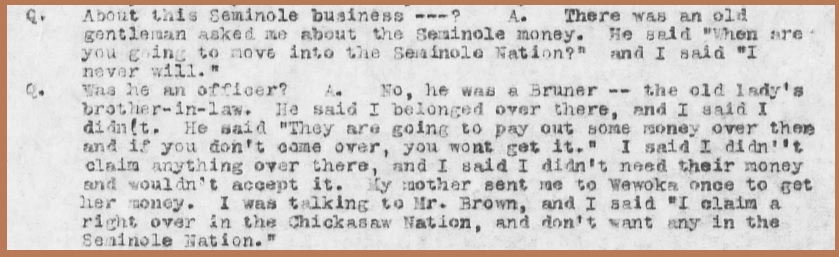
Then, the interview begin. Betsey Mahardy points out that she was actually Creek, and thus casting doubt into data that appears about her on the enrollment card. She states that some relatives of her were the ones who had enrolled her as a Seminole Freedman, but she clearly states "No sir, no Seminole Indian ever owned me."

She pointed out that her sister "Ben Bruner's wife" was the relative who enrolled her, but her identity was that as being Creek, and not Seminole. The interview also goes on to inquire about her marriage to Wyatt Mahardy as well as her first marriage that was performed by John Ishtone, a well known Seminole preacher.


It was revealed during the interview that Wyatt Mahardy was now deceased, and had passed only a few months before.

An interesting exchange occurred about whether Betsey was Creek or Seminole. She explained how at the time the war began, she was visiting her sister who was Seminole, then all of them had to leave and go south into Chickasaw country to avoid the war.

Questions about her son by her first marriage then arose, and she explained how she was married to a Seminole, which brought about the question:

 Q."What do you mean by saying you was a slave and married to this Indian? A. "Indians has slaves."
 Q. "You said you were married to Bruner who was an Indian?" A. "I married him."

She went on to later describe issues about payments and life in the Territory, including whether the children attended Indian school.


A very strong statement of support for Samuel Mahardy came from John Thomas a Chickasaw by blood. He confirmed much of what Betsey had said about their coming into Chickasaw country during the war. He also confirmed that Samuel had attended Chickasaw schools and had boarded with him, while going to that school. He confirmed that Mahardy was always viewed as being Chickasaw. He also confirmed that Wyatt Mahardy had received payments on behalf of the boy Samuel, while attending school, and he, John Thomas has witnessed Wyatt Mahardy receiving payments.


The interview with Samuel Mahardy himself is most revealing, and he tells a fascinating story about himself, his childhood and his identity as a Chickasaw. Having once been given land as a Seminole freedmen he returned the certificates awaiting correction or adjustment to his status as being Chickasaw.

He confirmed that his father collected Chickasaw money on his behalf, and pointed out how his father once purchased red boots for him and a fine saddle for his mother.

The most clear statement by Mahardy and how he identified himself  was when the questioning went back to his status as a Seminole. He interrupted the questioner and made a powerful statement:


The entire portion of his interview appears below.


Samuel explains the confusion of how he came to seen as Seminole and his objection from his early years and insisting on his strong identity as Chickasaw.


The young Mahardy recalled how Chickasaw officials came to their home and even spent the night there, took down the names of the family, and he would later learn that their names were stricken from the Chickasaw rolls. Clearly the young Samuel wished to be officially recognized by the tribe where he lived, was a part of his entire life, and was adamant about his being recognized by the officials as part of the community in which he had been a member his entire life.


There were more pages in the file, but the final decision was not made in Samuel Mahardy's favor. His name remained on the Seminole Rolls.

Many times, the issue of whether one is "Indian" or not arises. In this case, clearly Samuel Mahardy was Chickasaw. Not only by blood, but by culture and identity. Yet, he was treated differently because of the "Negro" blood from a grandfather. The current practice of the day to insure that a perceived "stain" from African blood would be his identity, thus enforcing a racially influenced policy of racial "superiority" and a racist "inferiority" to be place on having an African presence.

Betsey would remain on the Seminole lists also though she stated that she was Creek and not Seminole. The nations were clearly close to each other geographically, and contact among people was fluid. The Mahardy family is clearly a family with blended cultures, blood lines, and tribal histories. Theirs is one that reflects a true "melting pot" that was the life of families in Indian Territory, and it is one that can be studied from many perspectives. The Mahardy legacy is richly rooted in multiple tribes, and is one that exemplifies the complexity of life in a pre-statehood land that would eventually become the state of Oklahoma.
* * * * *     * * * * *     * * * * *
This is the 10th article in a series devoted to sharing histories and stories of families once held as slaves in Indian Territory, now known as Oklahoma. The focus of the series is on the Freedmen of the Five Civilized Tribes, and these posts are part of a project with a goal of documenting 52 families in 52 weeks.

Tuesday, July 26, 2016

How Many Oklahoma Freedmen Were There?


I have often wondered why there is not much in depth information about Oklahoma's amazing African American past. On many websites, one sees the African American history beginning with the attack upon Greenwood in Tulsa in 1921. However--black history did not begin with the attack in Tulsa. African American presence is well documented in the mid-1800s but still not spoken of widely. As early as the Indian Removal when Choctaws and Cherokees brought slaves with them, there was a black presence on the soil of what is now Oklahoma.

Someone asked me recently if the numbers of Freedmen were so small, if that would explain why there is so little information. I have become interested in the size of the population also, and recently ran into an article that appeared in the Indian Advocate in 1900 that addressed the size of the population, in Indian Territory.

 Included in the numbers were the numbers of Freedmen from the Five Civilized Tribes. The population of Freedmen included in the article represented 4 of the 5 tribes. (Seminoles were reported as one general population and did not break out the Freedmen in their count.) But of the total population was 314,000 from the tribes, and more than 17000 were classified as "Freedmen".


(Source: same as above.)


The total numbers of the Indian Tribal Freedmen was notable, numbering over 17,000.

The numbers are approximate, and were rounded off, but they are still statistically significant:

Cherokee Freedmen:   4000
Creek Freedmen:         5000
Choctaw Freedmen:    4150
Chickasaw Freedmen: 4500

TOTAL:                      17050

With over 17000 people there are many aspects of the people's lives that can be studied and examined by historians and scholars of many disciplines. There are several dozen black towns, hundreds of families, numerous schools, churches, cemeteries, newspapers, societies & associations that will reflect amazing histories still to be told of the Oklahoma Freedmen.

Hopefully more blogs, preservation and heritage associations, books and articles will be shared by those who are students of all of Oklahoma's history. Among the Freedmen were tribal leaders such as Stick Ross, George Vann, Henry Cutchlow, Sugar George, Harry Island, Cow Tom, Bettie Ligon, and so many more.

There are still stories to tell and I hope that more descendants of freedmen will tell their stories. Their legacy extends beyond the Dawes rolls, and their history predates even their freedom.

Let us all strive to tell all of Oklahoma's story!

Wednesday, March 9, 2016

African American Families from the Mississippi Choctaw Files

National Archives Publication M1186, Enrollment Cards
Mississippi Choctaw Rejected MCR 1112
Color Image Source: Ancestry.com. Oklahoma and Indian Territory, Dawes Census Cards for Five Civilized Tribes, 1898-1914 [database on-line]. Provo, UT, USA: Ancestry.com Operations Inc, 2014.

The rejected files of the Mississipi Choctaw (MCR files) reflect rich data for family history and those with ties to Mississippi, and who have heard that there are family ties to Choctaws, and to Choctaw communities, will find that this record set could yield some amazing data.

Do not be dismayed that this information comes from a record set marked "Rejected". There are many reasons why an ancestor's history could be found among these records. Some of the reasons are cultural, some political, some historical and some social. All of the reasons were used with the MCR files, and vary from one file to another. But it should be understood that these records were created by persons in the late 1800s, and early 1900s who stated that they had Choctaw family ties, and many of them provided remarkable family information. Regardless of the reason for the final outcome of the case the status of the family record among the MCR files should not prevent the family researcher from exploring the files.

In the case above, the application was for Frank Nicholas, and his children Rosaline and Frank Jr. They lived in Pass Christian, Mississippi.

The Dawes Commission interview went into great detail about the family background and sought to determine how the Choctaw blood was part of the family history.

National Archives Publication M1301 MCR 1112
Applications for Enrollment of the Commission to the
Five Civilized Tribes 1898-1914
Image Source: Fold3.com


In this case the detail extracted from the applicant went into detail about the source of the Choctaw ancestry. The applicant was examined as to whether claim was being made under Article 14 of the Treaty of Dancing Rabbit. This line of questioning was common among most cases in the MCR category. In this case the applicant repeated what had been told to him most of his life about his own ancestry.
Source: Same as above


Source: Same as above

The application jacket for this family was closely connected to additional files, it is imperative that all of the files are combined to glean thorough information about the family. From the same files for Frank Nicholas, references are made to additional family members who also submitted applications.

Source: Same as above

After analyzing the cases of the additional relatives it was decided that there was not sufficient evidence to prove the Choctaw connection, since there was no attempt in earlier  years to be enrolled as Choctaw citizens.

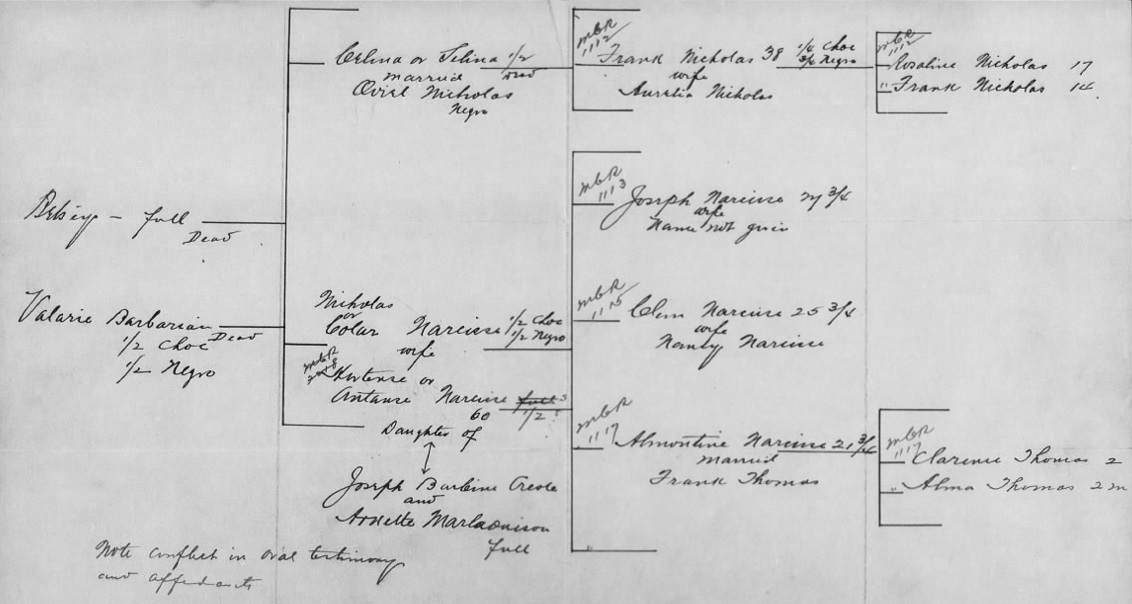
In spite of this decision--it is also clear that an unexpected gem awaits the researcher. In the course of the many interview questions, careful notes were taken on the case and this was one of the cases where a hand drawn, multiple generation pedigree chart was included. For any researcher this is a real treasure to find. Because of the complex questions asked, additional names of relatives and they were included in the Frank family file.
Multiple generation pedigree chart in file
Source: Same as above

It should also be pointed out that there are over 35 pages in the family file. These pages along with the files for the additional family members are extremely valuable in piecing together the family narrative.

Regarding the family tie to the Choctaws, there may have truly been one, with the evident mixed race ancestry of the family, but because the cultural ties had long been cut, this particular family was not officially identified by the Dawes commission, and was thus placed among the MCR files. Thankfully, the family data will still direct the researcher to the family members, and from that information, more of the family story can be told.

***** ***** *****
Additional Files Related to Frank Family


All files shown above are from National Archives Publication M1186 and all persons mentioned on the above enrollment cards have ties to the same family as Frank Nicholas. There are accompanying application jackets (M1301) and all will hold some unique facts that will be useful to the researcher.

It is strongly recommended that persons of Mississippi ancestral ties explore these records. The images of the enrollment cards reside on Fold3, as well as Ancestry, with the Ancestry images presented in color. (The application jackets NARA publication M1301, are only in black and white on each site.)

There are more than 7000 MCR files and a first examination of the MCR files indicate that over 2000 of them reflect African-American families stating family ties to Choctaws of Mississippi.

Monday, January 25, 2016

In Search of Diana Fletcher

Courtesy of University of Oklahoma, Western History Collection

We have all seen her image, a dark skinned woman in Kiowa attire. She is referred to as Diana Fletcher, and her image is found on many sites devoted to African-Native history. Her face has been seen on promotional posters, book covers, but the question remains: who was Diana Fletcher?

There is only one photographic image of her. The photo resides in the University of Oklahoma, Western History Collection, Photo lab. There is no biography of her, and no details about the origin of the photograph. However, many sites that celebrate African-Native history, culture and facts, use the photograph frequently.

However, the are several "biographies" about her, citing ancestral ties to Virginia, then Florida, then Seminole and lastly Kiowa. I have been curious about her history have wanted to know how much of her life could be documented. And the few articles that give her history---none of them contain any source citations.

Statements about her life are few and here are some of the statements that I often see about her:

1) Her father is said to have been born in Virginia and later a runaway slave.
2) He was said to have gone to Florida and married a Seminole woman.
3) Her mother was said to have died during the removal.
4) Diana was said to have attended Hampton Institute, Indian School
5) She was said to have been under pressure "from American society" to hide her Indian identity but she maintained her Black Indian identity.
6) She is said to have learned Indian crafts from a Kiowa stepmother.

There are many websites that promote her biography:

Sites that mention Diana Fletcher

ILoveAncestry.com provides a story of Diana Fletcher. On that site a small bio appears about Diana Fletcher, and the site makes a reference to statements that Diana was at one time a school teacher. She was said to have learned crafts from a Kiowa "step mother". She was said to have been separated from her father and that the Kiowa family adopted her. The site makes a reference to Carlisle Indian school, but does not provide definitive statement nor citation that Diana had studied there.

Women in History Ohio, provides a brief history with basically the same information. Dates of birth and death are unknown, as well place of death. However, note it is said that her mother died on the Trail of Tears, the removal to the west.

Alibi .com featured an article about an actual search to learn more about Diana. Yet, there was no success is locating anything about her either.

*Outlaw Women is a site that no longer exists but it was referenced in the article on Alibi. Apparently it was suggested that Diana attended Hampton, and resisted "pressures" to deny her Indian heritage, but she was able to maintain it. Again, no citation of sources was noted.

The fact is, most articles that feature her photo will then go into general history about the Five Civilized Tribes, and make broad statements about 19th century history. In spite of the fact that some sites make broad statements about education in Freedmen Schools, and suggest that she may have attended the Hampton Indian School, or Carlisle, and that she may have taught in Freedmen Schools of Indian Territory, there is no evidence to support these statements.

I have decided to look more closely at the data as presented. I have found some pieces of information that seem to be conflicting.

Conflicting information:
It is said that her mother died on the "Trail of Tears".  Yet it is also said that Diana was born in Indian Territory. If her mother died during the removal, then Diana's birth could not have occurred later in Indian Territory after Seminoles arrived. The site then goes on to say that she lived and was taught skills among the Kiowas, and it states that she she taught in "Black Indian schools" operated by the Five Civilized Tribes. It has to be understood that neighborhood schools in the Five Tribes were run by individual tribes, and many of these schools are fairly well documented.

Furthermore, It would be most irregular for a Kiowa woman to teach in a Freedman School, with little to no exposure to their culture, having been raised Kiowa. The Freedmen from the Five Tribes, lived within their own cultural context, and a Kiowa woman would have little cultural knowledge of the Five Tribes, in which the Indian Freedmen from the Territory lived.

To be specific, the Five Tribes from which the Freedmen come are Cherokee, Choctaw, Chickasaw Creek and Seminole nations. The Kiowas are not among the tribes known as the Five Civilized Tribes. How would a Kiowa woman become a teacher in the schools mentioned? And in which school specifically did she teach?

From the Choctaw, Creek and Cherokee schools that I have studied in depth, they were staffed with trustees from the local community and most teachers came from the states.

Researching the Facts:Diana's tribal affiliation was said to be Kiowa, though her father was Seminole. Nothing states how or why her father did not become a part of the the Bruner or Barkus bands, which are part of the 14 bands that comprise the Seminole Nation, to this day. And during the years of removal, there is no surname of Fletcher that appears among the John Brown, or Jim Lane bands of Africans who relocated with the Seminoles in 1838.

The Kiowas themselves, originally from western Montana were removed from Montana to Colorado, and eventually ended up in what is now southwestern Oklahoma, where Diana is said to have lived. They arrived in the Oklahoma Territory (not Indian Territory) after the Civil War in 1867. So, the Kiowas did not arrive in the Territory until almost 30 years after the Seminoles arrived in Indian Territory. And this was 30 years after Diana would have been born.

 And if her mother died during the removal, the Kiowas arrived in Indian Territory, 30 or so years after Diana was born, thus making her a young adult when they arrived. And if her father married a Kiowa woman, it would have taken place after Kiowas came to the Territory after the civil war.

The Basic  Questions: 
Question: What are the other names affiliated with her?  Answer: No other names.
Question: What was her father's name?  Answer: His name has never been known.
Question: How was it known that he was a runaway and that he lived with Seminoles? Answer: No evidence.
Question: How is it known that he remarried, and that Diana had a stepmother? Answer: No evidence.
Question: Who was her stepmother? Answer: Name never given.
Question: How was it known that her step mother taught her crafts? Answer: No evidence
Question: And what crafts specifically did she learn? Answer: No evidence
Question: Again---when did her father meet the Kiowa stepmother? Answer: Not known.

Problems With the Story of Diana

1) It is said that Diana's father escaped from Virginia to Florida, and joined maroons in Florida and became part of the community of Seminoles. There is no knowledge of Diana's father's name. If he was Seminole, he would be documented, because like the other Five Tribes--there are ample records. But--the name of the man said to be a runaway slave from Virginia, has never surfaced. PROBLEM: If we assume that the surname was Fltecher, note that there was no name of "Fletcher" on the name of the early bands of Black Seminoles that were removed. This would include the Jim Lane Band, the John Brown Band, and the Pompey Payne Band, These bands later merged and became the two Freedman band that still exist today--the Cesar Bruner Band, and the Dosar Barkus Band.

2) Her mother is said to have died on the Removal--the Trail of Tears. PROBLEM: Various sites state that Diana was born in Indian Territory. If her mother died during the removal, then Diana would not have been born after the Seminoles arrived in the west. In other words she could not have been born after her mother had already died.

3) Her father remarried a Kiowa woman and Diana was raised and taught crafts by her Kiowa step-mother. There is nothing wrong with her father having re-married. However, the timing is essential here. PROBLEM: The Seminoles arrived in Indian Territory in 1838,  The Kiowas did not arrive in Indian Territory until after the Civil War in 1867. Assuming that Diana was born between 1838 and 1840, and the Kiowas did not arrive in Indian Territory almost 20 years later, Diana would have been a fully grown woman by the time the Kiowa mother would have arrived in the Territory

4) Diana was said to have been educated at the Carlisle Indian school on one site and on another site she was said to have attended the Hampton Indian School. PROBLEM:
Both schools were established in the late 1870s, almost 40 years after Diana was born. The typical student at the Indian Schools were young children to adolescent in age, and they were not individuals in their 30s and 40s.

So, What do the records reflect?

*There was no Seminole with the surname of Fletcher on the Dawes Rolls, nor was there a Fletcher to be found on the Black Seminole bands that preceded today's Bruner band and Barkus bands. (There are numerous websites that reflect the names of the Black Seminole Bands)

*There is no teacher called Diana Fletcher reflected from faculty of any of the Freedmen Schools of the Five Tribes.


I have already written several articles of the Freedmen schools, on my blogs. In addition there are a few additional links that also describe the history of those schools.
-Choctaw Freedmen Schools
-Oak Hill Academy (for Choctaw Freedmen-Presbyterian run)
-Cherokee Colored High School (click for link to OHS article about the school.)
-Dawes Academy was in the Chickasaw nation, but not run by the tribe. (In fact the Chickasaw nation did not provide tribal supported schools for their former slaves and children.) This school was supported by Calvary Baptist Church an African American church in Berwyn Oklahoma.


Searching Official Records

In spite of statements that records are lost or don't exist--there are numerous records from the Kiowa nation that are quite abundant. The Oklahoma Historical Society, formed a partnership with Ancestry in 2014 to provide access to the records of multiple tribes that were microfilmed several decades ago. Now those images are available on Ancestry as well. Included among those records are several thousand pages of Records of the Kiowa Indians. I decided to search the records of the Kiowas for Diana Fletcher.


Screen shot of Search page of Oklahoma & Indian Territory Records
Source:Ancestry.com. Oklahoma and Indian Territory, Marriage, Citizenship and Census Records, 1841-1927 [database on-line].
Provo, UT, USA: Ancestry.com Operations, Inc., 2014.
Original data: Indian Marriage and Other Records, 1850–1920. Oklahoma Historical Society, Oklahoma City, Oklahoma.


Among the Oklahoma digitized Indian records there are literally thousands of pages reflecting data of Kiowa Indians to research. The following image reveals the size of the collection of Kiowa Indians.

The numbers in red were added to show the size of the databases that pertain to Kiowa Indians. After searching this Ancestry collection, no Diana Fletcher was found.


Some Thoughts about Diana Fletcher

There is a possibility that there may have definitely been someone called Diana Fletcher who lived among Kiowas. However, the story that has evolved about her over the years could be a combination of real fact, mixed with conjecture. If the story about her mother is correct, then she may have been orphaned and raised by a step mother, but not a Kiowa woman. And this would have occurred before the Kiowas arrived in the Territory, therefore making the story of the step-mother quite unlikely.

It is possible that a woman called Diana could have chosen on her own to spend time with people who were Kiowa. However, it is possible that her exposure may have come during her adult years, and not childhood years from a Kiowa "stepmother".

There is the possibility that a woman called Diana Fletcher had some contact with an Indian School in Oklahoma Territory, instead of Indian Territory. This is possible, but evidence is yet to be found.

There is the possibility that a woman called Diana Fletcher was "adopted" into the Kiowas, and welcomed into the community. But this may have occurred when she was much older, and not during years when she was a child, decades before the Kiowas were relocated to the Territory.

Unfortunately, so far, there are no documented facts about the beautiful woman in the photo. There is great temptation to invent her story, but some of the stories so far conflict with history and historical timelines. There is possibly the  "hope" that her story would ring true, was simply that--a hope for a romantic story to tell about the mysterious woman in the photo.  

But as much as we may want to believe in the romance of being taken in, and cared for, and taught the traditions of an indigenous people, we cannot make it so.

Placing her in schools when she was already an adult, make the story of Diana a fragile story.
Putting her birth sometime after the death of her mother, also weaken the story of Diana.
And creating a relationship with all others whose names remain unknown, make her story more fictitious than fact.

What we do have however, is the evidence of the photo itself--a beautiful woman called Diana in native dress. She may have been an "adopted" person but my guess is that her "adoption" was later in life and not as a child.

Unfortunately, to "invent" her story with facts that can easily be chipped away, is simply not necessary.

Her photo alone speaks to a woman proudly standing, with confidence as she faced the camera.
Her photo speaks to her presence, and reflect her confidence and dignity, but the other statements about her presented as fact, make her story simply --- a story.

Diana's story should not be created or invented by those wishing for a nice love story. Her story should not be laced with circumstances about her that have yet to be proven.

 Whoever Diana was, simply her presence can be presented simply as we see her. A beautiful woman whose name can be called.