Thursday, July 15, 2010

Old Newspapers Tell The Stories


Researching ancestors and their stories requires utilizing resources that come from the region where our ancestors lived. In other words----study the community.

Having ancestors who were slaves in Indian Territory has its challenges, since few books and texts even reflect the fact that black chattel slavery took place in Indian country.  Furthermore, can details be learned about the lives of the ancestors who were enslaved prior to the removal of the Five Tribes to the west?  

What were their lives like?  
Were they treated the same way other slaves in the deep south were treated?  
Did they flee from bondage?
Were they often sold from each other?  
Were there such things as slave auction blocks in Indian communities before removal?

And what about the slaves themselves? Did they practice the traditions of their slave holders? Did they speak the language and practice their customs?

Some of these answers might never be known---however, there are a few glimpses into the lives and the fate of those enslaved, that can be found in early newspapers.

In Georgia, the Cherokee Phoenix was the first American Indian newspaper, and it was published in the years prior to the removal of Cherokees to the west.  A few of those issues can be found, online, and I located several issues on the University of Georgia website, particularly for the years 1828-1833.

Glancing through each issue of the newspaper, one can learn a lot about the many issues facing the Cherokee citizens at that time.  While I was looking at the images I began to notice that a series of small announcements of local interest, on the pages of the Phoenix, that described estate sells, marriages, deaths and other announcements. It was in that section that I saw them. They were small announcements, but they were there, nevertheless -- notices pertaining to Africans within the Cherokee communities.

Some of the answers to the questions that I had, were found in those small announcements.
The one that was the most sobering----stood out:


Announcement for the sale of slaves of Thomas B. Adair


There they were, listed just above bushels of corn, and horses and cattle. The estate was being sold---and among the "items"---were three people, Joe, his wife Nelly and their child.  


More questions arose for me--with no answers to be found.  

Were they sold together as a family?  
Were they separated from each other?  
Did Nelly lose her child to a high bidder?  

One can only hope that they may have been fortunate to remain together as they had no choice in their fate.

Did some of those enslaved men and women ever resist enslavement by fleeing on their own? Or-- were there any abolitionists to assist them?  

Again, I found some answers by looking at other issues of the same publication.

In January 1832 an announcement appeared pertaining to a woman called Lucy.


Ad for runaway slave Lucy

It is noted that Lucy was raised in the Cherokee Nation, and she was spoke Cherokee better than she spoke English--which was described as being broken English

Some slaves were seized by others.  But---it is not clear if they were being assisted by abolitionists or by others seeking to take them into bondage elsewhere.


Jack, a slave was said to have been seized by Jesse Anderson  

Were Jesse Anderson's aliases part of a network to assist slaves fleeing from bondage?   Or was Jesse Anderson a slave trader?


Ad for the recapture of the slave Eliza and Michael Doudy, said to have assisted her escape.


Was Michael Doudy, who assisted Eliza, working with a network and if so, could that network have been possibly a southern branch of the Underground Railroad?  She too, was fluent in Cherokee. It is suggested however, that there was some willingness on her part in her leaving her master.

I noticed that some did runaway with a companion:

Ad for 2 runaway slaves in Cherokee Phoenix


Although the specific answers to my questions remain unclear--what can be learned in general about slaves in Indian communities before the Removal?

It is clear, that like all people---those enslaved, longed to be free. It is also evident that they resisted. 

Although these persons cited above are not people in my own family I still learned a great deal from reading these small announcements about slaves in Indian communities in the early 1830s.  Even though there were many who would never escape and never live to see freedom, one can definitely determine, that those who did not run away---still felt the same drive, the same passion for freedom, athough the opportunity was not there for them to leave. 

And some, it is known---would also feel the pain and sorrow, if any of these runaways been caught---for their punishment would probably be metered out in view of the other slaves. 

Most punishments for runaways consisted of public whippings and rubbing salt into lacerated skin. Few men or women survived such punishments. Those who remained behind would have the emotional scars of seeing these punishments, to captured runaways.  Reading these ads one can only hope that some were successful in their quest for freedom.

So through the newspapers that came from the regions where our ancestors lived---we can read and learn about the political and social climate that surrounded them.

As we seek to reconstruct the stories of what happened to the ancestors, some small glimpses of their lives can be found in the old newspapers such as the Cherokee Phoenix.  

We know, as genealogists to study the community, and I am humbled by the strength shown by my ancestors who survived the horrors of slavery, who who had endured so much.  

To them I owe great respect. 

In their honor, I shall continue to seek and to tell their stories 

Friday, July 9, 2010

Photo of Two Original Dawes Enrollees Found in Arizona

Thomas Stevenson with son Houston and Grandsons, Jessie & Sylvester
( The elder gentleman Thomas (2nd from Left and son Houston 2nd from Right are both
Chickasaw Freedmen Dawes Enrollees)

One of the lessons I have learned over the years is the value of interacting and sharing what you do with other researchers.  An example of this came from a conversation in one of the daily chats on AfriGeneas during the Lunch Bunch daily chat.  While sharing with each other, a fellow researcher who lives in Phoenix Arizona,  was aware that Oklahoma is one of my states. In that chat, she mentioned that she knew some people from Oklahoma and knew one man, now deceased who was a Stevenson. I remarked that I know that the Stevenson line was a very large family clan among Chickasaw Freedmen.  The man whom she knew was Leonard Stevenson who was deceased.  However,  she knew a member of the family who lived nearby.  As our online conversation continued she decided to phone her friend, and to ask a few questions.  The Stevenson family member said that there were a few old photos that she could look at if she wished. 

Well------that is all I needed to know----I urged my friend to please take advantage of the generous offer to look at whatever photo that she had to share.  She promised to do so, when she returned from an upcoming trip.  (Well---patience is important for those of us who pursue family history.)  However, I was able to convince her to take a look at the photos as soon as possible, since her friend was generously offering to allow her to see them.  

Last night---I received a phone call from my Phoenix friend, (Vicky Daviss-Mitchell)  This is the same Vicky who runs Mariah's Zepher blog. She called to let me know that she had sent me some email.  I was anxious to see what she had sent (hoping that a photo was in that email.)  Well----to my delight---a wonderful photograph of 4 handsome men---two of whom were original Dawes Enrollees--Thomas and Houston Stevenson.  The photo was a 3 generation image of this particular Stevenson family, and it was a wonderful image!!

Of course----I had to explore their history.  

This particular Stevenson line lived in Katie, I.T. in Pickens County. The old man in the photo above was Thomas Stevenson. At the time he enrolled, he was a young man 26 years old.


Thomas Stevenson was a young man, with a wife Alice and several children.  The youngest child in the household at that time, was Houston Stevenson, who was an infant of 3 months at the time the family applied for enrollment.

Thomas Stevenson's father was Dud Stevenson who was deceased at that time, but his mother Georgia Ann Stevenson was still living.


I decided to pull the Dawes packet and noticed that like many Chickasaw Freedmen---their interviews had been cut from their packet and replaced with summaries.  This practice was later noticed and addressed when it appeared that some on the Dawes Commission had been purging pertinent data on Freedmen and replacing them with summaries instead of the actual testimony. Such a "summary" was in the file of Thomas Stevenson.


However, the good news is that on this summarized interview---was a reference to the fact that Thomas's mother---Georgia Ann----there was an interview for her on another file---the previous file--Chickasas Freedman Card 422.

I decided to look at the records pertaining to Thomas's mother Georgia Ann Stevenson.

On her enrollment card I learned that she had been born a slave of Chickasaw Indians.By examining the card of his mother Georgia Ann, additional information was learned about the family of Thomas Stevenson, including the names of his siblings: Benjamin, Robin, Levy, Carrie (who married a Butler), Malsy, & Ida.  Thomas's sister Carrie married Charley Butler who was a Choctaw Freedman.

Front side of Enrollment card for Georgia Ann Stevenson, mother of Thomas Stevenson

It was noted that Georgia Ann, was at one time a slave of Chickasaw David Burney.   One the reverse side of  the card, her parents were listed:

Reverse side of enrollment card for Georgia Ann Stevenson, Chickasaw Freedwoman

Her parents were Ceasar and Leah James, both of whom were slaves of Chickasaws. Her father was enslaved by Holmes McLaughlin, and her mother was enslaved by Chickasaw David Burney.

Since Thomas's file mentioned the mother's testimony, I decided to examine her Dawes application packet.
She too had one of the summarized interviews, but a bit more information was provided there.


In her interview, she mentioned that Thomas's wife Alice was a daughter of Viney Stevenson, another former Chickasaw slave. She also provided the names of her own children, including some that had married.  These other children are actually the siblings of Thomas pictured in the photo above.

From the one photo and learning their names, I was able to obtain some interesting information on this branch of the Stevenson line.

Plus photos of two original Dawes enrollees--Thomas and his son Houston, are among the faces seldom seen when Freedmen are spoke of.

Close up of Thomas and son Houston Stevenson,Chickasaw Freedmen

Though the interview was summarized the packet there is a gem in the packet! In addition, to the info from the cards, in the packet of Thomas and Alice Stevenson, was a rare birth affidavit!  Note that Oklahoma did not become a state until 1907.  Thomas was born in 1901. So this is one of those precious birth certificates found in a Dawes application packet, that predated statehood. Not only is the infant child Houston presented on this certificate---but the attending midwife's name was included.  In this case, Georgia Ann, Thomas's mother was the midwife and listed as such.


A quick glance at Carrie's husband's file, from the Choctaw Nation, he was connected the Butlers to the powerful Pitchlynn family in the Choctaw Nation. Charley Butler's father Dove Butler was a slave of Thomas Pitchlynn, as were both of his parents.


The lesson here is two-fold----always tell others what interests you. 

In this case, mentioning Oklahoma as an area of research, and mentioning the Stevenson surname, led to the wonderful photo above, and the interesting history of this branch of a very large clan of Stevensons from Oklahoma to Arizona.  

The second lesson is to exhibit some curiosity about those who come from the area where you family lived.  I am not related to the Stevensons, but knowing that they were such a large family among Chickasaw Freedmen, interests me, and exploring this small piece of their history was a delightful experience

Thank you Vicky Daviss Mitchell for going to look at the  photo and a special thank you to your friend for sharing the image!

Saturday, July 3, 2010

Earliest List of Slaves from Indian Territory Found in Rare Letter


Heading of letter written to the Ft. Smith, Arkansas Freedman's Bureau October 1865


Intro to Letter of October 1865, seeking help for loved ones still held in bondage in Indian Territory

In October 1865 a group of black men--once held in bondage in Indian Territory--wrote a series of letters to the Freedman's Bureau asking for help.  Their families were still being held in bondage by Indian slave holders, many months after the war had ended. The letters were sent to the Freedman's Bureau in Ft. Smith Arkansas, and they were seeking assistance in the release of their loved ones from the painful yoke of slavery.

These letters are poignant and sobering.  Any individual who appreciates the spirit of Freedom, will find these letters touching, sobering and a reminder that slavery---no matter where---was a horrific condition to impose upon others.

Following a tip shared by a colleague to look at Freedman's Bureau letters, I sought a reference to a letter from former slaves from Indian Territory.

One letter in particular stood out---it was written by former slaves of the Five Slave Holding Tribes in Indian Territory.   The men writing the letter spelled out in detail what was happening to their families still not freed--and this was in October of 1865 six months after the war had ended. Following their request for help was a list of names----the names of their particular loved ones.

Few lists of names of people exist that mention slaves by names WHILE they were held in bondage.  What followed the letters indeed was a list of the families of these particular men. This is quite possibly the very first list of names of enslaved people from Indian Territory---prior to their release from bondage.

(It should be mentioned here, that the Treaty of 1866 eventually abolished black chattel slavery in Indian Territory.)  

Therefore, considering that slavery was not yet abolished---this could possibly be the very first list of slaves by name to come from the Territory and considering that slavery had ended in the United States by this time---this letter is even more significant.

One page of the letter states:

"But to our sad disappointment, the war is now apparently ceased and a general peace among the white and red man is agreed upon, and generally adhered to, by those two races, and yet our dear ones are still held and tyrannized ever in a most cruel manner, by their former masters. Since the right of property in our race has been abolished by the US Government the masters have become brutal in their treatment of our color......."


The letters are heartfelt and reflect strong feelings for their loved ones still held in bondage.  Though the signers speak mostly of Choctaw and Chickasaw nations, but one of the names of the signers (Bushyhead) reflects some Cherokee heritage as well.  Several of these men had served in the Union Army, including the Indian Home Guards and the US Colored Troops.

Signers of the letter

The signers were: Buck Bushyhead, Watson Brown, Grundy Thompson, Wilson Thompson, Isaac Kemp, Andrew Chief Watkins, Ben Colbert, Randolph Gardner, Jerry Kemp, Henry Kemp, John Fisher


Remarkably the names of the families were also included in their appeal, and so this small collection of names represents possibly the very first list of names of enslaved families, still held in bondage in 1865.  Though small, this may also possibly be t:he earliest list that could be described as a  small "census" of black families from Indian Territory.

I have decided to share these names here:

Exhibit A
A List of Freedmen from Choctaw&Chickasaw Nations (October 1865)

Family of Buck Bushyhead (US Soldier) Nancy & Lucyann & Josephine & Margaret & Narciss Bushyhead.
Family of Charles Perry (A Discharged Soldier)  Agga & Simon & George & Sanders Perry
Family of Andrew Chief Watkins 3 sons James, Jacob & Charles Watkins.


Family of Watson Brown (Interpreter) Wife Harriet Brown, Child Minny(?) Brown
Family of Daniel Loman, (Farmer) Wife Sophia, 1 child Robert Loman. Also sister and four children:
 Sister's name Nancy Harrison children's names: Isaiah & Sary & Lisa & Buck
Family of Ben Colbert  Has mother and two brothers.  Mother's name Rachel Colbert. Bros names July & Mobeal Colbert. One sister Nancy Colbert.


Family of Grundy Thompson (Blacksmith)  Wife Rachael Thompson
Family of Hanson Thompson (Blacksmith) Five Children Mahaly, Henry, Angeline, James and Rachel.
Family of Willson Thompson (Farmer) Wife Elizabeth, one child (Infant) Mother Jane Thompson and two brothers William and Pompey Thompson


Family of Randolph Gardner (Boarding House Keeper)  Mother, 3 nieces 1 nephew. Mother's name Tennessee Gardner, Nieces names Laury, Missa & Jane Gardner. Nephew's name John Gardner
Family of Isaac Kemp Wife and one child. Wife's Name Susan Child's name Elizabeth. Also Mother Frances Kemp and her children 4 in number: Frances, Mary, Charles & Elijah
Family of Jerry Kemp, (Blacksmith)  Wife and 4 children. Wife's name Frances Kemp.  Children's names: Francis, Mary, Charles and Elijah


Family of Henry Kemp Wife and 3 children.  Wife's name Caledonia. Children's names Leroy & Leander & Infant.
Family of William Fisher  Wife Ellen and child names Alexander. One sister named Emily Fisher. Two nieces named Isabella & Prly(?) Fisher. Also Father and Mother names John & Nancy Kemp and their children Moses, Dickson Betty Adeline,  (?) and Francis Kemp. And a sister and her child Frances Kemp, and her children Mariah and Iverson and Ben (?) and Thomas and Johnny Kemp and infant.

It is not known when these families eventually got to breathe their first breath of freedom, but many of these persons remained in Indian Territory---which was their home, and 30 years later, many of them and their children were later enrolled by the Dawes Commission and received land allotments.

Buried in the hundreds of letters sent to the Freedman's Bureau was this wonderful piece of  history from Indian Territory and I was blessed with the opportunity to find their names and to share them here.


Tuesday, June 29, 2010

High School Life in Oklahoma Black Communities

 
Pages from Souvenir Booklet from combined 
school event from participating black high schools in
1950, Muskogee County, Oklahoma

When we speak to our elders, asking them about details from their own life and their youth can sometimes bring out wonderful artifacts from their lives.  These artifacts are more than just mere souvenirs, for they are reflections of the times.

I had a chance to look at such artifacts from a cousin who lived in Muskogee Oklahoma when a young girl, and she shared a booklet from her youth.  Though a this might appear to be a mere senior prom book---it told a greater story.

It must be pointed out that Indian Territory, now Oklahoma is seldom mentioned as part of the south, but southern it was. In the early days of Indian Territory there was slavery, slave rebellions, the Civil War, Reconstruction, and then legalized segregation. Freedmen struggles, and the struggles of blacks who fled the deep south----all led to circumstances that made the lives of our ancestors in the Territory and later in the new state of Oklahoma very challenging.

But this was also felt among those of the next generation, who became our parents,  Although the 20th century for many brought a degree of stability,  hundreds of black families at the very least, saw a system that would provide mandatory education for their children, though segregated. Thus, children of  Indian Freedmen from the Slave holding tribes as well as "state Negroes" both became victims of a well entrenched system of exclusion that would last for 6 decades. But----they coped within the system.

Their schools did not have much funding individually to hold their own events such as proms. And many had senior classes that were extremely small---in some cases less than 10 graduating students. So---to provide some social outlets for the students, the segregated schools decided to hold a combined senior prom, incorporating the black schools in the area.  Most were from Creek communities, including towns such as Tullahassee, Rentiesville and Summit.

From my recent visit to Reno Nevada, and spending time with my father's first cousin who attended such a segregated school in Oklahoma-- she brought out some wonderful old photos and souvenirs from her high school days in Muskogee Oklahoma. She graduated from the well known all black high school in Muskogee, Muskogee Manual and Training School.   One of her mementoes was a souvenir book from her Senior Prom in 1950.
Cover of Souvenir Booklet from Senior Prom 1950


The prom was a collaborative effort between the black high schools in the nearby black towns and settlements, and all celebrated together.  The booklet reflected the communities where mostly Creek Freedmen resided, and the names of the seniors from each participating school was listed. They were listed as "Special Guests."

Though the booklet could simply be described as a souvenir from an event in the life of a teenage girl, it is more than that.  The families living in a segregated south, did carve out meaningful lives for themselves. They thrived and shared events and they too, holding on to precious memories of the days of their youth.

The booklet reflects the fact that even where some of the graduating classes were notably small, such as Ft. Gibson, they were segregated and would not be merged into the larger school systems till the late 1960s, when integration came. So their schools, though separate and not equal to the schools of their neighbors--persevered, by merging events and social activities and they interacted within a larger community where residents of the small black settlements cooperated to provide a social network for their children.


Many of these students attending this senior prom in 1950 are now in their 70s, and thankfully time has changed somewhat---even in Oklahoma.  Though struggles still continue especially for those seeking more information on their history in the historical black communities---it is through the artifacts of our families that we can obtain interesting glimpses into the past.


The greater lesson is for us to inspect the items from the past and to place them in the historical context from which they came. 

These schools no longer exist and the children and grandchildren of these students now attend integrated schools, with exposure to the same curriculum, textbooks and opportunities.  We must also appreciated how our parents and grandparents coped within a world that put so many obstacles in their paths for success. Our own appreciation for their accomplishments should therefore enlighten us and inspire us all to tell their stories.

Thursday, June 10, 2010

Let My People Go! An Appeal to the Ft. Smith Freedman's Bureau Field Office

Old Commissary Bldg.
Ft. Smith Arkansas Field Office Freedman's Bureau
(Library of Congress)

A good friend and colleague of mine from Hampton Virginia, was going through a publication that she had pertaining to records of the Freedman's Bureau.  Known officially as the Bureau of Refugees Freedmen & Abandoned Lands, this bureau worked as an agency providing services to newly freed slaves. Selma Stewart, Hampton AAHGS president shared with me a series of documents that she saw indexed, and that they contained references to Indian Territory Freedmen.  She thought that I would be interested.  Indeed, she was right. 

Some background----

The Freedman's Bureau had a field office in Ft. Smith Arkansas. Among the many tasks at the Ft. Smith Freedman's Bureau office, was also to serve as an office that assisted with the needs of Freedmen from Indian Territory. These were those enslaved by the Indian tribes that had held families of African descent in bondage. 

Freedom had already come to Ft. Smith by late 1863, when a combination of abolitionist activities, and the occupation of the Ft. Smith fort by Union soldiers, occurred, and many once enslaved black people inhaled their first breath of Freedom. In nearby Indian Territory--in both the Cherokee and Choctaw Nations, many men got the word that if they could make their way to either Ft. Gibson, or Ft. Smith---they too, would be free.  Some took their chance and escaped, mostly in the dead of night. They would eventually find their way to the Federal line---and if able bodied, they enlisted. 

After the war, many wished to return to Indian Country---but several indicated that they had been prevented from returning----as slavery had not yet ended. 

They had but once choice---to appeal to the US Government for assistance to set their people free.  These letters were retained by the Ft. Smith Field Office, and they provide a glimpse into the days after the war, when in late 1865 and 1866--some of these individuals wanted to be reuninted with their loved ones.

They wrote for assistance under the leadership of Daniel Loman, a Choctaw Freedman. They also compiled a list of names of some of the families still being held in bondage.  

The letter pertaining to their suffering right after the war, depicted a time in which though the war had ended, the plight of slaves held in bondage in Indian Territory--was a dangerous one.

Daniel Looman was a leader among a group of other men, who wrote to the Bureau asking for assistance.  He was among a group of men who had escaped from bondage, who still have loved ones remaining in bondage towards the end of 1865.  They wanted to be reunited with their loved ones, and they were in fear of losing their lives.


Letter sent to Freedman's Bureau

Thanks to Selma Stewart a devoted Virginia genealogist, these documents were brought to my attention.  Filed among a series of over 70 reels of microfilm---these precious pages reflecting the letters and some of the names are a wonderful find. They tell another part of this long over looked history.  I present a one of those pages here. 


A Partial List of Freedmen still held in bondage
included in appeal to the Freedman's Bureau in Ft. Smith, Arkansas


Once received, this letter was directed to the national headquarters of the Freedman's Bureau in Washington DC.


Cover Letter sent to Washington DC seeking
relief for families still held in bondage, October 1865

Let us hope that the wait to be reunited with their families was not too long. 

The Treaty of 1866 eventually abolished slavery in the Indian Tribes, and although many today, would like to see this never mentioned again, thankfully, some of  the stories of these forgotten people have been found, and can be told.

Friday, June 4, 2010

When Freedom Came...to Indian Country

Lucinda Davis - Former Slave in Creek Nation
Photo  Courtesy Oklahoma Historical Society

* * * * * * * * * *

"...But one day old Master stay after he eat breakfast and when us negroes come in to eat he say" After today I ain't your master any more. You all as free as I am." We just stand and look and don't know what to say about it. ......." Phyliss Pettit, Cherokee Freedwoman

* * * * * * * * * *

Every family that descends from enslaved people, has a story---a story that is probably lost.  This is the story of how they learned that bondage was over. This is the story of what happened to them, when freedom came.

For some word came to them as they worked the fields. We all know that when Gen. Granger sailed into Galvestor Harbor, in 1865,he told the enslaved that they were forever free, and the celebrations were immediate! But for others, Freedom was not immediate and it was not easy. 

In Indian Territory many slaves had been taken south into Texas to hide from Federal soldiers, and to prevent the slaves from running to Freedom. And it is clear by reading some of the narratives of the former slaves that Freedom came differently. 

No celebrations, took place---some were told directly and others heard from soldiers that they were Free, and some stole their own freedom fleeing in the dead of night--risking their own lives just to breathe one sweet breath free from bondage.

Thankfully, the Oklahoma slave narratives are poignant reminders that bondage---no matter who the enslaver was--was bondage.  They yearned to breathe free air, and like their brethren in the United States, the enslaved men, and women in Indian Territory yearned for the same thing. Some escaped and seized their own freedom. Others sampled the first taste of Freedom when Union soldiers came through, raiding communities, and so many of the men, once given the chance--joined the United States Colored Troops, serving in the Union Army.

I share these few brief snippets of statements from the WPA Slave Narratives from Oklahoma, as samples of freedom stories of the Indian Freedmen, who recalled how they learned that they were, at last free people.


MARY GRAYSON-CREEK SLAVE
Slaveholder: Mose Perryman

...Then, early one morning, about daylight, old Mr. Mose came down to them cabin in his buggy, waving a shot gun and hollering at the top of his voice. I never saw a man so mad in all my life, before nor since! He yelled in at mammy to "git them children together and git up to my house before I beat you and all of them to death." Mammy began to cry and plead that she didn't know anything, but he acted like he was going to shoot sure enough, so we all ran to mammy and started for Mr. Mose's house as fast as we could trot.


We had to pass all the other Negro cabins on the way, and we could see that they were all empty, and it looked like everything in them had been tore up. Straw and corn shucks all over the place, where somebody had tore up the mattresses, and all the pans and kettles gone off the outside walls where they used to hang them.


At one place we saw two Negro boys loading some iron kettles on a wagon, and a little further on was some boys catching chickens in a yard, but we could see all the Negroes had left in a big hurry. I asked mammy where everybody had gone and she said, "Up to Mr. Mose's house, where we are going. He's calling us all in."

"Will pappy be up there too?" I asked her.
"No. Your pappy and your Uncle Hector and your Uncle William and a lot of other menfolks won't be here any more. They went away. That's why Mr. Mose is so mad, so if any of you younguns say anything about any strange men coming to our place I'll break your necks!"  

Mammy was sure scared!  We all thought sure she was going to get a big whipping, but Mr. Mose just looked at her minute and then told her to get back to the cabin and bring all the clothes, and bed ticks and all kinds of cloth we had and come back ready to travel.


"We're goin to take all you black devils to a place where there won't no more of you run away!" he yelled after us.

So we got ready to leave as quick as we could. I kept crying about my pappy but mammy would say, "Don't you worry about your pappy, he's free now. Better be worrying about us. No telling where we all will end up!"

Mr. Mose found a place for us to stop close to Fort Washita, and got us places to stay and work. I don't know which direction we were from Fort Washita, but I know we were not very far. I don't know how many years we were down in there, but I know it was over two for we worked on crops at two different places, I remember. 

Then--one day Mr. Mose came and told us that the War was over and that we would have to root for ourselves after that. Then he just rode away and I never saw him after that until after we had got back up into the Choska country. Mammy heard that the Negroes were going to get equal right with the Creeks and that she should go to the Creek Agency to draw for us, so we set out to try to get back. ..........
* * * * *
MARY LINDSAY - CHICKASAW SLAVE
Slaveholder: Sobe Love
We git along the best we can for a whole winter, but we nearly starve to death, and then the next sprig when we getting a little patch planted Mistress go into Bonham and come back and say we all free and the War over.


She say "You and Vici jest as free as I am, and alot freer I reckon, and they say I got to pay you if your work for me, but I ain't got no money to pay you. If you stay on with me and help me I will feed and home you and I can weave you some good dresses if you card and spin the cotton and wool."

Well I stayed on, cause I didn't have no place to go, and I carded and spinned the cotton and wool, and she make me just one dress. Vici didn't do nothing but jest wait on the children and Mistress.


Mistress go off again about a week, and when she come back I see she got some money but she din't give us any of it. After a while I asked her ain't she got some money for me, and she say no, ain't she giving me a good home? Den I starts to feeling like I ain't treated right. ...........So one night I jest put the new dress in a bundle and set foot right down the big road a-walking west, and don't say nothing to nobody ! It's ten miles into Bonham, and I gits in town about daylight. I keeps on being afraid, cause I can't git it outn my mind I still belong to Mistress.


Purty soon some negroes tell me a negro name Bruner Love living down west of Greenville, and I know that's my brother Franklin, cause we all call him Bruner. I don't remember how all I gits down to Greenville, I know I walks most the way, and I finds Bruner. Him and his wife working on a farm, and he say my sister Hetty and my sister Rena what was little is living with my mammy way back up on the Red River. My pappy done died in time of the War and I didn't know it. ........
* * * * *

PATSY PERRYMAN - CHEROKEE SLAVE
Slaveholder: Judy Taylor
Then mistress took her slaves and went somewhere in Texas until after the war. She started back to the old home place, but wasn't going to take us with her until mammy cried so hard she coulnd't stand it and told us to get ready. We drove through in an ox wagon and sometimes had to wait along the way because the streams were flooded and we couldn't ford.

We found the old house burned to the ground when we got back and the whole place was a ruin. There was no stock and no way for any of us to live. The mistress told us that we were free anyway and to go wherever we wanted to.

We went to Fort Gibson and then to Tahlequah; mammy earning our way cooking at both places. Victoria was hired out to Judge Wolfe and that's where she was when father had her stolen. We was all worried about her for a time, until we found out she was with him.

* * * * *
MATILDA POE, - CHICKASAW SLAVE
Slaveholder: Isaac Love

When de War was over, and ol Mster told us we was free, Mammy she say, "Well I'm heading for Texas." I went out and old Master ask me to bring him a coal of fire to light his pipe. I went after it and mammy left pretty soon. My pappy wouldn't leave old Master right then but old Master told us we was free to go where we pleased, so me an pappy left and went to Texas where my mammy was. We never saw old Master anymore. We stayed a while in Texas and then come back to de Indian Territory.
* * * * *
LUCINDA DAVIS - CREEK SLAVE

Slaveholder: Tuskaya-Hiniha

I don't know when de War quit off. and when I git free, but I stayed wid old man Tuskaya-hiniha long time after I was free, I reckon. I was jest a little girl, and he didn't know whar' to send me to, anyways. One day three men ride up and talk to de old man awhile in English talk. Den he called me and tell me to go wid dem to find my own family. He jest laugh and slap my behind and set me up on de hoss in front of one de men and dey take me off and leave my good checkedy dress at de house!
* * * * *

CHANEY RICHARDSON - CHEROKEE SLAVE
Slaveholder: Charley Rogers

.....All the slaves was piled intogether and some of the grown ones walking, and they took us way down across the big river and kept us in the bottoms a long time until the War was over.....We lived in a kind of a camp, but i was too little to know where they got the grub to feed us with. Most all the Negro men was off somewhere in the War.......  Then one day they had to bust up the camp and some Federal soldiers go with us and we all start back home. We git to a place where all the houses is burned down and I ask what is that place. Miss Hannah say, "Skullyville, child. That's where they had part of the War."

All the slaves was set out when we git to Fort Gibson, and the soldiers say we all free now. They give us grub and clothes to the Negroes at that place. It wasn't no town but a fort place and a patch of big trees.
* * * * *

BETTY ROBERTSON - CHEROKEE SLAVE
Slaveholder: Chief Joseph (Rich Joe) Vann

When the War come they have a big battle away west of us, but I never see any battles. Lots of soldiers around all the time though.


One day young Master come to the cabins and say we all free and can' stay there lessn we want to go on working for him just like we'd been for our feed, an clothes. Mammy got a wagon and we traveled around a few days to go to Fort Gibson. When we git to Fort Gibson they was a lot of negroes there, and they had a camp meeting and I was baptized. It was in the Grand River close to the ford, and winter time. Snow on the ground and the water was muddy and all full of pieces of ice. The place was all woods, and the Cherokees and the soldiers all come down to see the baptizing. .........

NELLIE JOHNSON - CREEK SLAVE
Slave holder: Chief Rolly McIntosh
One day my pappy come home and tell us all that the Creek done sign up to quit the War, and that old Master send word that we all free now and can take up some land for our own selves or just stay where we is if we want to. Pappy stayed on that place where he was at until he died.
* * * * *

As we seek the stories of our ancestors---whether in Indian Territory or in nearby states---we must learn how slaves were freed.  And we must learn about the impact of this newly freed population was felt in the community where they lived.  They had toiled for decades without pay. Suddenly they were free. Some continued to live in bondage until others came to release them with the word of freedom.  Others remained in a hostile land where their freedom was tolerated but resented.

Most of us will never learn how our ancestors coped in those first days when freedom came.  However by reading the stories of those who lived nearby---whose stories were recorded---we can learn about the climate of the day, the sentiments of the day, and we learn about the community where our ancestors lived. 
They encountered the same obstacles, and though their freedom stories might not remain, we can still get a glimpse into the world where they lived which will assist us in telling the family story, much better.

At least we can rejoice as we wonder how they coped, when freedom came.

When Freedom Came

When freedom came some wept for joy
and others fled at night.

When freedom came--no more free toil
nor auctions bringing fright.

When freedom came some found their way
to Gibson all alone.

When freedom came some would stay
not hearing freedom's song.

When freedom came, at long last
free air they heaved their sigh.

When freedom came---for some not fast
No more their dreams to die.

When freedom came no nighttime flight.
For now they stood as men.

When freedom came their women might
Join them at slavery's end.

When freedom came the Freedmen formed
New hopes, new goals, new dreams

When freedom came, old prayers now worn.
Families finally now redeemed.

When freedom came tell to all
of how they came to be.

When freedom came they finally stood.
Intact as family.

©Angela  Y. Walton-Raji 2010

Tuesday, June 1, 2010

Old Newspapers - A Gateway to the Past Days of Indian Territory


Muskogee Cimeter - Muskogee, Indian Territory
 August 1904

In 1904 the Muskogee Cimeter, an African American newspaper in Indian Territory, a series of articles appeared reflecting the events from the local citizens. This Muskogee newspaper, was based in the Creek Nation, but it reported events pertaining to Freedmen from both Creek and Cherokee Nations, in addition to all items newsworthy to the black population as a whole. From such newspapers much history can be learned and one can also reflect how the events of the day may have affected their own families.

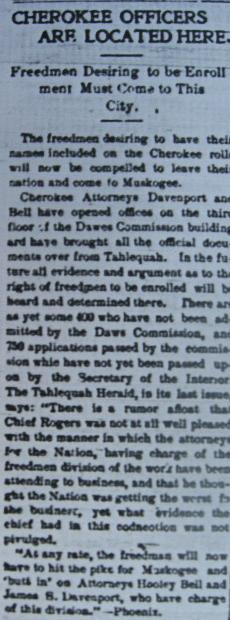
Glancing at the front page of the Muskogee Cimeter, in August 1904 one learns that towards the end of the Dawes interview process, several hundred Freedmen from the Cherokee Nation were still not interviewed. Therefore, they had to travel from their homes in Cherokee country, to interview with the Dawes Commission in Muskogee.

Cherokee Freedmen to go to Muskogee to Enroll

* * * * * * * * * * * * * * *

In the town of Rentiesville (referred to as Rentie) the activities in this small town can be gleaned by reading this entry.
Articles from the town of Rentiesville

The activities of the local AME Church were mentioned and the community was also preparing eagerly for the annual August 4 BBQ. As is known by many with ties to Oklahoma, August 4th was celebrated for many decades as the official celebration of Emancipation. This day commemorated the date when the Loyal Creeks made an official designation of the Freedmen as citizens of the nation. This was prior to the 1866 treaty, in fact. For many years Freedmen throughout Indian Territory symbolically embraced August 4, as a day to celebrate their own release from bondage. Many black communities held annual picnics, barbecues and celebrations to honor this date. In the latter half of the 20th century some of the emancipation celebrations evolved in to local church homecoming celebrations that occurred at the same time, but the newspapers of the day clearly reflected the importance of August 4th as a celebration of Freedom.

(According to scholar Gary Zellar: On August 4, 1865, the Loyal Creek Council formally declared that African Creeks would be considered full citizens of the Creek Nation. African Creeks soon designated August 4th “Emancipation Day” and organized celebrations, including picnics, parades and speakers beginning as early as 1867, which continued through the Territorial days and early years of Oklahoma statehood. The celebration fell into disuse as the African Creeks and other Indian freedpeople were increasingly marginalized in the twentieth century.)
SOURCE: Gary Zellar, African Creeks: Estelvste and the Creek Nation (Norman: University of Oklahoma Press, 2007).

Remembering August 4th Emancipation Day

* * * * * * * * * * * * * * *

Acts of violence towards people of African Ancestry were common throughout the South and in the twin territories--Indian Territory/Oklahoma Territory life was no different:

Holdenville Citizens Needing protection
The town of Holdenville had experienced violence towards its black citizens and Federal officers were aswked to intervene. This occurred 3 years before statehood, and many in that small community were not protected from such threats to their safety.  References to the Republicans (the more liberal part of the day) being unseated by more hostile southern Democrats, were heard, and the terror with which the population lived are discussed.


* * * * * * * * * * * * * * *

A Call for a Mass Convention
The political climate of the day was felt by the local population and was reflected in the same publication. A call for a mass Colored Convention was made and was scheduled for August 16th calling many who were spokespersons of the day to celebrate.  The purpose was to call for the rights of suffrage as stated by the United States constitution.  As statehood quickly approached, the concernw as that blacks living in the soon to be new state, be given the right to vote, and not be ostracized as were blacks in other parts of the South.

The call for a Mass Colored Convention

* * * * * * * * * * * * * * *
The stories from the newspapers of the day, reflect the political and social climate that our ancestors experienced.  Indian Territory in pre-statehood days was a volatile place and our ancestors lived with those fears for their life and safety.  Thankfully, one can still explore the newspapers of the day that assist us in telling the story more effectively.  They can also become useful guides for researchers when sitting down to discuss the issues of the day, with the elders. 

Our goal of course, is to tell the story.