Showing posts with label Dawes Commission. Show all posts

Wednesday, October 11, 2017

The Family of Delia Noble - Seminole Freedmen


When researching families from Indian Territory, it is often valuable to study not only the enrollment cards but also to remember the various categories of records where families are found. The standard enrollment cards are always a starting point, and they are particularly essential when researching those tribes where the interviews were never microfilmed. The lack of records are found when examining families that are Seminole and Creek families.

However, by examining the files of relatives found in "other" categories such as the "New Born" files, one can often learn more about the family. I was able to do this with data on a Seminole Freedman family, the Nobles of Wewoka.

With this family we begin with a Seminole New Born card, with 3 children, Stephen, Leford, and Rachel. All 3 children are 5 years or  younger. Their mother is Delia Noble, and their father George Noble is said to be a Creek citizen.

Seminole Freedman New Born Card #9
The National Archives at Ft. Worth, Ft. Worth Texas 1868-1914

NAI Number: 251747

Record Group Title: Records of the Bureau of Indian Affairs, Record Group 75


On Seminole Freedman card #648,  we find Delia Noble, and 6 other children. The children were Shake Payne, and William, Benjamin, Robert, Lyman and Elbetta, all with the Noble surname. All whose names appear on this card are noted as members of the Bruner band.


Seminole Freedman Card #648
(Source: same as above)

Back side of card
(Source: same as above)

It is also clear that the father George Noble is a Creek citizen as he is found on Creek Freedman Card 1400 (Field card 1516)

Creek Freedman Card #1400
(Source: same as above)

(Back of Card)


Application Jackets

With both parents application jackets do not exist. There is not one for George Noble among the Creek files, nor is there one for Delia Noble among Seminole files. However, because there was as separate effort to enroll Stephen Noble as a Creek, the family story is found. Stephen's name was put on a Seminole Freedman card (see above) among those cards known as "New Born" cards. Thankfully there is an extensive file to be found reflecting his status, with interviews pertaining to not only the family but their presence on earlier rolls.

Looking and finding data on the family was a challenge. For Seminole Freedman Card number 648 no application jacket exists among the many digitized images found on Fold3 and Ancestry. Among the collections to be found are the categories of  "Seminole", "Seminole Memorandum", "Seminole Newborn", and "Seminole Newborn Freedmen". And strangely, there is no single category of "Seminole Freedmen" to be found. So the file that pertained to Delia's file was not included among the many microfilmed records.

However, from the file of "Seminole Newborn Freedmen" a file accompanies the card with the 3 children, Stephen, Leford and Rachel. The greater surprise is that an extensive set of documents were contained within that file, and it is from that file of the Newborn Freedmen, that an amazingly rich series of interviews and documents are found.

One first finds some birth affidavits of the children. Such documents are often found in the application jackets and these are valuable records because they provide information that pre-dates Oklahoma statehood and also the process of documenting births.


Ancestry.com. U.S., Native American Applications for Enrollment 

in Five Civilized Tribes, 1898-1914[database on-line]. Provo, UT, USA: Ancestry.com Operations, Inc., 2013.


(Source: same as above)


The most essential part of this application jacket is a multiple page document, examining the status of the family. Keep in mind that the father in this household-- George Noble was a Creek Citizen and their mother Delia was Seminole.

Many of the questions involved their status and the effort was made to determine if they were Seminole or Creek. George Noble, in fact had appeared in front of the commission in 1904 to enroll his son Stephen as a Creek. George explains how he was enrolling his son and it was noted that Delia his wife was Seminole.

(Source: same as above)

Much of the questioning in the interview centered around whether or not George was registering only one child while the others were registered as Seminole. He explained himself several times, and he was challenged on whether he was accurate about the dates. He pointed out that he record dates of birth from the family bible, and he noted was registering the child Stephen because the others had been registered already as Seminoles.

Much of the interview seems to ask the same questions more than one time. An associate of George Noble was also called to verify the birth of the child, and the examination continued.

(Source: same as above)


At times there appeared to be an effort to confuse George the witness pointing out statements that he had made earlier in response to previous questions.

(Source: same as above)


Repeatedly questions about George's movements were posed to him and other witnesses, how often he came to trade and with whom he visited when coming to town to trade. Also the time in which George came to file on his land were discussed.


(Source: same as above)

As witnesses were called, the reader can glean much about the process of Dawes enrollment, when often the line of questioning would stray from the status of the applicant and often focus on one or two details would surface. However, the reader can also learn much about the movement and life of the applicant with some of the details expressed.

(Source: same as above)


The complexity of questions directed to applicants is clearly seen in this file. As much as some files were strangely brief or non-existent in many files, this case seemed to cover multiple angles about his desire to enroll his son.

The point is also that the questioning pertains to Creek enrollment, although George's wife and children were Seminoles of the Bruner band. Also the ultimate status of the family would be that of Seminole family, it is also important to realize how close these two tribes were as well. Families new each other, and mingled socially. Many from one tribe chose a spouse from the other tribe, and it is well known that both cultures share similar origins from the southeast.

(Source: same as above)

The file went on for multiple pages, and even beyond these question and answer interviews 20 more pages were part of this file, consisting of letters pertaining to the Noble family.

(Source: same as above)

Questions about whether or not people knew George Noble closely were asked even to the point of asking if the witnesses had visited the Noble household and recalled the birth of the child Stephen. There was focus on the fact that there was movement when called to appear and register, and one can see how often people were responding to the call to enroll.

One associate was called and asked about his own child's date of birth, and whether or not George Noble's child was born before or after his child's birth. Delia is mentioned continually, and her status as Seminole was repeatedly mentioned. But her voice, appeared to be the one voice that was missing. She was not a witness in these pages, yet, her presence and status as a Seminole was never challenged.

(Source: same as above)

(Source: same as above)

There are 19 more pages that are part of this family's file. Clearly, one might find much value in researching the records and files of Newborn Freedmen to document more of the family's rich and complex history.

Decision

In 1907 a decision was finally made on the case for Stephen. The application to enroll him as a Seminole Freedman was denied. However the denial was based on the fact that he had been enrolled as a Creek and his status was therefore not changed. As one can see from the first illustration above, a line was drawn through his name on the front of the card.


(Source: same as above)


(Source: same as above)


Delia and her children were enrolled as Seminole Freedmen, and the one child Stephen was kept as a Creek citizens. Since the Seminole Nation still allows the two Freedman bands to be a part of the nation, it is hoped that descendants of the Noble family are still a part of the nation that is their birthright. The extensive file reflects a complex and interesting history, and hopefully their story will be told of how all but one of Delia's children were Seminole, and how one branch became Creek.

This is the 30th article in a 52-article series devoted to sharing histories of families once held as enslaved people in Indian Territory, now known as Oklahoma. The focus is on the Freedmen of the Five Civilized Tribes, and these posts are part of an on-going project to document 52 families in 52 weeks.


Thursday, August 3, 2017

Joe & Dillard Perry Chickasaw Freedmen & Chickasaws by Blood

One of the more intriguing stories of identity, race, and heritage comes from the story of two brothers, born in Indian Territory. Their story on the surface appears to be a simple one where an elder in the family registered her grandsons with the Dawes Commission. She had been enslaved in the Chickasaw Nation and was doing what many people did during the years of the Dawes enrollment process. She registered her family. The saga Joe and Dillard began when they were first enrolled and place on the rolls of Chickasaw Freedmen.

However, what emerged was a story that mirrored that of many others in Indian Territory. The two Perrys had a mother of African Ancestry, and their father was native American--Chickasaw Indian. The story is unique because the parents of the two young men had a true relationship and had planned to raise their family together.

In 1892, Charlie became ill and died, thus leaving Eliza with her two boys to raise alone. Having an extended family that was quite large, Eliza received support from her mother Harriet, and it was Harriet the matriarch who appeared and enrolled the children. They were enrolled along with a large clan of other family members on Chickasaw Freedman Card #61.

On the front of the card, one can clearly see the names of the two grandchildren whose cases would later be challenged. Joe and Dillard have roll number 267 and 268. Because of the controversy, one can also note that an asterisk was placed near their numbers.

Chickasaw Freedman Card Number #61
The National Archives at Ft. Worth, Ft. Worth Texas  1898-1914,
NAI Number: 251747, Record Group Title: 
Records of the Bureau of Indian Affairs, Record Group 75

Reverse side of card

This is clearly a very large family and much rich genealogical data is found on the card, reflecting the spouses and children of those represented when the grandmother enrolled them. On the top card above the names of Joe and Dillard, is the name of their mother Eliza. Eliza would later be the one to request that her sons be placed on the Chickasaw roll by blood.


Close Up of Data on Card


The back side of the card also revealed the name of the Joe and Dillard's father Charley Perry, who was, by that time, deceased.

Close up on reverse side of card

Before looking at the application jacket, this case is one in which much is revealed in the various details found on the card itself. Some of the notations added after the initial interview are noted in red and they reflect various actions pertaining to the two young boys and how the commission acted upon them.

The back of the card contains more data about changes in their status. It should be noted that they originally began the process in 1898, when the grandmother appeared to enroll all of her children and grandchildren. Then the mother Eliza began a suit, because her husband was Chickasaw, by blood and she wanted them to be recognized as such. A decision was made in 1906 (see note below) to cancel their status as freedmen and transfer them to the rolls by blood.

An important footnote is written in red on the bottom of the front side of the card, directing the reader to a change in status for Joe and Dillard Perry, cancelling their status as Freedmen.
(same as above)

When they were transferred to the blood roll a card was completed for them as Chickasaws by blood. And as one can clearly see from the blood card---it was quickly canceled.

(same as above)

And one can tell by the notations on the front of the card how their case evolved. And the large stamp of course reveals a later decision as well.

(Notations on card - close up)


(Additional Notes on back)


From both the card "by blood" and the "Freedman" card it is clear that this was a complicated case. But then so much more about the case emerged when reading the application jacket. The details about Eliza, her marriage to Charley Perry, and the subsequent cold treatment by his relatives toward her are also reflected.

Several pages from the series of interviews are presented here. What emerges is the fact that Charles and Eliza had a relationship and had begun living together. But marriage between an Indian and one of African ancestry was forbidden by law and threat of punishment. As it turns out, Charlie and Eliza were arrested for cohabiting and were taken to Texas. Their crime? She was black and he was a Chickasaw Indian. It was pointed out during one of the interviews that she was also one quarter or one eighth Indian, however, the presence of African blood in her veins somehow in the eyes of the Chickasaw community and policy put a "stain" on the public perception of the couple and their right to have lived as husband and wife. Their marriage made their act of having a relationship with each other, a crime.

They had two children Joe and Dillard, and some of the witnesses from the Perry family said only that they had "heard" that there were two children, but had never met them. It was later stated that Charlie and Eliza married while in Texas, but another official objected, finding it inconceivable that a "negress" and an Indian would be allowed to marry while in Texas.

National Archives Microfilm Publication Number M1301
Application packets Chickasaw Freedman #61
Ancestry.com. U.S., Native American Applications for Enrollment in Five Civilized Tribes, 
1898-1914[database on-line]. Provo, UT, USA: Ancestry.com Operations, Inc., 2013.

The questioning began addressing the family background of Charlie Perry, and whether the witnesses had knowledge of the two boys Joe and Dillard being his sons. In addition, several people, including relatives all mention that Charlie would go away and live someplace else, for a while, but would only return to they Chickasaw family for short visits. 

(same as above)

A series of questions were addressed to the witnesses about not only the two young boys being the sons of Charlie Perry, but also several were asked about the mother and whether Charles was mentioned as being married to Eliza.

(same as above)

The grandmother Harriet also took the stand and spoke about her knowledge of the case of Charlie and Eliza. Harriet was the grandmother who went and registered the family from the beginning of the Dawes Enrollment Process.


(same as above)


(same as above)


(same as above)

(same as above)

Eventually after much discussion occurred about the status of Eliza and Charlie Perry's marriage, Eliza herself finally took the stand to speak.

(same as above)

When Charlie became ill, he was at the home of his Chickasaw Family. Eliza did go and visit him while he was ill, but clearly did not stay long for she was not really welcomed while there. Charlie died, and Eliza faced the future years without her husband, and began to negotiate life with her two children.

As stated, their Freedman grandmother originally enrolled them, but Eliza mentioned in her interview that she should consider suing on behalf of her sons, so she did file a lawsuit for the right of her sons to be enrolled as Chickasaw by blood. Their father Charlie, who was now deceased, was, in fact, a Chickasaw Indian. But the children were not accepted by their Chickasaw relatives and they were, in fact rejected by their Chickasaw grandmother, who admitted that she never knew them. There was deliberate avoidance of contact with the bi-racial children of their Chickasaw father, by his family.

What emerged was a story of challenges, and counter-challenges to be thrown in the face of the Perry children, despised for their African blood, and ignored although they carried the blood of their Indian fathers. So the children were enrolled as Freedmen, then cancelled as Freedmen, then enrolled as Chickasaws by blood, then cancelled as Chickasaws by blood, and re-enrolled as Chickasaw Freedmen. Theirs is a noteworthy cases, and it was not a unique case--there were others involving Choctaw as well as Chickasaw Freedmen. The case of Bettie Ligon also addressed the status of a woman who was originally as a Choctaw Freedman and her efforts to be enrolled as Chickasaws by Blood. That was the well known landmark case Equity Case 7071.

The story is a complex one, and in a future piece I shall focus on the genealogy of the larger family of Perrys, Taylors, Johnson, Bruners and other who comprised the structure of this one blended family of cultures, tribes, races and bloodlines. Truly, it can be said that the case of Joe and Dillard Perry continues to be a complex one for genealogists and students of Indian policy, law and sociology.

* * * * * * * * * *

This is the 23rd  article in a 52 article series devoted to sharing histories nad stories of families once held as enslaved people in Indian Territory, now known as Oklahoma. The focus is on the Freedmen of the Five Civilized Tribes, and theses posts are part on an on-going project to document 52 families in 52 weeks.

Wednesday, March 9, 2016

African American Families from the Mississippi Choctaw Files

National Archives Publication M1186, Enrollment Cards
Mississippi Choctaw Rejected MCR 1112
Color Image Source: Ancestry.com. Oklahoma and Indian Territory, Dawes Census Cards for Five Civilized Tribes, 1898-1914 [database on-line]. Provo, UT, USA: Ancestry.com Operations Inc, 2014.

The rejected files of the Mississipi Choctaw (MCR files) reflect rich data for family history and those with ties to Mississippi, and who have heard that there are family ties to Choctaws, and to Choctaw communities, will find that this record set could yield some amazing data.

Do not be dismayed that this information comes from a record set marked "Rejected". There are many reasons why an ancestor's history could be found among these records. Some of the reasons are cultural, some political, some historical and some social. All of the reasons were used with the MCR files, and vary from one file to another. But it should be understood that these records were created by persons in the late 1800s, and early 1900s who stated that they had Choctaw family ties, and many of them provided remarkable family information. Regardless of the reason for the final outcome of the case the status of the family record among the MCR files should not prevent the family researcher from exploring the files.

In the case above, the application was for Frank Nicholas, and his children Rosaline and Frank Jr. They lived in Pass Christian, Mississippi.

The Dawes Commission interview went into great detail about the family background and sought to determine how the Choctaw blood was part of the family history.

National Archives Publication M1301 MCR 1112
Applications for Enrollment of the Commission to the
Five Civilized Tribes 1898-1914
Image Source: Fold3.com


In this case the detail extracted from the applicant went into detail about the source of the Choctaw ancestry. The applicant was examined as to whether claim was being made under Article 14 of the Treaty of Dancing Rabbit. This line of questioning was common among most cases in the MCR category. In this case the applicant repeated what had been told to him most of his life about his own ancestry.
Source: Same as above


Source: Same as above

The application jacket for this family was closely connected to additional files, it is imperative that all of the files are combined to glean thorough information about the family. From the same files for Frank Nicholas, references are made to additional family members who also submitted applications.

Source: Same as above

After analyzing the cases of the additional relatives it was decided that there was not sufficient evidence to prove the Choctaw connection, since there was no attempt in earlier  years to be enrolled as Choctaw citizens.

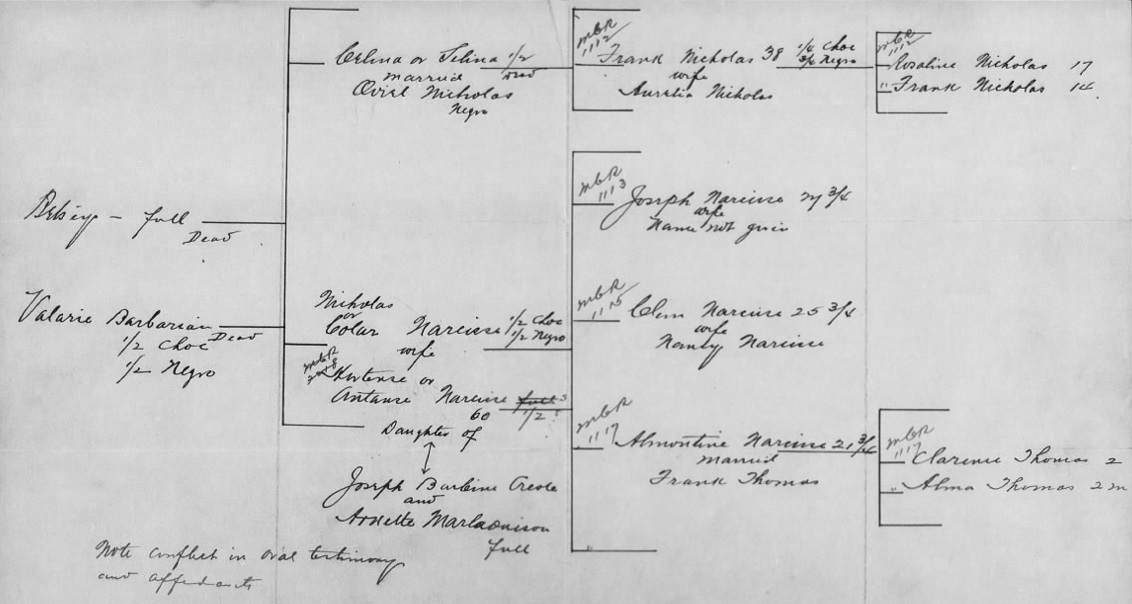
In spite of this decision--it is also clear that an unexpected gem awaits the researcher. In the course of the many interview questions, careful notes were taken on the case and this was one of the cases where a hand drawn, multiple generation pedigree chart was included. For any researcher this is a real treasure to find. Because of the complex questions asked, additional names of relatives and they were included in the Frank family file.
Multiple generation pedigree chart in file
Source: Same as above

It should also be pointed out that there are over 35 pages in the family file. These pages along with the files for the additional family members are extremely valuable in piecing together the family narrative.

Regarding the family tie to the Choctaws, there may have truly been one, with the evident mixed race ancestry of the family, but because the cultural ties had long been cut, this particular family was not officially identified by the Dawes commission, and was thus placed among the MCR files. Thankfully, the family data will still direct the researcher to the family members, and from that information, more of the family story can be told.

***** ***** *****
Additional Files Related to Frank Family


All files shown above are from National Archives Publication M1186 and all persons mentioned on the above enrollment cards have ties to the same family as Frank Nicholas. There are accompanying application jackets (M1301) and all will hold some unique facts that will be useful to the researcher.

It is strongly recommended that persons of Mississippi ancestral ties explore these records. The images of the enrollment cards reside on Fold3, as well as Ancestry, with the Ancestry images presented in color. (The application jackets NARA publication M1301, are only in black and white on each site.)

There are more than 7000 MCR files and a first examination of the MCR files indicate that over 2000 of them reflect African-American families stating family ties to Choctaws of Mississippi.