Monday, March 28, 2011

Freedom Celebrations in the Cherokee Nation

Flyer for Emancipation Celebrations in Oklahoma

For many years, throughout Indian Territory, a number of celebrations of Freedom took place.  Today they are often commemorated by Juneteenth celebrations, but among many of the  former slaves of Indian Territory--celebrations of freedom from bondage always took place in August, and especially around August 4th.

It is known that this was common especially among former slaves of Creek Indians, but this was also the case in the Cherokee Nation. Cherokee Emancipation ceremonies were said have been elaborate and festive events.  Although many Cherokee slaves were released officially from bondage in 1863, they joined other former slaves of Indian tribes by celebrating August 4th as well.

Elizabeth Ross a field worker for the Indian Pioneer project, described the events in Cherokee Country:


Ross went on to describe a particularly memorable event in Tahlequah the capital of the Cherokee Nation. She describes events as they occurred in the latter part of the 1870s.


She pointed out how at that time, (the 1870s) there were still many former slave living who had come into the Territory during the years of the Removal (the Trail of Tears) being brought as slaves along with their Cherokee enslavers.


As time passed the Cherokee Freedman celebration took place more frequently even into the 20th century at Four Mile Branch.


Today Four Mile Branch is where an historic Cherokee Freedman church and cemetery are located. This site is most likely where the last of the Emancipation celebrations occurred.

In the summer of 2005 images were taken of this cemetery by
Tonia Holleman and Angela Walton-Raji

Looking Across Four Mile Branch Cemetery
Images captured in 2005 by Tonia Holleman & Angela Walton-Raji


Although the celebrations of freedom are now events of the past, but hopefully many who share this history will appreciate the value of honoring the ancestors both enslaved and free, both native and states-originated, and both Freedmen and "by blood".

All of the history belongs to all of the people and it is time to begin to tell those stories.

Monday, March 21, 2011

The Minor & Newborn Dawes Freedmen Cards

Enrollment Card of Walton Family
Source: National Archives M1186, Choctaw Freedmen Card 777

When documenting the families from Indian Territory, it is important to "read the small print" or rather the notations that appear on the bottom of the primary family documents.

In the case of my Walton family, all of whom were enrolled as Choctaw Freedmen, a small notation was made on the bottom of the card regarding the children of Sallie Walton's daughter Louisa.  

Notation on card to see New Born Freedman Card #230

It is important  to understand how the records of the Choctaw Freedmen are actually classified.  The notation refers the reader to New Born Card #230. However, there is no New Born Freedman category.  The category among the Dawes Enrollment Cards is actually "Choctaw Minor Freedmen".


Sure enough, when looking into the Choctaw Minor Freedmen, Card #230 did reflect more information about the family.  Louisa the mother of the children, had married and three of her children were reflected on the same card.

Louisa Ingram Sanders' children were reflected on this enrollment card 
of Choctaw Freedman Minors

Since there was an enrollment card for the three children, I became curious and wondered if there was possibly an interview and detailed family file, and I decided to look closely in the M1301 records, and sure enough there was.  In fact there was a 32 page file on the family that accompanied the file.  Some pages were depositions, some were letters and others were critical vital records, such as birth affidavits.  

In this case, two birth affidavits were in the file, and these documents are significant, because they are vital records that were pre-statehood vital records.  Oklahoma would not enter the Union until 1907, but in the file were birth records of some of Louisa's children (and Sallie's grandchildren).

This birth record of John Sanders (Louisa's son) was created two years before statehood.
Source: National Archives, M1301 Choctaw Minor Freedmen #230


This birth record of Ethel Sanders was also in the file. Again this is the second pre-statehood 
birth record found in the Minor's packet


In addition to the birth affidavit a testimony by their father George Sanders was also made on behalf of his children.  
Page 1 of George Sanders' Testimony for his children


Page 2 of George Sanders Testimony


This was an exciting find, because the Sanders branch of the family are cousins and it was never known for years exactly how they were related.  Louisa, the mother of the children was the sister to my grandfather, Sam Walton on Dawes Freedman Card 777.    These cousins would visit us over the years, but it was not until following the notation on the Walton Card and pulling both the Sanders family card and their packet, was the relationship clear.

The lesson here is to follow all notations on the cards and to study them and see what additional data can be found.

Friday, March 11, 2011

A Closer Look at Susan Colbert, Choctaw Freedwoman

Enrollment Card of Susan and Israel Colbert, Choctaw Freedmen

In early January, I wrote a piece about Susan Colbert's interview in the Indian Pioneer Papers, by Gomer Gower was an interesting one.

Her voice was not heard, it was summarized and the voice telling the story was the interviewer who wrote about her Cherokee father, and her being placed on the Freedman Roll, which according to the interviewer, was a wise decision, for the Choctaw population was "protected" from countless numbers of "bogus" claims that would have resulted had this woman of mixed ancestry been treated differently.

I found the interview curious not only because of the biases expressed by the interviewer, but the fact that the reader was not hearing her voice---only his narration of her life.  I decided therefore to took at some records created 30 years earlier---her Dawes Card. 

-From the interview, it was stated that her father was Bob Parrot a Cherokee Indian.
-But from the Dawes Card it is revealed that her father was Tom Parris, A Choctaw Indian.
Enrollment Card of Susan Colbert with husband Israel Colbert, and their children


Reverse side of Enrollment Card.  Susan's data appears on line 2. Note her father 
is identified as Choctaw, and not Cherokee.


-From the interview it was stated that she married Tom Smith a Choctaw citizen who was half Choctaw, half Negro.
-From the Dawes Card it is revealed that Tom Smith was a Cherokee citizen.

Thomas Smith, a husband from a previous marriage was not Choctaw, 
but noted as Cherokee on her Dawes Card.


-From the interview it was stated that their marriage was very brief due to his cavalier lifestyle and he left shortly after their marriage.
-From the Dawes Card it is revealed that Tom Smith was around at least long enough for them to have had three children, who do appear on the card with her.

The children of Susan and Tom Smith are reflected on the Dawes Enrollment Card. 

-From the interview it was stated that she married a Choctaw Indian, Israel Colbert.
-From the Dawes Card, it was revealed that she married Israel Colbert a man once enslaved by Sam Colbert. (Also both of his parents were enslaved by Choctaw Sam Colbert.) 


Fathers and  Father's Slave owners indicated.


Mothers and Mothers' Slave Owners indicated

The lesson learned from the case of Susan Colbert, is that we must rely on multiple sources of information to truly understand the story of an ancestor. With Susan Colbert, she was interviewed in the 1930s and for some reason, her words were not produced, but merely her story was presented in the 3rd person. However, when one looks at the records produced 30 years earlier, a different story emerges about Susan Colber, her life, her husbands and her identity.  She was not the daughter of a Cherokee, but the daughter of a Choctaw.  Her first husband was not half Choctaw, but he was a Cherokee citizen.  

Truly in order to explore the lives of one's ancestors, it is imperative that as many resources as possible are utilized to tell the story, and to tell it accurately.

Sunday, February 27, 2011

Remembering Oak Hill Academy for Choctaw Freedmen

Elliott Academy once known as Oak Hill Academy is noted on this Oklahoma Historical Marker
Photo by Byron Hooks

Known in its earliest days as Oak Hill Academy, this long forgotten institution was known in later years as Elliott Academy till it vanished from the landscape of the Choctaw soil upon which it once stood.

This was once a boarding school full of dormitories, school buildings, smoke house, an active farm so much more, to sustain itself.  The school was built by the Presbyterians in the 1860s and for many years this missionary endeavor by Presbyterian missionaries brought education to the children of Choctaw Freedmen. Known for its beautiful grounds and facilities, nothing beyond this historical marker represents the grandeur of this long gone institution.

Life at Oak Hill was well described in the book by Robert Flickinger, and also by a former student, Jordon Folsom a Choctaw Freedman who was interviewed in the Oklahoma Pioneer papers.  Folsom's family were slaves of the large Folsom clan in the Choctaw Nation, and his interview in the Oklahoma Pioneer Papers was extensive.  He attended Oak Hill and described life as a student.


Excerpts from the interview with Jordon Folsom, Choctaw Freedman

The interview with Mr. Folsom is a lengthy one, describing life as a student and also a long lost LeFlore Cemetery once on the grounds of the school.

Sadly, little is known of the school today.  In the 1900s after statehood, the school was known as Elliott Academy when a large donation was made to build a school named after the wife of David Elliott.  The school was eventually absorbed into the segregated school system, and over time, like many black schools, it was closed.   The buildings are now gone, and nothing but a sign near the Valiant Cemetery mentions it by name.  

James McGuire, Choctaw Freedman. A Student at Oak Hill

The young men and women who attended Oak Hill later became leading men and women in their own communities after completing their studies. Some returned to teach in the communities around Valiant and Idabel.


Young men in front of boys residence hall at Oak Hill

One of the more well known men of the community was Wiley Homer who was a supporter of the school and one who frequently spoke at Oak Hill Academy.  He was a slave of John Homer, a Choctaw Indian, and while a boy, was hired out to Samson Loring to watch cattle. He learned how to read by memorizing and  learning the variations in the cattle brands. When his natural aptitude had been noticed he heard his employer Loring comment about his natural intelligence, he then vowed himself to learn as much as he could. So this self-taught man began his own efforts to pursue education. 

The Oak Hill book actually describes how Wiley went about his education after freedom.  (Note Choctaws abolished slavery in 1866 and a year later Wiley Homer began his personal quest for enlightenment.)

"When, at 16 in 1867, he was accorded his freedom he obtained a primer and first reader, and undertook to master these by private study. About four years later, a testament and shorter Catechism were given him. He now had what was regarded as a good library for a young man and he applied himself to the reading and study of these books, in the evenings and other periods of spare time. The testament was frequently taken to the field when plowing, in order that he might learn to read a verse or two, while the team was resting, or get a neighbor, passing on the road, to read it for him. The reading of the testament soon awakened a desire to be a teacher and preacher, and this greatly increased his interest in the study of that book."
  
Portrait of Wiley Homer

He became interested in establishing a church and he created a small brush arbor place of worship and later became the founder of Beaver Dam Church in Grant, I.T. in 1873.  Many graduates of Oak Hill later moved to the same community in Grant, Indian Territory and joined the same church.

This is an image taken in 1904 at the Beaver Dam Church, founded by Choctaw Freedman Wiley Homer
Source: Oak Hill Academy for Choctaw Freedmen, by Robert Flickinger


In the early years of the 20th century, Oak Hill continued to thrive. Students from Idabel Valiant, Grant, Hugo, Wynnewood and other places where former Choctaw slaves lived, flocked to this distinguished academy where education flourished and where a path was created to a new way of life and enlightenment.


 But Oak Hill had two major setbacks due to fire. In 1908 the Boys Hall caught fire.  Funds were secured to build another dormitory. Then two years later the Girls Hall also had a fire. The third floor was severely damaged. In addition to that statehood brought about the beginning of the end of the Academy.  

The new state provided laws for the establishment of schools an Oak Hill school district was "created" that split the area of the grounds of Oak Hill community. The new state armed with a new law of racial segregation also set to quash any influence the Oak Hill community had, by establishing a law that wherever there were 6 students existed a new district or school had to be established. Thus the miles that separate families living on their allotments in rural areas, were then also used to break up the once community that had thrived as a social unit. 

Many parents were very much afraid of repercussions that might occur if they did not comply, especially since he new state of Oklahoma was now under the influence of a strong southern white bias that had no interest in educational development of black people, so the end of the Oak Hill was forthcoming. Within a very short time, three public schools were established in the vicinity of Oak Hill and parents were warned against not complying with the new rules.  

"The mission schools previously established for many years in the chapels of the churches of the Presbytery of Kiamichi became public schools and the pastors that continued to teach became public school teachers."

The school did continue for several years, average enrollment around 100 students. 

More images of the school


The Oak Hill High School Curriculum:

9th : Grammar, Arithmetic, Composition, Civics, Elementary Algebra, Bookkeeping.

10th Grade: Algebra, Hill's Etymology, Physical Geography, General History, Rhetoric.

11th Grade: Algebra, Rhetoric, Ancient History, American Literature (Abernathy), Composition, Botany, Plane Geometry.

12th Grade: Solid Geometry, (Hessler & Smith's) Chemistry, Newcomber's English Literature, Political Economy.

Electives: Astronomy, Geology, Zoology, Trigonometry; Surveying, Stenography, Typewriting, Telegraphy.

In January 1908, when P. K. Faison, first superintendent of the public schools of McCurtain county, made his first visit to Oak Hill, he stated that Wheelock and Oak Hill Academies were the only graded schools in McCurtain county at that time.           

(SOURCE:  Oak Hill Academy, Choctaw Freedmen, by Robert Flickinger, 1914)


In 1910, the school received a donation to build Elliott Hall. This would eventually replace the burned dormitories. A $5000 donation was made by David Elliott who donated funds to build a new residence hall to be named after his wife Alice Lee Elliott. The school name was subsequently changed from Oak Hill Academy to Elliott Hall Academy. This new hall provided an office for the superintendent, a library and reception room, places for boarding and laundry departments, rooms and bath. The school stood on a small elevation known as Oak Hill.  

Eventually absorbed into a segregated school system of Choctaw County, the legacy of Oak Hill Academy and of Elliott Hall, eventually was removed from historical memory. The school operated till 1936. 

Today only a marker remains.

WHERE WAS THE SCHOOL?
Today, there are no physical traces of the school. 

Outside of Valiant Oklahoma, near the entrance to the Valiant cemetery, is an historical marker.  (see image at top of this post) I

t tells a brief story of this school, which for several decades brought the only education in this part of Choctaw country to the children of slaves who lived in the Choctaw Nation. An aerial satellite view, using Google Maps, shows where the marker is.

Aerial view of location of historical marker

However, while using Google Maps to locate the marker, I typed in the name several ways, and found a surprising entry on another Google Maps image.  

When I typed in Elliott School, Valiant Oklahoma, another image indicator appeared on the map. Several hundred feet away from the entrance to the cemetery, the indicator pointed to something that appeared to be the entrance to some private property.

In the upper right hand portion of this image is an indicator pointing to something that was once there.  The lower portion of this image shows the cemetery where the historical marker stands near Valiant Cemetery.

Again using Google Street View, I decided to take a street level view of the site where the marker in the image above points.

Is this the old entrance to what was once Elliott Academy?
Source: Google Street View Image

Looking at that same site again by Google Satellite image, I zoomed in for a closer view, and one can see scars in the ground indicating structures that were there at one time there.  Could I truly be looking at the remains of Oak Hill?

Could those images and scars on the soil be the ghosts of Elliott Hall, and other structures that once graced the grounds of Oak Hill, and later Elliott Academy?


Only my imagination now speaks to me as I look at this image.  Could that light diagonal scar across the grounds be the path that the students in two photos above used to cross their campus? Could the larger rectangular scar be the remains of Elliott Hall?  Is there any local who might be able to answer these questions?

I do not know the community of southeastern Oklahoma very well, but I treasure the history of the people who attended Oak Hill, and whose minds and futures were nurtured upon it's soil.  I celebrate the pride of the Choctaw Freedmen who were trained at Oak Hill and later Elliott Hall, and I am saddened that nothing remains of its old glory than  a marker several hundred feet away. 

How much I would enjoy seeing more unfold of the history of this region and I hope someday to learn of a new surge of pride and sense of history from this small corner of Choctaw Country. 

The people and stories in and around what is now southeastern Oklahoma is a rich one.  Armed with a fierce desire to learn and aided by the efforts of Presbyterian missionaries, the Choctaw Freedmen community was able to plant a strong desire for learning and to nourish it for decades. Hopefully some day the lives of the people who lived here, will be told.

All photographs of the school are taken from the book The Choctaw Freedmen and the Story of Oak Hill Industrial Academy by Robert Elliott Flickinger.


Tuesday, February 22, 2011

Free Men, Slaves and Slave Traders in the Creek Nation

Many of the early days of contact between Africans and members of Creek Nation, occurred when runaway slaves from the United States found themselves in communities in the Creek Nation.  During those early years, in the late 1700s, according to scholar Gary Zellar, in the book African Creeks the time was one where slaves were not taken hostage or enslaved, but one in which there was a cooperative relationship. Many who interacted with Creeks, quickly learned the Muscogee Creek language and served as interpreters for several decades. One of the more popular interpreters was a black man known as Ketch.

Source: African Creeks: Estelvste and the Creek Nation by Gary Zellar, University of Oklahoma Press, 2007

Over the years relationships changed and it was learned that there was a price on the head of many who were of African descent, and eventually slaves from other communities were captured and returned for reward, and/or sale. Zellar points out that the years of the American Revolution brought about a change in the relationship with blacks and by the latter part of the 1700s, it was realized that slaves could be captured and that rewards were often offered for their capture.

Source: African Creeks: Estelvste and the Creek Nation by Gary Zellar, University of Oklahoma Press, 2007

By the time of the removal there were many slaves brought west with all of the tribes, including the Creeks, and black chattel slavery had taken a strong hold. While studying this historical fact, I had questions.

Could slave traders to be found in the Territory?

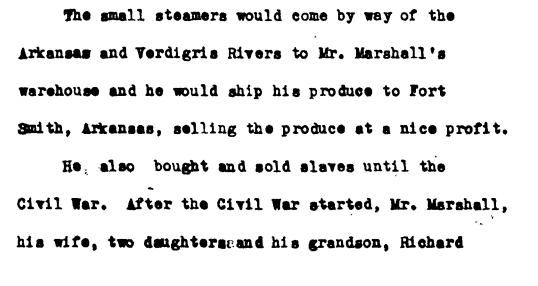
While reading Pioneer papers, I was surprised to see an interview referencing a man from the Creek Nation, who was said to have been a prosperous slave trader. Richard Adkins was the grandson of Creek Indian Ben Marshall. Adkins was interviewed about his life in the Creek Nation, and he spoke in detail about his grandfather Ben Marshall, and although this narrative was written in the third person, it is interesting indeed to see a reference to the fact that he came from a slave owning family, and a slave trading family.
Richard Adkins also described life with his grandfather Ben Marshall, and how he was a businessman of many  specialties. Among his goods that he traded regularly--were human beings.


Digital Collections, University of Oklahoma, Western History Collection
Indian Pioneer Collection Volume 1, Interview with Richard Adkins

So it appears that during the years of the Civil War, like many slave holders, Ben Marshal made the effort to get his slaves out of the way of Union soldiers, so that they would not get the idea of freedom in their minds, and would not have opportunity to flee to freedom. But----how interesting and relieving to read that some of the slaves had escaped. They had resisted!!!

This is one of the few references to escaped slaves tied to a specific slave owner.  It was also good to see that there was resistance, and some even if only a few, had been successful in their escape.  The references to those who "went North" refers to those who had left with Opothle Yahola and gone into Kansas.  Many of the male slaves who left eventually returned as soldiers in the 1st and 2nd Kansas Colored Infantries (later redesignated as 79th and 83rd US Colored Infantry). There were others who had returned as Union soldiers with the Indian Home Guards as well. But it was good to read even from a family member of the slave holding family that the act of resistance had taken place, for the enslaved people in the Indian tribes, like their brethren in the United States, yearned for the same thing---the right to live as free men and women.

As a genealogist I was curious about two things---could I find out how many slaves Ben Marshall had? 

And could I find any slaves of Ben Marshall in later years?

I decided to look at the 1860 Slave Schedule. I expected to find some, but I was surprised at how many I found:


Source:  8th Census of the United States, National Archives, and Records Administration
1860 M653, The Creek Nation, page 17

Upon close examination, Ben Marshall's name begins near the bottom left and the list of slaves that he owned was extensive.  Looking at the list, more closely one sees elderly people among the enslaved.


Elders were listed among the enslaved

I was surprised to see that the list of his slaves continued on the next page:


In total---in 1860, a year before the war began, he owned 76 slaves! I wondered if I could find any in later years, who may have lived during the years of the Dawes Commission era. In the Richard Adkins interview, I learned that Ben Marshall died during the War, presumably down south where he had taken many of his slaves.


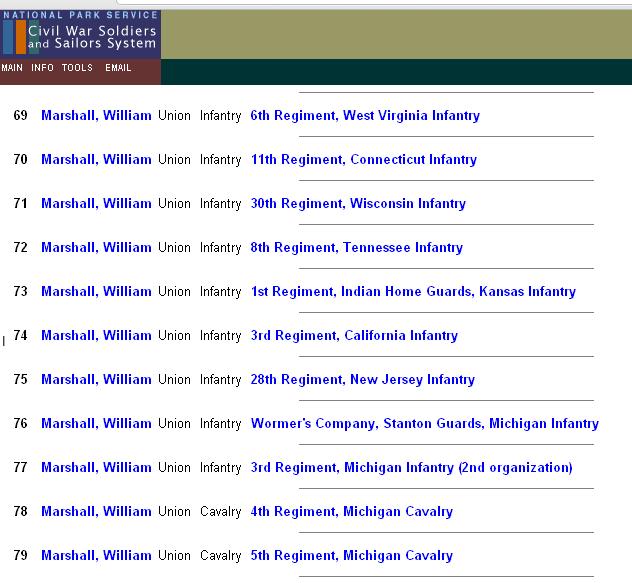
I did wonder also if there were any of his slaves that might have joined the Union Army could be identified.I looked at the records from the National Park Service database of Civil War soldiers.  I did notice that there was a soldier called William Marshall who was one of  the black soldiers that served in the Indian Home Guards.


I became curious if I could learn more about William Marshall.  Did he live long enough to file a Dawes card in the 1890s?  YES!!!!!   

And then I was amazed at what I found: He was a slave of Ben Marshall. He would have been one of the slaves that Richard Adkins had known that had escaped to the "North."  But there was more.

William Marshall was a slave of Ben Marshall as indicated on his Dawes Card

The reverse side of the card, would hold even more information that caught me by surprise:

William Marshall's father was Ben Marshall, the slave owner and slave trader.

Ben Marshal, the slave trader was the father of William Marshall, the Freedman.  

And William was one who did escape from his own father, to join the Union Army to fight those even from his own tribe who had joined the confederate army and who had vowed to keep others enslaved.

So, with the Pioneer interview, I was able to not only document a slave of Ben Marshall, I found one of the slaves, and that slave would have been a sibling to Richard Adkins' mother- and therefore also an uncle to Richard Adkins.  One of his own uncles was a slave in the family.  This of course happened in many places where people were enslaved, and should not be a surprise. But this is one of the first times I have found a documented slave trader listed as the father of one of his slaves in Indian Territory.

And there is the irony-----the descendants of William Marshall----all of whom are also direct descendants of Ben Marshall the slave trader, are not eligible for admission to the Creek Nation today. Their "sin" is having been born of an African woman, and like many of the slave holding tribes, slave descendants are still excluded from citizenship to this day.  Had William Adkins mother been white the descendants would be members of the tribe today. Interestingly, these policies have yet to be addressed by the citizenry that acknowledges that the practice is unfair, but somehow still, ok.

But---the history is there, and the history is a rich one. This small glimpse into the lives of persons from the Creek Nation is only a beginning. 

For the descendants of Ben Marshall's slaves, there are additional  records, to study.  With the Creek Nation, many interviews are missing and were never microfilmed.  Some claim it is because of blended families like that of William Marhsall, but that cannot be substantiated. However, for the descendants of the family of William Marshall and other families like his, there are other enrollment cards, there is also the 1895 Old Series cards that unlock the doors for many Creek researchers, and there are the rich interviews from the Pioneer records, as well as Military records. The Civil War Pension file of William Marshall will tell even more stories from his life.

This is a story that can be told from many perspectives, free people, the enslaved, slave owners and slave traders, and those who resisted! All stories deserve to be researched and told! This is a mere beginning.