Showing posts with label Oklahoma Historical Society. Show all posts

Saturday, September 30, 2017

The Family of Louisa Gibson, Choctaw Freedmen

Not far from the city of Idabel Oklahoma, one can find the family of Louisa Gibson. She was a citizen of the Choctaw Nation. Her family lived in the town of Shawneetown, in Red River County of the Choctaw Nation, in Indian Territory. Louisa appeared in front of the Dawes Commission submitting an application for herself and for her children. Her children were Geneva Shaw, Luanna Shaw, Perry Shaw, and Australia Gibson. The father of the first three children was Sandy Shaw, presumably a previous husband. Australia Gibson's father was Hiz Gibson.

Choctaw Freedman Card #1266
The National Archives at Ft. Worth, Ft. Worth Texas 1868-1914

Record Group Title: Records of the Bureau of Indian Affairs, Record Group 75


Louisa was born enslaved and was held enslaved by Susan Jones, wife of Robert Jones. Robert and Susie Colbert Jones were the largest slave holders in Indian Territory. Louisa's parents were Aaron Shoals, and Amanda Shoals. Coming from the largest slaveholder in Indian Territory, Louisa's parents clearly had chosen to have their own name, and never used the surname of their former enslavers. 

Reverse side of card.
Source: same as above image


Many members of the Gibson family were also listed on the 1896 Choctaw Roll.
1896 Roll, Choctaw Nation
Ancestry.com. Oklahoma and Indian Territory, Indian Censuses and Rolls, 

1851-1959 [database on-line]. 

Louisa had another daughter, Sallie who was married at the time of the Dawes Commission and she appeared in front of the commission on her own. Information on Sallie Wooten is found on Choctaw Freedman Card #1387, enrolling her own children Beatrice, Prentice and Everett Wooten. Her husband Garrett Wooten was not a citizen of the Choctaw Nation. Like her mother, she and her family also lived in Shawneetown.

Choctaw Freedman Card #1387
The National Archives at Ft. Worth, Ft. Worth Texas 1868-1914


Record Group Title: Records of the Bureau of Indian Affairs, Record Group 75


Reverse side of card.
Source same as for above image


The application jackets for Louisa revealed very little additional data on the Gibson family. The expected interview was not included in the file. Only a small memorandum was in the file reflecting the same data for the family.


Thankfully, the family members did receive their land allotments. The standard land allotment data was present including plat maps, and descriptions of the land that they received. One standard data set was collected from Louisa and put onto the pre-printed forms. Like all families admitted, a set of land records appeared for each person including the young children, so the family researcher will want to obtain the files for each family member.


Ancestry.com. Oklahoma and Indian Territory, Land Allotment Jackets for Five Civilized Tribes,
1884-1934
[database on-line]. Provo, UT, USA: Ancestry.com Operations, Inc, 2014

Source: Same as above image

Source: Same as above image


It was mentioned that the family was transferred to the roll of Choctaw Freedmen, from a roll of Chickasaw Freedmen. The same data appeared on the file and the application jacket contained only one document that was significant. Apparently Louisa had a son Mark, who died in 1900. A document reflecting his death appeared in that file.

So in spite of the few records, Louisa Gibson and her children by both Shaw and Gibson have a strong legacy left upon the soil where they lived. They were enumerated in the Federal Census in 1910, now living in McCurtain County of Oklahoma. The question arises whether they lost their land as so many tribal citizens did, or was land sold and they relocated or was this the same community where they had always lived? The old settlement of Shawneetown, where the Gibsons had lived during the Dawes era, was located near what is today's Idabel Oklahoma, and Idabel is in McCurtain County.

By 1910, Louisa had either been widowed, or her second husband Gibson had died, as she was now using the name of Louisa Shaw.


Four years later, her daughter Australia married F. J. McDonald in Idabel, Oklahoma.


Ancestry.com. Oklahoma, County Marriages, 1890-1995 [database on-line]. Lehi, UT, USA: Ancestry.com Operations, Inc., 2016

Not much more is known about the Gibson family of Choctaw Freedmen, however, their legacy continued in the same community for decades.

Hopefully the descendants of Louisa Gibson Shaw  will be known, honored and celebrated.

**********
This is the 27th article in a 52-article series devoted to sharing histories and stories of families once held as enslaved people in Indian Territory, now known as Oklahoma. The focus is on the Freedmen of the Five Civilized Tribes, and these posts are part of an on-going project to document 52 families in 52 weeks.

Monday, January 18, 2016

Historical Society Partnership Brings Forth New Records

Databases on Ancestry For Oklahoma & Indian Territory Research

In the fall of 2014 a special partnership between the Oklahoma Historical Society and Ancestry was announced. It was announced that some unique collections and holdings at OHS had been digitized by Ancestry, and they were now being made available to the public. One feature that many Oklahoma researchers learned right away were the images of the Dawes Cards, in the original color. This was a welcomed treat, because of the differences that the color images present.

However, it is clearly understood that one record set does not present the entire story and that there are many more records for those who have Indian Territory history as an interest. Thankfully the partnership has brought to life some amazing records previously unavailable outside of Oklahoma. These records are no in themselves "new". They are "new" in terms of their availability to the public more easily and are "new" to a wider audience.

Now, it is widely known by many that there are thousands of pages with images of records created decades before the Dawes Rolls, and for the tenacious researcher, they also should be examined in order to tell more of the ancestral story. These "new" records were made years before the Dawes Rolls, and the hold incredible information for researchers.


I have recently written two articles recently reflecting some of my own finds among these new records, and those articles can be read my Choctaw Freedmen Blog.

And since last fall's announcement, it has taken several months for me to analyze the actual content of the various databases and to note the differences between them. In addition, I have also found my own way of locating them quickly, and I am happy to share what I have been able to learn about them with my readers. 

The four databases listed above are massive, and each one holds a wealth of data, that I have outlined with screenshot images below.

Finding The Databases Quickly:

I have personally found, that the quickest way to get to them is to go outside of Ancestry to get back in. I make quick Google search with the following words: Ancestry, Oklahoma and Indian Territory.

By typing these words, this will bring all four of the databases to one page on the google search. See the following screen shot:


Google Search Results for New Oklahoma Collections on Ancestry


When on the Ancestry site, simply click on the desired collection and begin the search. It is important however to fully understand what each database holds, so I have inserted some screen shots from the site to illustrate the contents of the database.

1) Oklahoma and Indian Territory Indian Census and Rolls 1851-1959

When on Ancestry, when clicking on the "Browse" Button the holdings appear like the illustration from the screenshot below.


                  The following screenshot reflects is a list of all of the holdings found in that database.


2) Oklahoma and Indian Territory Dawes Census Card for Five Civilized Tribes 1898-1914


This is where the Dawes cards, often called Enrollment Cards can be found. NOTE---there is another category on Ancestry that says Enrollment cards, but it is really an INDEX to the Enrollment Cards, and not the cards themselves. To see the actual Dawes Card--this database is the proper index to find them.

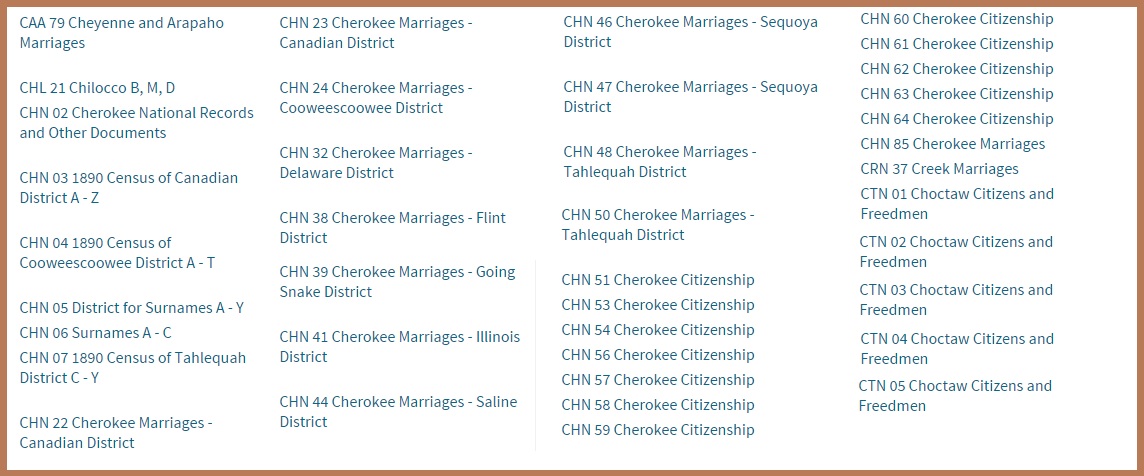
The following screenshot reflects selections that consist of the following:


3) Oklahoma and Indian Territory Marriage, Citizenship and  Census Records 1841-1929

Included in these records:


4) Oklahoma and Indian Territory, Land Allotment Jackets, for Five Civilized Tribes 1884-1934

The choices in this collection are seen in this screenshot image:


Hopefully this explanation of some of these new databases will assist many Indian Territory researchers in exploring their ancestral story. For many years, the focus has been exclusively on one set of records, but now as a result of the partnership and this recently digitized set of records, options are available for researchers, to explore families more easily and more efficiently.

In a future post, I shall present examples of the data to be found in some of the individual collections.