Showing posts with label Dawes Rolls. Show all posts

Monday, November 6, 2017

The Family Legacy of Philip A. Lewis from the Creek Nation


The Lewis family of Muskogee Oklahoma has already been profiled with much focus on the maternal side of the family. Philip and Elzora Lewis applied in front of the Dawes Commission in 1898 and Elzora's family story was outlined in an earlier post. However, the story of Philip Lewis is as detailed and one can go back even further when examining his own family history.

As presented before, the Lewis family resided in Muskogee, and appeared in front of the Dawes Commission in 1898 to enroll themselves and their children as Creek Freedmen.


Creek Freedman Card #105
The National Archives at Ft. Worth, Ft. Worth Texas 1868-1914
NAI Number: 251747

Record Group Title: Records of the Bureau of Indian Affairs, Record Group 75

(Reverse side of card)
Source: Same as above

Like so many cases, others, the Application Jackets for many Creeks simply do not exist, were never microfilmed, and have possibly been destroyed or hidden from the public domain. But thankfully a far better interview does exist for Philip Lewis, and like his wife Elzora, the Indian Pioneer project in the 1930s provided an opportunity for him to speak freely about his own family history. In addition, the full interview reflected an expansive knowledge of Creek history.


University of Oklahoma, Western History Collection
Interview with Phillip A. Lewis
Indian Pioneer Papers Digital Collection


Source: Same as above


Source: Same as above

Source: Same as above


From the interview, some glimpses into the lives of his family can be gleaned. Philip spent much of his youth in the care of his beloved grandmother Rachel. She was a caregiver to many and she nurtured many in her Creek community, though yet, enslaved. Rachel continued care for multiple children even during the post war years when they were now free, and allowed to attend school when of age. 

Philip attended school at Fountain Church for primary education, and later he attended the Tullahassee Mission School for Creek Freedmen. Education was a priority in the with Philip, and he became himself an educator, later teaching at the Tullahassee himself.

Image Source: Same as above


Tullahassee School
Courtesy Oklahoma Historical Society


Source: Same as above

Philip Lewis was one of the earliest known Freedmen who became an educator at the school that he once attended. Also it is noted that the Lewis interest in education continued well into the 20th century, for it was noted in the 1920 census, that Philip and Elzora's daughter Melvina worked as a school teacher at a unnamed "rural" school.

(part of 1920 Federal Census, Muskogee, Ward 4, District 94)


They lived mostly around the city of Muskogee, well into the 20th century. Phillip and Elzora's names are also found in a city director for Muskogee Oklahoma in the mid 1940s.


The Story of the Grandparents of Phillip A. Lewis

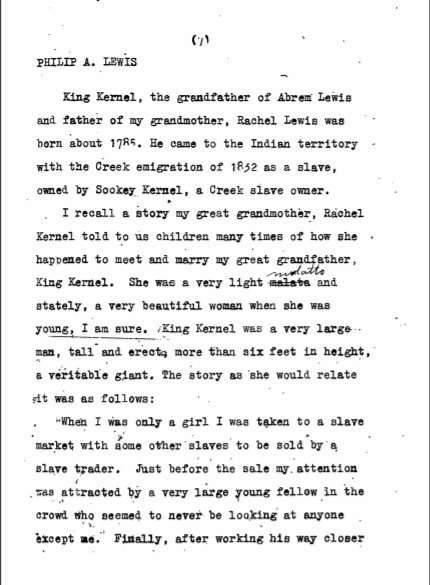
One of the many fascinating features in the narrative of Philip Lews was the story of his grandmother Rachel, and how she became the wife of King Kernal. The story is more than unusual, because it takes place at a place of sorrow and heartbreak---a slave auction.

He recanted the story that grandmother Rachel often told---of how she was being auctioned off to be sold to the highest bidder at a slave auction. One man in the crowd--another man enslaved, in fact, addressed her, and asked if his master purchased her, he asked if she would be willing to become his wife.  This is one of the stories in Indian history where the actual purchase of a slave is told from the perspective of the enslaved person's family.

In spite of it being a time of heartbreak, there was a degree of love that emerged between the two--enslaved people, King, and Rachel, and the love that grew from their union endured for decades, through enslavement, intro freedom, and to the cusp of statehood.


University of Oklahoma, Western History Collection
Interview with Phillip A. Lewis
Indian Pioneer Papers Digital Collection

Image Source: Same as Above

Image Source: Same as above


The Lewis family thrived well into the 20th century, with both Philip and Elzora living into the 1950s. Both of them had seen many changes from the era of slavery, the Civil War, the post Civil War years in the Creek Nation, to the years of westward expansion, the Dawes Commission era, into statehood and their eventual life as US Citizens. Their history is a rich one, going back over 200 years, and this strongly rooted Oklahoma family has a legacy that is honored and to celebrated.

Both are buried in Booker T Cemetery in Muskogee Oklahoma.

Image Source: Find a Grave


Image Source: Find a Grave

* * * * * * * * * *

This is the 34th article in a 52-article series devoted to sharing histories of families once held as enslaved people in Indian Territory, now known as Oklahoma. The focus is on the Freedmen of the Five Civilized Tribes, and these posts are part of an ongoing project to document 52 families in 52 weeks.

Monday, January 18, 2016

Historical Society Partnership Brings Forth New Records

Databases on Ancestry For Oklahoma & Indian Territory Research

In the fall of 2014 a special partnership between the Oklahoma Historical Society and Ancestry was announced. It was announced that some unique collections and holdings at OHS had been digitized by Ancestry, and they were now being made available to the public. One feature that many Oklahoma researchers learned right away were the images of the Dawes Cards, in the original color. This was a welcomed treat, because of the differences that the color images present.

However, it is clearly understood that one record set does not present the entire story and that there are many more records for those who have Indian Territory history as an interest. Thankfully the partnership has brought to life some amazing records previously unavailable outside of Oklahoma. These records are no in themselves "new". They are "new" in terms of their availability to the public more easily and are "new" to a wider audience.

Now, it is widely known by many that there are thousands of pages with images of records created decades before the Dawes Rolls, and for the tenacious researcher, they also should be examined in order to tell more of the ancestral story. These "new" records were made years before the Dawes Rolls, and the hold incredible information for researchers.


I have recently written two articles recently reflecting some of my own finds among these new records, and those articles can be read my Choctaw Freedmen Blog.

And since last fall's announcement, it has taken several months for me to analyze the actual content of the various databases and to note the differences between them. In addition, I have also found my own way of locating them quickly, and I am happy to share what I have been able to learn about them with my readers. 

The four databases listed above are massive, and each one holds a wealth of data, that I have outlined with screenshot images below.

Finding The Databases Quickly:

I have personally found, that the quickest way to get to them is to go outside of Ancestry to get back in. I make quick Google search with the following words: Ancestry, Oklahoma and Indian Territory.

By typing these words, this will bring all four of the databases to one page on the google search. See the following screen shot:


Google Search Results for New Oklahoma Collections on Ancestry


When on the Ancestry site, simply click on the desired collection and begin the search. It is important however to fully understand what each database holds, so I have inserted some screen shots from the site to illustrate the contents of the database.

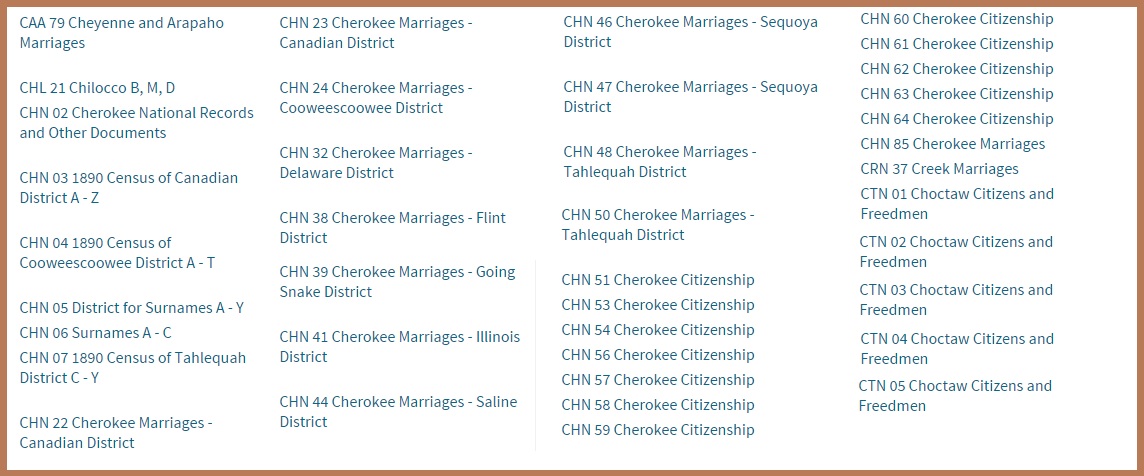
1) Oklahoma and Indian Territory Indian Census and Rolls 1851-1959

When on Ancestry, when clicking on the "Browse" Button the holdings appear like the illustration from the screenshot below.


                  The following screenshot reflects is a list of all of the holdings found in that database.


2) Oklahoma and Indian Territory Dawes Census Card for Five Civilized Tribes 1898-1914


This is where the Dawes cards, often called Enrollment Cards can be found. NOTE---there is another category on Ancestry that says Enrollment cards, but it is really an INDEX to the Enrollment Cards, and not the cards themselves. To see the actual Dawes Card--this database is the proper index to find them.

The following screenshot reflects selections that consist of the following:


3) Oklahoma and Indian Territory Marriage, Citizenship and  Census Records 1841-1929

Included in these records:


4) Oklahoma and Indian Territory, Land Allotment Jackets, for Five Civilized Tribes 1884-1934

The choices in this collection are seen in this screenshot image:


Hopefully this explanation of some of these new databases will assist many Indian Territory researchers in exploring their ancestral story. For many years, the focus has been exclusively on one set of records, but now as a result of the partnership and this recently digitized set of records, options are available for researchers, to explore families more easily and more efficiently.

In a future post, I shall present examples of the data to be found in some of the individual collections.

Tuesday, April 7, 2015

More Resources for Cherokee Freedmen Family History

The newly digitized in color images have been a pleasure to explore ever since they were announced when Ancestry partnered to bring more Oklahoma records to subscribers. Among the many new records now digitized, are some excellent resources for family history. Cherokee Freedmen, like descendants of other tribal Freedmen will be particularly thrilled to find the original color images of Dawes Cards.

Cherokee Freedman Card #850  National Archives Publication M1186 (Front Side of Card)

Back side of card

Source for Both Images: Enrollment Cards for the Five Civilized Tribes, 1898-1914; (National Archives Microfilm Publication M1186, 93 rolls); Records of the Bureau of Indian Affairs, Record Group 75; National Archives, Washington, D.C. [Note Ancestry has color images of original Dawes Cards.]

I am happy to point out  that there are additional resources for family history research for Cherokee Freedmen. Some reside on subscription sites while others reside on free sites. As many of these resources as possible should be used to construct the family history. Most are described for you here.

The Wallace Roll
This roll was conducted between 1890 and 1896, and it was compiled by John Wallace, who was a Special Agent. The roll was later rejected by the tribe and was not used for enrollment when the Dawes Commission began several years later. However, the roll still exists and it resides on the National Arhives website in its entirety. 


Image of a page from the Wallace Roll

Source: Record Group 75, Records of the Bureau of Indian Affairs, 1793-1999, 
Wallace Roll of Cherokee Freedmen in Indian Territory 1890-1896


Researchers can access the entire Wallace Roll HERE, where it resides on the National Archives website.

A Break for the 1890 Census
Most genealogists are aware of the lack of records reflecting the 1890 census year. Oklahoma researchers, and Indian Territory researchers in particular have many records to explore reflecting the years between 1890 and 1900 that this missing census year is not an issue for genealogists with Oklahoma ancestors. Ancestry has captured many of these records as well as other free sites, and they should all be explored. The better news is that the collections now available include hundreds of pages of census that even preceded the Dawes Rolls and the Wallace Rolls. 


Cherokee Census of 1896
In this particular census, Cherokee Freedmen were enumerated at the end of each district section. In the image below the "Adopted" Freedmen appear in the Tahlequah District, on final pages after the Cherokees "by blood" were enumerated. (This comes from the National Archives in Ft. Worth and has the reference number of 7RA-19).

 
Ancestry.com. Oklahoma and Indian Territory, Indian Censuses and Rolls, 1851-1959 [database on-line]. Provo, UT, USA: Ancestry.com Operations, Inc., 2014. Original data: Selected Tribal Records. The National Archives at Fort Worth, Fort Worth, Texas. Group 7RA-19 Cherokee 1896 Census


1893 Cherokee Census
Many researchers are not aware that in 1893 another census was conducted in the Cherokee Nation. And like later records they also had pages reflecting Freedmen in each of the Districts of the Nation.


Ancestry.com. Oklahoma and Indian Territory, Indian Censuses and Rolls, 1851-1959 [database on-line]. Provo, UT,  USA: Ancestry.com Operations, Inc., 2014. Original data: Selected Tribal Records. The National Archives at Fort Worth, Fort Worth, Texas. Group 7RA-54 Cherokee 1893 Census

In some cases notes were made in the "remarks" column to explain a bit of additional data about the family enumerated.

(Notes made about family enumerated on census page.)


The 1890 Cherokee Census 
During this census year an enumeration of residents was also conducted in Indian Territory.  There are 6 reels of microfilm for this record set, and all are digitized on Ancestry. 


Ancestry.com. Oklahoma and Indian Territory, Indian Censuses and Rolls, 1851-1959 [database on-line]. Provo, UT, USA: Ancestry.com Operations, Inc., 2014.

Within this short collection are six different census schedules. 

Schedule 1 consists of those considered Cherokee Citizens, This schedule included Freedmen of the Cherokee Nation. 
Schedule 2 consists of children identified as orphans, and 
Schedule 3 consists of those considered "non-citizens."
Schedule 4 consists of those not classified as citizens but who claimed citizenship.
Schedule 5 consists of those who were considered "intruders" upon Cherokee land.
Schedule 6 consists of non-citizens who lived on Cherokee land with permission.

Sample page from Schedule 1: This page reflects Cherokee Freedmen. It clearly states their entitlement to citizenship.

1890 Cherokee Nation Census 1890 Schedule 1
This second image reflects a closer view of the names listed on the document.
(Closer view of same image)
Source for both images: Ancestry.com. Oklahoma and Indian Territory, Indian Censuses and Rolls, 1851-1959 [database on-line]. Provo, UT, USA: Ancestry.com Operations, Inc., 2014.
Brief look a schedule 6

Many persons who were considered to be non-citizens were also captured in the census of 1890, on Schedule 6. The heading clearly indicated their non-Cherokee status. This particular census year is interesting, because one should note that in the year before, in 1889 the first Oklahoma Land Rush occurred. As a result many non-Cherokees were present even in the Cherokee Nation itself and were simply enumerated as "American"  and in latter pages as "white" under the column for "Race or Nationality" 
Page from 1890 census showing Non-Cherokee residents

Cherokee Freedmen were not listed on this non-Cherokee census schedule.

It is helpful when using census records of any source to pay close attention the instructions that census takers were given. The descriptions for each of the schedules for this 1890 Cherokee Nation census are spelled out clearly.

Full description of 1890 Cherokee Nation Census schedules.

Source: Ancestry.com. Oklahoma and Indian Territory, Indian Censuses and Rolls, 1851-1959 [database on-line]. Provo, UT, USA: Ancestry.com Operations, Inc., 2014.


Land Allotment Applications
A final suggestion for Indian Territory research is to look at the records for Freedmen Land allotment applications. These are fully digitized images and they reflect the actual location of the original land allotment of the family members that were approved on the Dawes Rolls. All of these pages which number over a million, are located on the Family Search website and can be accessed free of charge.


Earlier Cherokee Freedmen Records
There is a unique set of records covering a wide span of years, which are strictly Cherokee Freedmen Records.  The records like most of these images come from the Federal Record Center in Ft. Worth Texas. This is the set of records known as Cherokee Freedmen Rolls and Indexes 1867-1897. 


Within that collection, one will find the 1880 Cherokee Freedmen Census.


Original data: Selected Tribal Records. The National Archives at Fort Worth, Fort Worth, Texas. Group 7RA-51 Cherokee 1880 Freedmen Census

Hopefully these sample documents will provide more information for Cherokee Freedmen historical researchers seeking to learn more of the people in the Freedmen communities and who they were, and how they lived. Using these records will assist many historians, and genealogists, and they will thereby aid in telling the story more effectively for generations to come.

Tuesday, November 4, 2014

Color Images of Dawes Cards Now Available!


National Archives Publication M1186, Choctaw Freedmen, Card #777
Sam and Sallie Walton & Family, of Skullyvlle, I. T.

Several months ago, I had a chance to speak with a representative from Ancestry, who shared with me that some good news was going to come out in November for Oklahoma researchers. Well, November has arrived, the good news has now been made public. Ancestry has acquired the Dawes Enrollment Cards, and now has all of them fully scanned in color! Although there are other online sites that contain Dawes cards, this is a treat to see the original image in full color. I was also pleased to learn that all of the cards were scanned in color, including the Freedmen of the Five Tribes.

What makes this special is that with many of the documents originally scanned in black and white, such as that of my gr. grandparents, (see images above and below) the place on the card where some tape was applied, can now be seen. On the black and white scanned image, the tape comes through as a solid black mass, and one cannot see through the faded transparent tape to view the words. (See two images.)


And what also makes having the color images available is that small details now appear more clearly on the card, some of which were a bit hard to see without tweaking the image. It should also be pointed out that there are many cards that had annotations made in different colors. The roll number was actually stamped in blue ink, and now with the color images, that can be seen.


National Archives Publication M1186, Choctaw Freedmen Card #778


Several years ago, I noticed that the first card among Freedmen cards in almost every tribe were often in very poor condition. Some were perhaps in poor condition because of exposure to sun, or had been damaged by some kind of liquid. So I was anxious to see how the new color images appeared with color scanning, so decided to look at Card No. 1, of the Choctaw Freedmen, that of Simon Clark. I know that his card had seen a lot of deterioration, and now with the color image, all of the markings appear much clearer.

Choctaw Freedman Card No.1

National Archives Publication M1186 Choctaw Freedmen Card No. 1


Cherokee Freedman Card No. 1
Cherokee Freedman Card No. 1 is also quite damaged, and the color image provides more opportunity for better analysis. Note the difference between the two, and note how having the color images allows for very faint writing to now be seen.


National Archives Publication M1186, Cherokee Freedman Card No. 1
Color Image


Chickasaw Freedman Card No. 1
National Archives Publication M1186 Chickasaw Freedmen Card No. 1
Color Image


Creek Freedman Card No. 1
National Archives Publication M1186 Creek Freedmen Card No. 1
Color Image


Seminole Freedman Card No. 1
National Archives Publication M1186 Choctaw Freedmen Card No. 1
Color Image


For Seminole Freedman Researchers, it should be noted that there is a slight error in the way that Seminole Freedmen Cards are scanned and labeled

The numbers on the Ancestry index for Seminole Freedmen says 600-699, 


However, when looking at the first seven images, they are actually the very end of the Seminole By Blood cards. With image #8 in that set of cards designated as Freedmen 600-699, the beginning of the Freedmen cards appears on what should be #609. In reality it is Freedman Card #1, that of Ceasar Bowlegs. 

So at first the early numbered cards for Seminole Freedmen might appear to be impossible to find. However, they are there, and are found in the subset erroneously labeled "Seminole Freedmen 600-609."

In all other cases the scanning is accurate, and it is still quite wonderful to see these records now in their original condition! Hopefully for some new data will be extracted previously unknown, or unseen. Having access to these color images, breathes new life into these valuable records!