Showing posts with label Cherokee Freedmen. Show all posts

Thursday, July 28, 2022

The Hearing on Capitol Hill


Senator Schatz Chairman of the Committee on Indian Affairs

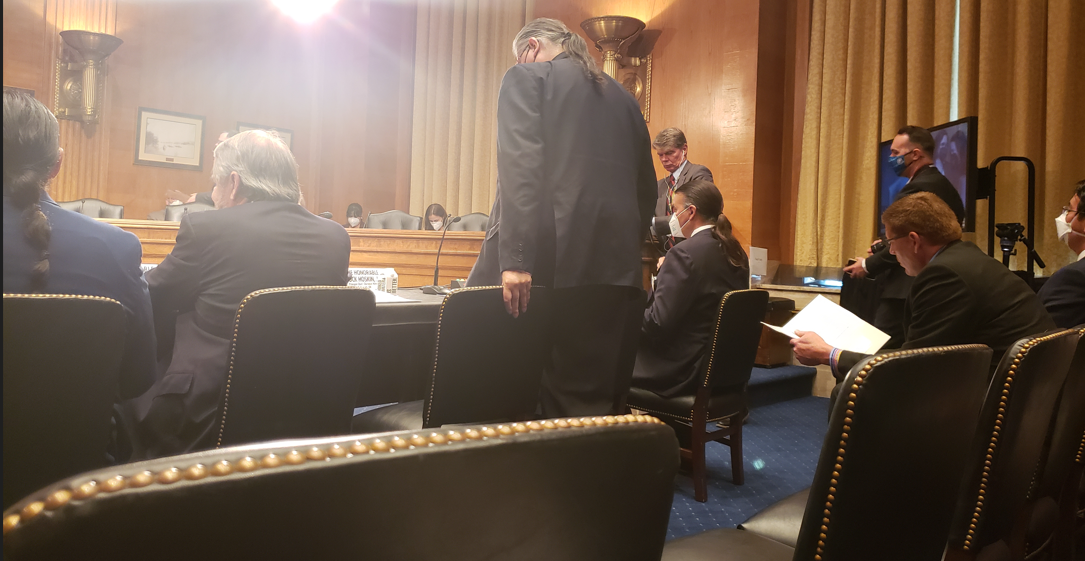
July 27th 2022 was a landmark date. For the first time in history a hearing on the status of Freedmen of the Five slave-holding tribes, occurred to address the neglicence of both tribal officials and Congress in issues pertaining to those once enslaved.

Focus of the hearing:  
Oversight Hearing on 1866 Reconstruction Treaties Between United States and Oklahoma Tribes.

The hearing was chaired by Senator Brian Schatz (D. Hawaii) and in attendance were descendants of Freedmen from all five tribes, whose ancestors were once enslaved in those nations. The tribes sent their own representatives to testify on their behalf. Representatives from the Cherokee, Choctaw, Chickasaw, Creek and Seminole Nations were all present. Each represenataive was given 5 minutes to present an official statement. Only one speaker on behalf of Freedman was included.

The first panel consisted of only one presenter--Congresswoman Maxine Waters, who had long recognized the issues affecting descendants of Freedmen, many of whom now live in her district in California. 

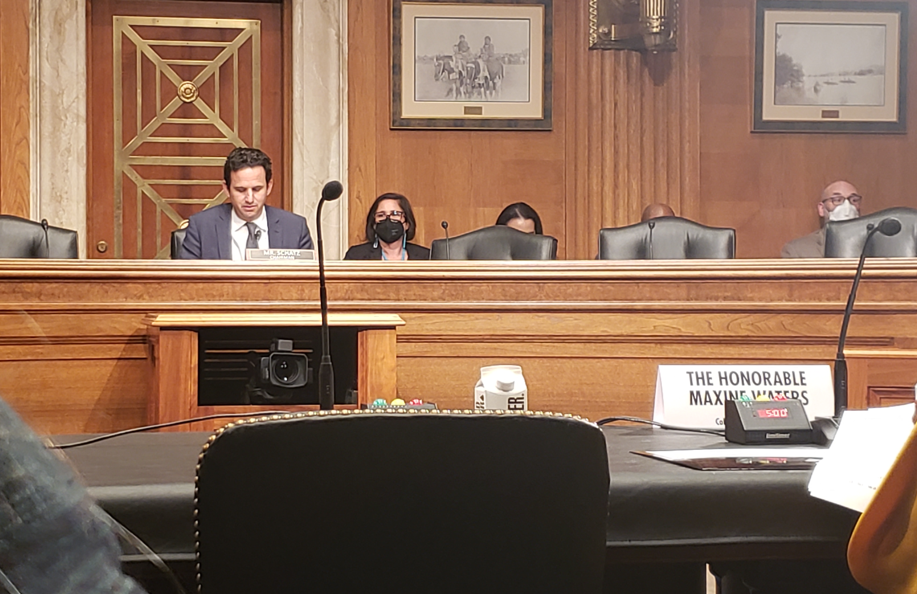
Congresswoman Maxine Waters speaks to Senate Committee

The second panel consisted of multiple speakers from the Five Tribes, in addition to a representative from the Department of the Interior, Bryan Newland, and the sole speaker from Freedmen, Marilyn Vann an enrolled citizen of the Cherokee Nation and President of the Descendants of Freedmen Association. 

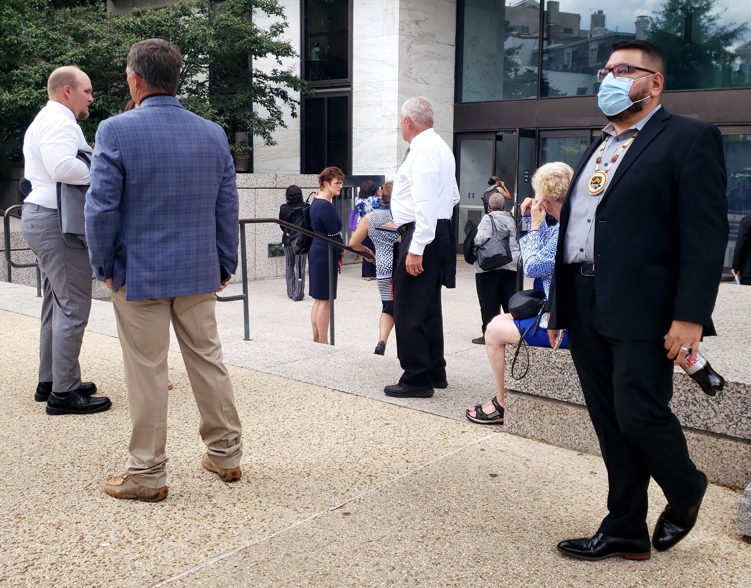
The audience consisted of Freedmen from all five tribes, many of whom met and gathered prior to the hearing outside of the Hart Building on Capitol Hill and who met for the first time. The hearing was historic because Freedmen who have ancestors documented ties to each tribe were present for the first time in Washington to attend an event addressing their issues.


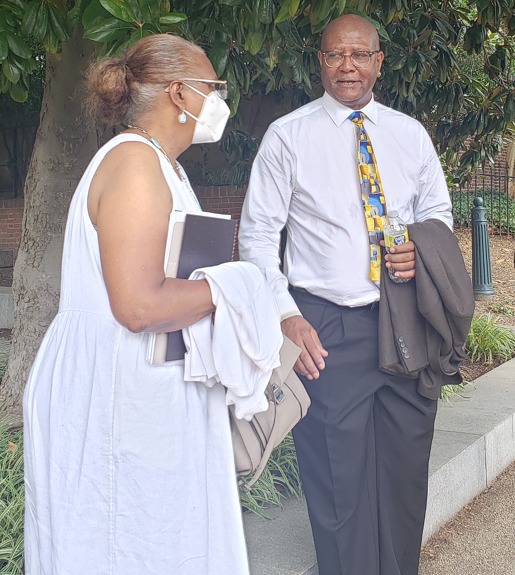
Dorris Burris Williamson and Terry Ligon


Attendees Gathering Before Hearing


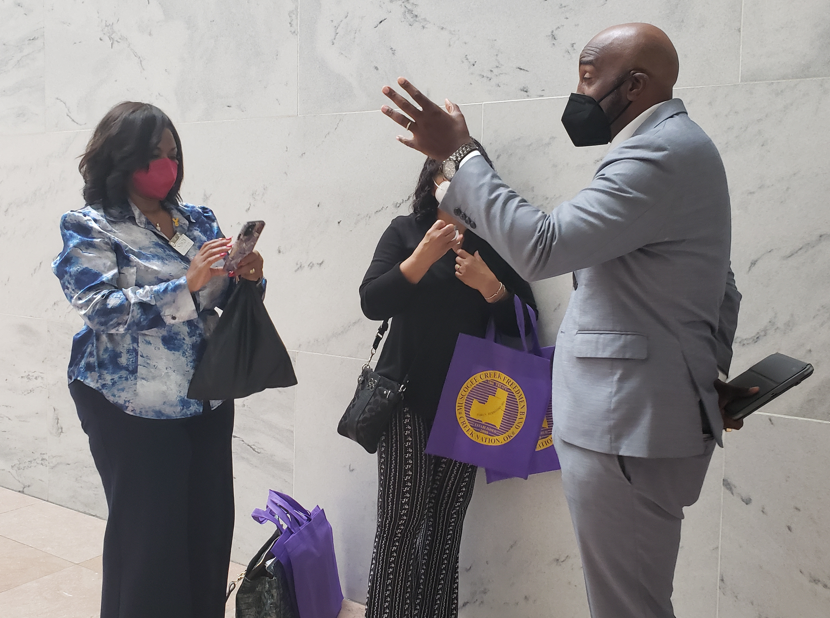
Creek Freedmen in Discussion Before Session


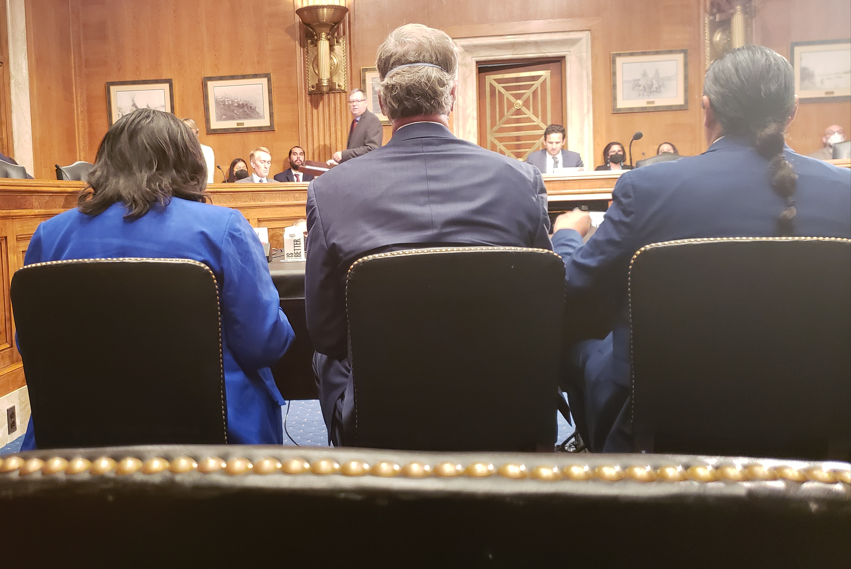
Panel 2 Listening as Congresswoman Waters speaks

It did appear that there was a strong interest expressed by the committee as they listened to the presenters. In addition some of the questions asked by the committee members were left unanswerable because the issues such as the size of the Freedmen descendant popultation have never been studied.


Senator Lankford of Oklahoma Listened intently to presenters


Partial view of Panel 2


Another view of Panel as seen by audience


Speakers from the Seminole Nation of Oklahoma


Speaker Representing the Choctaw Nation of Oklahoma


Speaker Representing the Muscogee (Creek) Nation


Speaker Represnting the Chickasaw Nation of Oklahoma


Speaker Representing the Oklahoma Freedmen 

The hearing began shortly after 2:30 pm and lasted until about 4pm. Some evaded questions directed to them and others answered questions when directly asked. The outstanding voice pertaining to the treaty and its history came from Principal Chief Chuck Hoskins of the Cherokee Nation of Oklahoma. who addressed the past as well as the present. Since the ruling in 2017 that confirmed the status of the Freedmen in the Cherokee Nation, Hoskins pointed out that close to 12,000 descendants of Freedmen have been admitted to citizenship in the nation and he was quoted as saying that they are a better nation because of it.

There will clearly be multiple disussions in many forums and platforms over the next few weeks. It is hoped that the hearing will be a new beginning in the movement to create awareness of the history of the Oklahoma Freedmen, and many more of the stories that pertain to their presence on the soil of Oklahoma will emerge.


Sunday, June 19, 2022

Celebrating Freedom in Indian Territory


For many years in the late 1800s Freed people from the Five Tribes celebrated freedom throughout the summer months. Many Indian tribal Freedmen, in the eastern most part of the Cherokee and Choctaw Nations, started celebrating Freedom the same time their neighbors did in nearby Arkansas. Some in the southern part of the Choctaw and Chickasaw Nations started celebrating Freedom the same time their neighbors did in nearby north Texas.  

However, the most interesting part of the Freedom story is reflected in the fact that throughout many parts of Indian Territory, a celebration of Freedom actually occurred for many years on August 4th. Several references to the August 4th celebrations were mentioned by former slaves when interviewed in the1930s and their intervviews were captured in the Indian Pioneer Papers. The day was celebrated for many years and believed by many to be the day that Freedmen came to their families, but so far, the actual choice of August 4th still is unexplained. Nevertheless, Freedom was embraced and honored and celebrated by those once enslaved and freed from bondage. 

In the 1930s Elizabeth Ross, a field worker for the Indian Pioneer project, spoke with several former slaves about the celebrations they frequented during their lifetime. She spoke with two individuals who provided her with rich information, E. P. Harris and Dennis Hendricks. Here are some excerpts from her article about Freedom celebrations. (1)

 Cherokee Nation

"During a number of years when Cherokee government was in existence, it was a custom of the Freedmen or former slaves of Cherokees and their descendants to observe August 4th as the anniversary of their emancipation. As a matter of historical fact, the Cherokee emancipation was issued in the month of February 1863. Just why the August date was selected is not clear, but no doubt many were of the belief that the fourth day of that month was the date up which freedom became their possession."

In the Cherokee Nation, large outdoor picnics unfolded in Talequah, Fort Gibson and other large Freedmen settlements, consisting of speakers, singing events, and of course large amounts of food for the celebrations. Many of the invited speakers were local leaders, of all background, whites, tribal leaders, and well known preachers.

One of the larger events was observed in Tahlequah in the late 1870s where a long line of horsemen formed part of an impressive parade. Ross describes the event:

"A long line of horsemen formed on the banks of a small stream nearly a mile south of the town, and then a procession headed by a man with drawn sword, beside whom rode another man carrying a United States flag, rode back and through the main street of Tahlequah." 

Years later celebrations were occurred on the "May Party Grounds" the same spot where the 7th of May anniversaty celebrations occurred. Years later, large events were also noted in communities like Four Mile Branch in Fort Gibson.

Creek Nation:
Aaron Grayson was interviewed in the 1930s and described the celebrations that he recalled from the 1870s till the early 20th century. (2)

"There was an annual celebration held each year from the period from 1870 on up until the early part of 1900, which was held by negroes and freedmen. The white people observed Independence day on July 4th, while the colored people observed the Emancipation Day on August 4th. The observance of this Emancipation proclamation was mainly for and by negroes and freedmen, yet the Indians and whites were welcome to attend the celebrations.

There were always good times, because no one became drunk, quarrelsome or tried to pick a fight, but only a feeling of good comradeship was felt by all who participated in the events. Of course the Lighthorsemen and the United States marshals were present to check any trouble and to keep peace and order. Many new acquaintances and lasting friendships were often made at these gatherings.

..."When the day of the big celebration arrived, the people did not come poking around one by one but they came in groups or by bands, such as the Bruner band, the Topkafka band, etc. These people had assembled at one of the tribal towns from where they had come to the celebration as early as they could. They came on horses at a gallop, laughing joking and  yelling and were heard miles away before they finally came to the chosen place of the event."

Aaron Grayson goes on to describe how the various bands arrived and the cannons would be fired as they arrived and marched in circles around the flag pole signaling their arrival. The food was prepared by the women which was a massive barbecue feast. All in attendance, native Creeks, whites as well as Freedmen and state negroes who all shared in the massive amounts of food. Grayson also described events such as selection of the day's queen, and his descriptions of the clothing worn by many of the horsemen was quite colorful. Many of these events were held at Wetumka and Wewoka, and the last major event occurring in Tuskegee town.

Choctaw Nation

In August of 1938. Sallie Henderson Moss was interviewed by James Russell Gray of the Pioneer project. She desribed her life in the Skullyville district near Brazil Station, in the Choctaw Nation. In her interview, she recalled the celebrations of emancipation in August. (3)

"The colored people used to have picnics on the 4th of August. They would have big barbecues with lemondade, stick candy and everything. They were celebrating the freeing of the slaves. The Choctaws freed their slaves, you know on August 4th. They would kill hogs and beeves, and have dances and general good times"

Sometimes the colored people would take sacks full of herbs called "devil's shoestring" and put the stuff in the creek the way the Indians taught them to. This devil's shoestring made the fish drunk and the fish floated to the top of the water and could be caught. We would have fish fries for our picnics."


The stories about the celebration of emancipation is an interesting one, particularly because so many embraced August 4th as the day to commemorate freedom, although freedom was actually not uniformly in August. Each of the tribes eventually abolished slavery officially when the treaties of 1866 were signed. However, it should also be remembered that many found freedom much earlier than that time.

Many had become free during the Civil War when some had joined various regiments of the union army. And sadly, at the same time, in some parts of the Chickasaw Nation many did not enjoy freedom until at least two years after the war, as there was much resistance in parts of the Chickasaw Nation to allowing their enslaved people to taste freedom.

Nevertheless, now that there is a legal holiday where descendants of the enslaved perhaps some of the long forgotten traditions will emerge again. To think that there has never been before now, any effort to celebrate freedom from slavery is quite incredible. We must celebrate our freedom, like the people of Galveston. Freedom is a basic right of all people, and truly we must find ourselves among those celebrants. Our own ancestors truly knew the value of being free to make one's own choices in life. Whether it it June 19th or August 4th or all days in between---we must embrace the joy of Juneteenth and how at some point in the lives of our ancestors--the trajectory of their lives changed when Freedom came.

H a p p y  J u n e t e e n t h ! ! ! 


Citations:


1 Digital Collections, University of Oklahoma, Western History Collections, Indian Pioneer Collections, Elizabeth Ross, Volume 109,  Interview ID 6764 Freedom Celebrations

2 Ibid  Volume 35, Interview ID 7458 Aaron Grayson

3 Ibid Volume 65 Interview ID 13620 Sallie Henderson Moss

Sunday, February 13, 2022

The Interesting Case of Moses Whitmire, Cherokee Freedman Trustee


When studying articles from the 19th century Indian Territory, anyone with an interest in Freedman history will note that numreous articles in the press appeared about the former slaves and the many struggles that they encountered. Some articles were about struggles for citizenship and equal rights and others made interesting references to schools and institutions established by and for Freedmen.
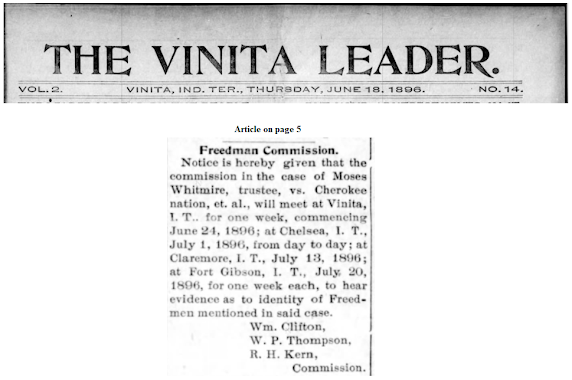
And one interesting case arose pertaining to funds set aside for Freedmen emerged in the Five Tribes, and one of them was the case of Moses Whitmire trustee for the Freedmen of the Cherokee Nation.

A special commission was appointed to represent the nation in a major suit known as Cherokee Nation v. Moses Whitmire, a case which began to cause much discussion in the late 1890s. The case involved not only specifically the rights of Cherokee Freedmen, but specifically the issue pertaining to funds that were to be set aside for Cherokee Freedmen.

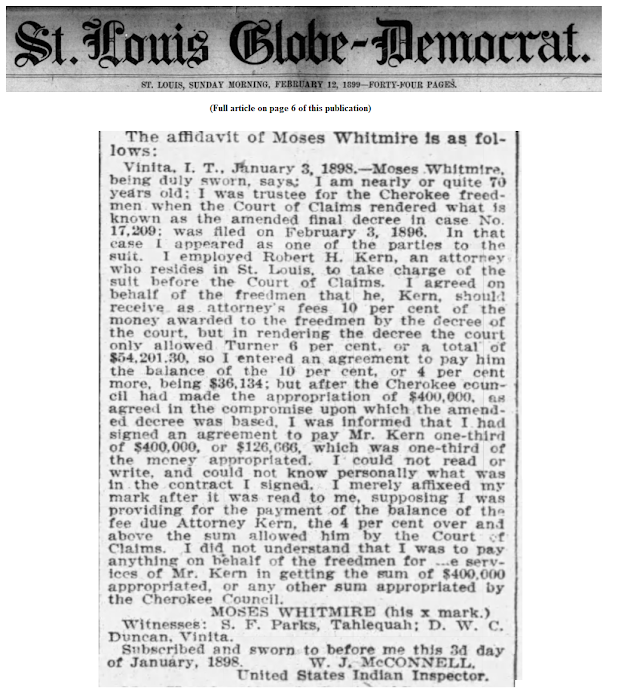
The issue was that of $400,000 to be provided for freedmen, and from 4% to 10% to go to two attorneys from St. Louis---Robert H. Kern, and J. Milton Turner. Whitmire was an elderly man had been appointed as trustee for the freedmen, but soon charges were brought up against him about the funds and a mishandling of funds, and allegations that he had promised a larger amount of the money to the attorneys and allegations arose about mishandling of funds. Whitmire refuted this, and made his own statement. He pointed out that he was unable to read or write and that a document that he was said to have signed was not read or understood fully by him. An article from the St. Louis Globe Democrat carried his statement in a piece about the matter.


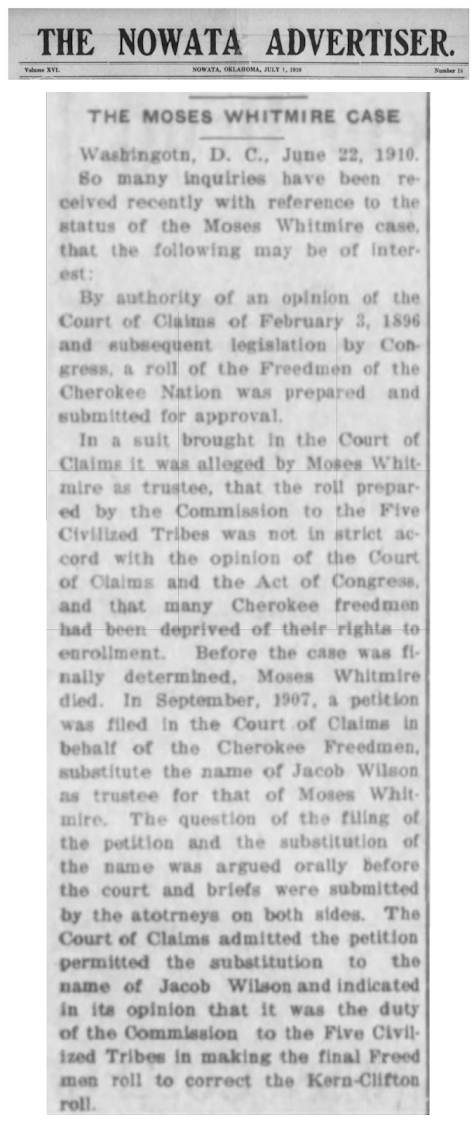
Ten years later the issue was still being discussed. by that time, Moses Whitmire had died but an interesting summary of the case appeared in a publication from Nowata, C.N.


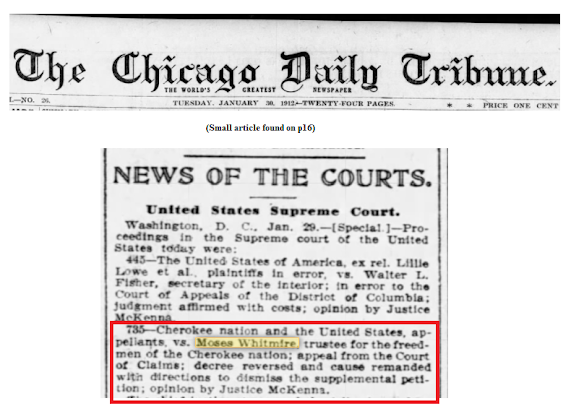
Two years later the issue had reached the U.S. Supreme Court, and a brief article from the Chicago Tribune describes how the issue was handled.


The Moses Whitmire case is a rare instance of a case from Indian Territory pertaining to Freedmen, appearing in the US Supreme Court. A few years earlier Equity 7071 involving Chickasaw Freedmen was to have been argued in front of the Supreme Court, but the attorney never filed the brief and thus, it was never heard. The Whitmire case appears to be one of the few cases that appeared, even if only briefly in the nation's highest court.

The plight of Freedmen from all of the tribes was one that was disputed and argued repeatedly in the post Civil War years,  and it appears that the case of Moses Whitmire was no exception. It is also clear that victories were few if ever won during those trying years before statehood.

And for Moses Whitmore the man, very little is known. In his younger years he was enslaved by Cherokee George Whitmire. By the time of the Dawes Commission, he was 70 years old, and he was most likely one who also came to the Territory during the Removal period. His mother's name was Peggy, also enslaved by Whitmire, and his father's name is not known. He resided in Hayden, in the Cooweescoowee District of the Cherokee Nation. As an elder his being selected as a trustee it is clear that with his being given such a position, he may have demonstrated other aspects of being a leader or man of influence among Freedmen.

 Not much is known about the descendants of Moses Whitmire and after over a century is it not known if they are aware of their ancestor's quest and position as a trustee for Cherokee Freedmen. Hopefully more will be known about Mr. Whitmire, the man, and of his quest to represent his community.


Cherokee Freedman Card #972
Ancestry.com. Oklahoma and Indian Territory, U.S., Dawes Census Cards for Five Civilized Tribes, 1898-1914 [database on-line]. 
Lehi, UT, USA: Ancestry.com Operations, Inc., 2014.

Original data: Enrollment Cards for the Five Civilized Tribes, 1898-1914; (National Archives Microfilm Publication M1186, 93 rolls); Records of the Bureau of Indian Affairs, Record Group 75; National Archives, Washington, D.C


Tuesday, March 2, 2021

Remarkable Freedwomen of Indian Territory


Left to Right:
Top Left-Sallie Walton, Top Center-Bettie Ligon, Right Center-Hagar Meyers
Bottom Left-Malinda Hall, Bottom Right-Lucinda Davis


Since March is Women's History Month, I thought that I would honor some often overlooked Freedwomen from Indian Territory. 

There are some women whose name should be said aloud. They are seldom mentioned in annals of Oklahoma history and even less so in the texts of tribal history. However, freedwomen from the Five former slaveholding tribe were not passive pawns in a system that worked against them. They lent their bodies and minds and spirit to cause to uplift those of their community. Some spoke up and showed courage during times of conflict. Others dared to resist and insist that they be acknowledged for who they were. Others simply told their story with all of the cultural nuances that they embraced. And others nurtured children who lived to tell their stories.

These were patient souls from whom we descend.  Some were well known, and others were simply quiet steadfast warrior women, worked tirelessly in their own domain. It is from such women who were the matriarchs of the families, and we must speak their names. These daughters of Oklahoma soil should no longer be bypassed in the annals of history. We honor them.

So weekly I shall profile at least one Freedwoman from Indian Territory, whose life was an inspiration and whose story deserves to be told.

To be honored this month: 

Sallie Walton, Choctaw Freedwoman, Matriarch of the Walton family of Skullyville
Bettie Ligon, Choctaw & Chickasaw Freedwoman - Head Litigant in Equity 7071
Hagar Meyers, Creek Freedwoman - Peacemaker woman of courage of the Green Peach War
Malinda Hall, Choctaw Freedwoman - Instructor and Educator of Choctaw Freedmen
Lucinda Davis - Creek Freedwoman - Survivor of Slavery, cultural storyteller of life in Creek culture

May they  never be forgotten.


Tuesday, February 16, 2021

Honoring Cherokee Freedmen Civil War Freedom Fighters


 In the US Civil War, men of African Descent were active in the quest for freedom.  Some had followed Creeks into Kansas. While there, some found themselves in a new status--that of free men. The opportunity to engage in the battle for freedom, several enlisted in one of three groups--Indian Home Guards, 1st and 2nd Kansas Colored Infantries, or the US Colored Troops. Note that the 1st and 2nd Kansas Colored regiments were later re-designated as the 79th and 83rd US Colored Infantries, respectively.

Cherokee Freedmen are found mostly among US Colored Troops, in both 79th and 83rd regiments.  However, a few names are found in other regiments as well. 

To honor Cherokee Freedmen Civil War Soldiers a partial list is placed here. Additional research is much needed to compile a comprehensive list, and hopefully someday such a project will be undertaken. Many of these men died during the war, and others died prior to the Dawes enrollment era, so many names have simply been forgotten with time. And some were born and enslaved in the Cherokee Nation, but moved away from the Territory in later years. Thankfully, Civil War records reflect their names, and their place of birth, their names can still be called and should be remembered.

Partial List of Cherokee Freedmen Civil War Soldiers

Indian Home Guards
Buck Bushyhead

11th US Colored Infantry
Aron Alberty 
George Bench

79th US Colored Infantry

Moses Carter
Wiley Carter
Thomas Daniels
George C. Davis
Isaac Rogers
Franklin Ross
Nelson Ross
Thomas Ross

83rd US Colored Infantry

Amos Adair
Andrew Brewer
Jacob Brewer
George Bushyhead
Moses Fields
Zachary Foreman
William Funkhauser
James Geary
Ephraim Isaac
Andrew Johnson
George Johnson
Israel Johnson
Moses Johnson
Henry Kidd
Dick Linch (Lynch)
George Martin
Hugh Martin
Toby Martin
Melton Washington
Edward Peter
Lewis Theodore
Burgess Thomas
John Webb
Daniel Webster
David Whitman
William Anderson
Aughter Williams

May the service of these men of the Cherokee Nation who served honorably in the Civil War and the quest for freedom, be remembered and honored. 

Tuesday, February 9, 2021

Remembering the Cherokee Colored High School


Courtesy of Dr. James McCullaugh, University of Northern Iowa

A few miles northwest of Tahlequah, Oklahoma, somewhere lost overgrowth one might find what may still remain of an area known as  Double Springs, I.T. In that area, there may be a few bricks that may be the remains of the Cherokee Colored High School. Original plans were to place this school in the Bartlesville area, but those plans were changed when white citizens of the Bartlesville area thwarted the plans, wishing to have no Negro school in their area. 

The site was selected in a very remote location away from any city or town. S. W. Ross was interviewed in the 1930s about the school and he summarized the history briefly in the Indian Pioneer Papers:

 
University of Oklahoma Libraries, Western History Collection
Interview with S. W. Ross, October 29, 1937


The building stood empty for a few years except for one caretaker after the school closed. It was then set ablaze and burned to the ground. The school was the one sole school for Cherokee Freedmen, citizens beyond the primary grades. 

A detailed history of the school was written by Dr. James McCullaugh from the University of North Iowa. The journal was published in the 2010 issue of Voices of Indian Territory.

The schools is one of the missing landmarks of Oklahoma Black history. Hopefully its history will not be forgotten.

Monday, February 1, 2021

Freedmen History Month Begins Week 1: The First Freedmen Documented


As many in the country are launching various aspects of Black History Month, I have decided to honor and celebrate my corner of the diaspora by honoring the Freedmen of Indian Territory, now Oklahoma.

The Freedmen were those people once enslaved, by Five tribes--Cherokee, Choctaw, Chickasaw, Creek and Seminole Nations. In addition there were some some free people of color who had not been enslaved, who were also categorized in the post Civil War years as Freedmen. After the war ended, the tribes that had fought with the south in the Civil War, signed a treaty with the United States to abolish black chattel slavery. The treaties were signed in Ft. Smith Arkansas, and the official ending of black chattel slavery ended. Though it took some time in many communities such as with Chickasaw Freedmen, freedom did eventually come to all of those newly freed slaves.

In spite of effort to remove them from the Territory--their tribal nations had been their home for decades and they remained. By the end of the 1900s there were over 20,000 people designated at Indian Tribal Freedmen. They were part of the Dawes enrollment process that made them eligible for land allotments prior to Oklahoma statehood.

Though the process did not treat all Freedmen equally, they still acquired their land, and they remain among the most documented people of African descent to live in Native American communities, and who lived with the culture, language, folkways, and spaces. Their presence is a strongly documented one, and their voices are among the least heard when speaking to their amazing history.

During Black History Month 2021, this will be a series devoted to honoring their history, their presence, their stories and their legacy.

This week's focus will be on The First Freedmen.  These are the Freedmen on the Dawes Roll found on Card #1 in each of their tribal nations. Throughout this week the story of each of those First Freedmen will be examined and shared.

Follow each day this week to read about these individuals and their history.

Cherokee Freedmen Card #1:  John Ross & Family
Choctaw Freedman Card #1: Simon Clark  Family
Chickasaw Freedman Card #1: William Alexander & Family
Creek Freedman Card #1: Paro Bruner & Family
Seminole Freedman Card #1 Caesar Bowlegs

Saturday, April 20, 2019

Freedmen of the Frontier

Freedmen of the Frontier


The book is here!

In 2017 I decided to undertake a year-long project to document 52 families in 52 weeks. The families to be documented were Oklahoma-based families that originated in Indian Territory among the Five "Civilized" Tribes-Cherokee, Choctaw, Chickasaw, Creek and Seminole Nations. These were African American families whose elders had at one time been enslaved by Native Americans.

The project ewas inspired by a popular genealogy blogging meme of documenting 52 ancestors in 52 weeks. But with this project the goal was to document the families from these nations, because so little is written about these families from the soil of what is now Oklahoma, although their enslavement, emancipation, and families were rooted on that soil.

By years's end, I had met the goal of putting the family stories out there, but decided to move the stories from my blog to book form, so that more people who have ties to the Freedmen of those nations, will be able to easily access these stories. Many people will find it easier to read their stories in book form than will actually go online and find their family story there.

The families profiled in the book are listed below:


The book can be ordered directly from AMAZON.

Saturday, December 30, 2017

The Family of Joe and Belle Davis -Cherokee Freedmen

Sons of Joe and Belle Davis, Cherokee Freedmen, Courtesy of Steve Spencer Top row: Willie Davis, Joseph Davis, Curtis Dan Davis, Middle Row: Jim Davis, Thomas Davis, Bottom Row: Carl Davis, Charles Davis, John Davis

The Davis family of Vinita, in the Cherokee Nation has a very rich history. Joe Davis the patriarch appeared in May 1901 to enroll his family as Cherokee Freedmen. He provided the names of each of his children, Sadie, Willie, Thomas, Joseph, Dan, Carl, and Charles. Two other sons not on the card were adults and had enrolled on their own card. It is recorded that Joe had at one time been enslaved by Kinnie Davis.

There are additional notes on the card referring to more information on the family. The Davis family names had also appeared on the Kern Clifton Roll--referred to at the K.C. roll. In the lower left part on the page it is noted that there are other relatives to be found on Cherokee Freedmen cards #1200-1204.

The National Archives at Ft. Worth, Ft. Worth Texas 1868-1914
NAI Number: 251747, Record Group Title: Records of the Bureau of Indian Affairs, Record Group 75

His father was Tom Faught and his mother's name was Betsy Davis. Tom Faught had been a slave and was enslaved by Peggie Faught, and his mother Betsy was once enslaved by Wm. A. Davis. The family resided at that time in the Cooweescoowee District of the Cherokee Nation. It can be assumed that Joe took the name of his mother as the family name was not Faught. No other information is provided on Tom Faught, other than the name of the slave holder.

Also note--the family was originally placed on the "Doubtful" card as there was a concern about their eligibility for enrollment. Their names were later moved to an approved card in 1904.

(Same as above)

Application Jackets

Joe Davis was interviewed on May 16, 1901 in Vinita, Indian Territory in the Cherokee Nation. The questions began immediately about Joe Davis and his status as a recognized Cherokee Freedman. His name dd not appear on the 1880 roll of authenticated Cherokee Freedmen, which immediately made the commissioners willing to find reason to prevent his enrollment as a Cherokee citizen. He identified his wife and children when asked, and identified also the name of the Cherokee who enslaved him--Kinney Davis. His mother Betsey had died before 1880. 


National Archives Publication M1301,
Applications for Enrollment
(Also accessed from Fold3.com, Native American Collection, Choctaw Freedmen)

In front of the committee, he presented a record of the family, and he indicated that the record that he had was abandoned by the Davis slave holding family when they had left it the estate at the end of the war. This is more than significant----Joe because he shared a document--a book that contained the names of all of the slaves held by the his family's slaveholders. The document is not found in this packet, and it can be assumed that he took it back and kept it. But on this page it is clearly stated, that he shared a book with the examining committee.

It should be pointed out, that few if any slave records from Indian Territory have ever survived, and at this time, , the Davis family still retained what they were able to found--a record confirming their own enslavement. It this record still exists by the descendants it should be preserved or placed in a county or state archives or museum, because its is a very rare slavery era record coming from Indian Territroy before it became Oklahoma. 

On that page, Joe Davis was asked about the slave owner Kinney Davis. The document states:
Q. You were a slave of Kinney Davis?
A. Yes sir.
Q. Is Kinney Davis here?
A. No sir. Here is his family record, every slave that was on there. (Produces a book.)
Q. How did you happen to get Kinney Davis family record?
A. We was the last ones that left the place, me and my mother, and we carried this off, my mother give it to me.
 This is probably the only case that may exist where a man once enslaved was able to prove the status of enslavement by producing the record that bore his name on the page!

 Joe Davis was then asked about his name not being on the authenticated 1880 roll of Cherokee citizens. His tone is one again of confidence. When pointed out that it was strange that his name did not appear on that roll, he replied that it as not that strange to him.


A beautiful expression of love

The most striking remark then follows when asked about his marriage to wife Belle. He was asked when they married, and he produced a marriage certificate from 1876. He was asked if this was his first marriage.

Q. Was Bell Davis your first wife?
A. Yes sir, she was the only woman I ever loved in my life.
Q. You love her yet, do you?
A. I love her yet, still harder.


This kind of tenderness is rarely seen in Dawes interviews, particular since many of the commissioners were known to be harsh and hostile to the Freedmen being interviewed.


(Same as above)

In this file, one gets a remarkable story of the movement of Joe Davis after the war. He pointed out in the previous page that he learned the barbering trade in the early 1870s and continues to document the various places where he lived and where. Between Vinita, Fort Gibson, Cabin (Cabin Creek), Texas and other places he lived and moved throughout the Territory.


(Same as above)

As much as Davis was moving around over the years, he was also resourceful. He acquired property and had owned one piece of land since the late 1860s.

(Same as above)

Others were called in to testify for Joe Davis--George Vann, William Tucker, and Amy Bean. There was a need to verify that he was truly recognized as a Cherokee and that people had recognized him over the years.
(Same as above)

 Another fascinating interview occurs when Amy Bean was sworn in. Joe Davis himself becomes the interviewer. He asks Amy how long they had known each other. She says that they knew each other during the time of the Civil War. Interestingly he also asks a fascinating question regarding where and what they did during the Civil War. Her reply again was remarkable and their exchange in general was amazing.

Q. What did we do during the war?
A. You know what we done, we hid in the mountains to keep the rebels from taking us off. 


A long analysis of the status of the family followed with the decision to remove their names off the doubtful roll and to enroll them as Cherokee Freedmen.

(Same as above)

Three birth affidavits are included in the file for the younger children, Dan, Carl and Charles.

Birth Record for Dan Davis(Same as above)

Birth Record for Carl Davis(Same as above)

Birth Record for Charlie Davis
(Same as above)

A final interview in the file appears with Emmet Skinner. He was a close acquaintance of Joe Davis and spoke of how they met first in Texas and later back in the Cherokee Nation. Again like the other interviews, the reader gets an amazing glimpse of life in a western frontier town in a small Cherokee town such as Vinita. Skinner himself was not a Freedman and possibly not a Cherokee citizen, as he appears in some census years as white and confirms that he was from Texas. Nevertheless his interview also reflects movement and life on the frontier as his father was a cattleman.

(Same as above)

He clearly knew Joe Davis well, and he spoke even with knowledge about the location of Joe Davis's barber shop. This was a clear friendship and relationship that was one of two who had known each other for many years.
 (Same as above)

(Same as above)

The file ends with other smaller memos including one with the resolution to enroll the family of Joe Davis as Cherokee Freedmen.

(Same as above)

Also an interesting recruitment poster also appears in this file. This flyer was widely distributed and one ended up in the Davis family's application jacket and is included here.


(Same as above)


Courtesy of Steve Spencer

There is much more that can be shared about this family, but these basic items are share here to record their story. Special thanks to the late Steve Spencer, great grandson of Joe and Belle Davis, who allowed me to research and document his history in 2007. Hopefully these records from the Cherokee Nation, will be a part of the family's narrative permanently and that their story will endure. May they be forever remembered and these stories are shared in Steve's memory.

**********

This is the 51st article in a 52-article series devoted to sharing histories of families once held as enslaved people in Indian Territory, now known as Oklahoma. The focus is on the Freedmen of the Five Civilized Tribes, and these posts are part of an ongoing project to document 52 families in 52 weeks.
Sunday, December 24, 2017

John H. Ross & Family, First Enrollee - Cherokee Freedmen

Much can be learned by researching the people who were at "the front of the line" especially in a collection such as the Dawes records. The Freedmen, who were disenfranchised for many years in the land of their birth were a part of the process however, and rich genealogical data can be gleaned from studying them. In this case the family on Cherokee Freedman card, #1 is examined. Were the people interviewed first people of influence? Were they interviewed first because they were once enslaved by persons of prminence? Or were they simply just "first in line?"  That will not be known, but in this case we see a man called John H. Ross.

John Ross applied for the enrollment of himself and a young son, also called John. Elnora a daughter was added later to the same card.


Cherokee Freedman Card #1
The National Archives at Ft. Worth, Ft. Worth Texas 1868-1914
NAI Number: 251747, Record Group Title: Records of the Bureau of Indian Affairs, Record Group 75


It is revealed that his father was a man called Stephen Ross and the father Stephen had once been enslaved by Cherokee chief John Ross. His mother's name was Emily Humphrey and her slave holders Cherokee John Riley. The father Stephen was deceased at the time, but the mother Emily was still living, and she also went through the Dawes enrollment process, and had her own card.

(Source: Same as above)


Mother Emily Humphries

Emily Humphries's name placed on Cherokee Freedman card #235. The front of her card indicates out that she had was 75 years of age. Interestingly, when her name was recorded the name of her slave holder was omitted. A note on the front side of the card points out that on an earlier roll her name was recorded as Emily Vann.

(Source: Same as above)


Her parent were Samuel Russell, and Annie Hall. Both had at one time been enslaved by a different person, called Ned Hall. From son John's card it was noted that her slave holder was John Riley, so clearly, she and her parents were held in bondage by different people.

Source: Same as above

The Enrollment Application
The application jacket for both John and Emily were examined, and Emily's is included in both files. So focusing on the file of John H. Ross, a fairly detailed interview appeared. In the first interview with John H. Ross he points out that his father was enslaved by Chief John Ross. It is also clear that his parents were married as Emily his mother was known at one time as Emily Ross. He also confirmed that his mother Emily had been enslaved by the Cherokee Riley family.
National Archives Publication M1301

Applications for Enrollment

(Also accessed from Fold3.com, Native American Collection, Choctaw Freedmen)

Questions were asked about his wife. He confirmed that her name was Peggy, but that she was by that time, deceased. Also for clarification he was asked if he ever used the name Jack Ross. His reply was that he had not used that name and that Jack was actually related to him, for they were cousins. Interestingly the desire to continue the tradition of naming the child John continued, because he named his young child John Ross, also.


(Source: Same as above)

A summary and analysis of the case is included in the file, with references to the child Elnora. It becomes evident that Elnora was a daughter of John Ross and Dora Rogers. Because they were not married with Elnora was born, it was first ruled that the request to enroll Elnora be denied.

(Source: Same as above)

In 1901 the interview with Emily Humphries was recorded. There were learn that was the first time that an effort was made to enroll Elnora the young girl and daughter of Stephen. Elnora' mother was Dora Rogers who was deceased. Questions were directed to Emily herself about her own background and she points out that she came from "the old country" meaning that he arrived with Cherokees on the Trail of Tears. She mentions the name of a slave holder called Jordan. (It is not clear if she was later sold to a Riley, of if she was passed on later to someone called Riley.)

(Source: Same as above)

A second interview with John H. Ross appears in the file, and some of the same questions were asked. It appeared that there were not major concerns and the decision appeared to be as simple one to enroll John H, and his son John as Cherokee Freedmen.

(Source: Same as above)

It was later decided in 1902 that after John had provided satisfactory evidence about Elnora that she would finally be added to the same card as John H . Ross, and son John. It was stated that she would have her name place on Card number 1.

(Source: Same as above)

Another interview from 1902 reflects the efforts that John made to enroll both of his children. Most of the remaining documents reflect the effort to insure that both John and Elnora would be enrolled.

(Source: Same as above)

One can see the decision made a month later pertaining to the case.
(Source: Same as above)

Finally in 1904 an official decision with multiple signature appears closing the file and the case for enrollment of both children of John H. Ross as Cherokee Freedmen. 

(Source: Same as above)


(Source: Same as above)


(Source: Same as above)

These children were the children of a man who was the first in his line to be born free. They were grandchildren of a man once enslaved the principal chief Chief John Ross. And they were great grandchildren of a woman brought westward during the years of the removal. And the names of the parents left behind in the east are revealed and reflected.

The thoroughness in the process was fascinating and impressive. Was it because  this was the first case of Cherokee Freedmen to be processed? Or was it possibly because of the connections to Chief Ross which influenced the case? The answer will not be known, but the names of additional ancestors of the children are found through their father's words as well as the words of their grandmother Emily and that adds such value to the records.

The case also illustrates how long the process often took for Dawes applicants and how many families waited for years for a final decision. Of course as time has shown, the status of Cherokee Freedmen would be met with challenges over the years, for over 100 years in fact, even until times as recent as the present. But it is hoped that the records clearly reflect the legacy of those who were part of the nation whether through family, or legal status legislated by the peculiar institution of slavery. The Ross family has a rich history, and a legacy that goes back prior to the years of removal and continues to this day.
**********

This is the 46th article in a 52-article series devoted to sharing histories of families once held as enslaved people in Indian Territory, now known as Oklahoma. The focus is on the Freedmen of the Five Civilized Tribes, and these posts are part of an ongoing project to document 52 families in 52 weeks.