Showing posts with label Seminole Nation. Show all posts

Tuesday, June 20, 2023

"Yall as Free as I am."


Juneteenth and a Season of Freedom

We celebrated Juneteenth yesterday, which is a national holiday honoring the end of slavery and beginning of freedom in the United States for millions of people. However, for several thosand people just to the west, in Indian Territory, slavery continued. A full year after the Civil War the five slaverholding tribes finally abolished slavery by signing a treaty with the United States. Four different treaties were signed, with 3 tribes signing their own treaty--Cherokee, Creek and Seminole Nations. Choctaws and Chickasaws signed the same exact treaty, and at last slavery was abolished in Indian Territory.

There are not many stories written explaining how freedmen came to the various communities. However, years later a few of the formerly enslaved people referred to their experiences when freedom came to them. Below are a few of these memories shared in the 1930s when the WPA (Works Progress Administration) launched the Slave Narrative Project. Thankfully a few of the stories of Freedmen from the Five Tribes were also captured in that process.

Below are a few words documented by the project. Note that the final piece is the only reference made to freedom of an ancestor who was enslaved in the Choctaw Nation. It is a reference simply to my gr. gr. grandmother, and who had freed her. Though her own words are not there---the word "freed" is still there as part of our own family's story of freedom. 

Those enslaved in Indian Territory should never be forgotten. Though many were told that they were not worthy, and that their blood did not count--it needs to be said: It did count! They did count! And their history is there to find.

Although our ancestors were not freed on Juneteenth, we still celebrate the beginning of the end. It would take a full year in the territory and for many such as the Choctaw Freedmen, it would be 19 years before citizenship was finally given to them. 

* * * * *
 
~~Phyllis Pettit~~
Cherokee Nation

"But one day Old Master stay after he eat breakfast and when us negroes come in to eat, he say: 'After today I ain't your master any more. Yall as free as I am.' We just stand and look and don't know what to say about it."1

After while Pappy got a wagon and some oxen to drive for a white man who was coming to the Cherokee Nation because he had folks here. His name was Dave Mounts and he had a boy named John.

We come with them and stopped at Fort Gibson, where my own grand mammy was cooking for hte soldiers at the garrison. And I was named after her. She had a good Cherokee master. My mammy was born on his place.

We stayed with her about a week and then we moved out on Four Mile Creek. She died on Fourteen-Mile Creek about a year later. 

When we first went to Four Mile Creek we saw some negro women chopping wood and asked them who they worke for and I found out they didn't know they was free yet."

* * * * *

~~Charlotte Johnson White~~
Cherokee Nation

"Near as I ever know I was born in the year 1850 away back in dem hills east of Tahlequah; the Cherokees called it the Flint District and old master Ben Johnson lived somewheres about ten miles east of  theh big Indian town Tahlequah.

Never did know jest where his farm was and when de new towns of this country spring up, it make it dat much harder for me to figure out jest where he lived and where I was born."

...I hear about the slaves being free when maybe a hundred soldiers come to de house. Dey was a pretty sights settin' on their horses, and de men had on blue uniforms wid little caps. "All de slaves is free," one of de men said, and after dat, I jest told everybody, "I is a free Negro now and I ain't goin to work for nobdy."

A long time after de war is over and everybody is free of dey masters I get down to Muldrow (Okla) and dat's where I join de church. For 58 year I belong to the colored Baptists and I learn dat everybody ought to be good while dey is livin', so 's dey will have a better restin' place when dey die." 2

* * * * * 

 ~~Kiziah Love~~
Choctaw Nation

...I  married Isom Love, a slave of Sam Love, another full-blood Indian that lived on a a jining farm. We lived on Masater Frank's farm and Isom went back and forth to work fer his aster and I worked ever day fer mine. I don't 'spect we  could of done that way iffen we hadn't had Indian masters. They let us do a lot ike we pleased jest so we got our work done and didn't run off.

I was glad to be free. What did I do and say? Well, I just clapped my hands together and said thank Gof Almith, I'se free at last."3

* * * * * 

~~Sallie Walton~~
(Dawes Interview for Walton Family)


In 1899, my great grandparents from the Walton family appeared in front of the Dawes Commission to be interviewed. Basic information was collected, and a member of the Perry family was present and testified on behalf of my great grandmother Sallie. One sentence stood out for me, that referenced how freedom came to the Perry slaves. This is the only reference to freedom from family records. and they are shared here as well.

"The mother of Sallie Walton was freed under my sister Emeline Perry."4
Q. Was your sister a Choctaw?
A. Yes sir

* * * * * 

Clearly, a critical task awaits us---to find our freedom story!

 1 Federal Writers' Project: Slave Narrative Project, Administrative Files. 1936. Manuscript/Mixed Material. Retrieved from the Library of Congress, <www.loc.gov/item/mesn001/>
2
Ibid
3
Ibid
4
National Archives Publication M1301, Applications for Enrollment of the Five Civilized Tribes

Sunday, August 21, 2022

Reflections on the Senate Hearing & Meeting With Descendants of Oklahoma Freedmen


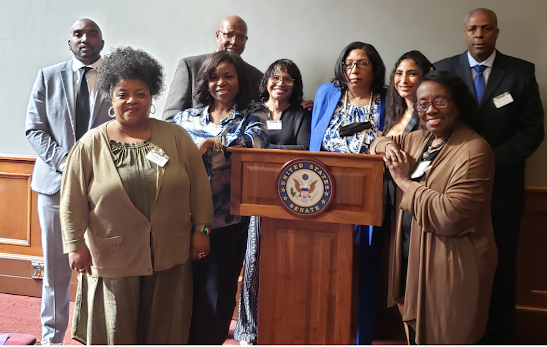
Women (left to right): LeEtta Osborn Simpson (Seminole); Rhonda Grayson (Muscogee); Sharon Linzy Scott (Muscogee), Marilyn Vann (Cherokee), Rosie Khalid (Cherokee); Angela Walton-Raji (Choctaw)
Demario Solomon-Simmons, (Muscogee), Terry Ligon (Chickasaw), Calvin Osborne (Creek)
(This group met in Senator Schatz's office after the Senate Hearing)

On July 27th, the Senate Committee on Indian Affairs met in Washington DC to listen to input from the five slave-holding tribes. These tribes are the Cherokee, Choctaw, Chickasaw, Creek and Seminole Nations. The purpose of the hearing was to discuss issues pertaining to the descendants of Freedmen--the African people once held in bondage in those nations. I was fortunate to be able to attend this hearing.

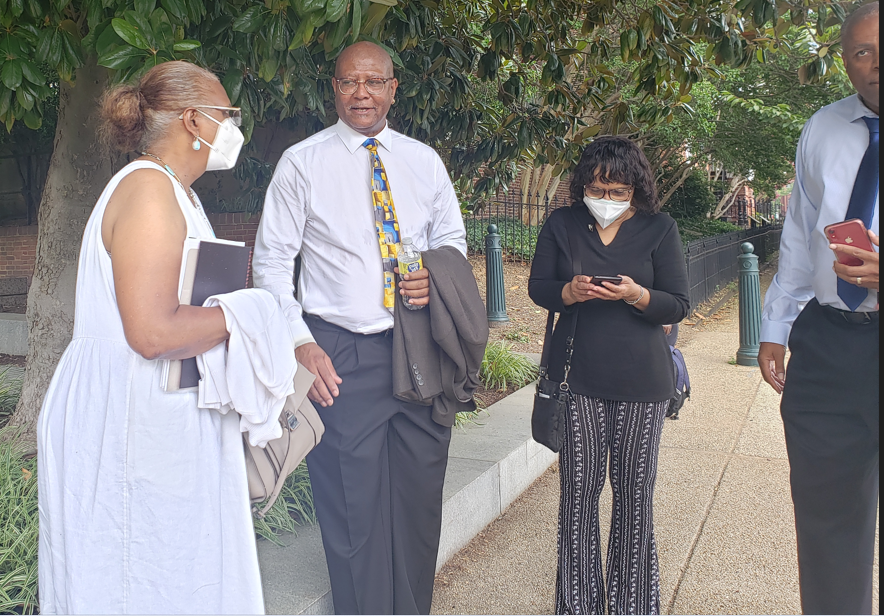
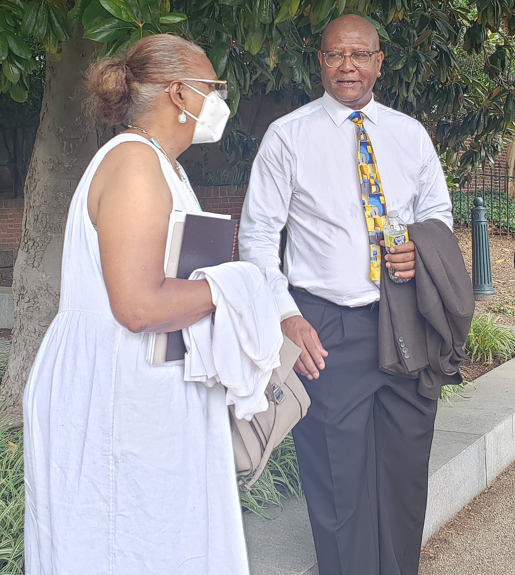
Upon arrival at the Hart Senate building, Freedmen descendants gathered in front of the building before shortly before 2:00 pm when doors were opened. For them, it was an opportunity to meet descendants from other tribal nations, for the first time. Interactions were congenial, friendly, among the small group of descendants some of whom were meeting in person for the first time. 

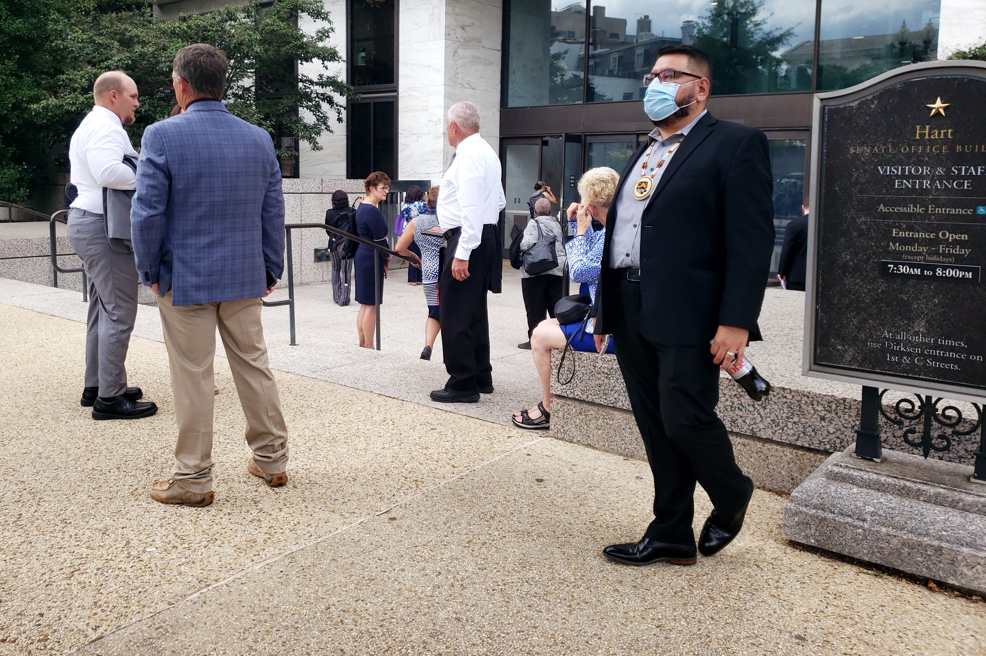
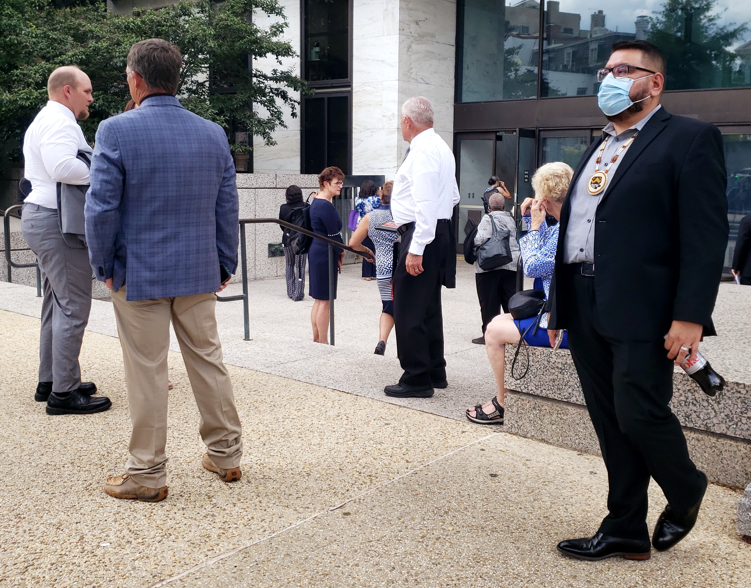
Before the committee convened, all in attendance gathered in front of the Hart building. There was little interaction between tribal representatives among themselves, and the gathering in front of the building was extremely quiet. But for Freedmen representatives all five tribes were present, and this was only the second time since 1866, that Freedmen descendants from all five nations were present in Washington for a hearing pertaining to their status within their own respective nations. The first time was in 2021 when descendants gathered for a hearing in the House of Representatives.

No others were present at the Senate building, except the Freedmen descendants and invited speakers.


Choctaw, Chickasaw and Muscogee chatting before hearing
Lto R: Doris Burris Williamson, Terry Ligon, Sharon Linzy-Scott, Calvin Osborne

                                                
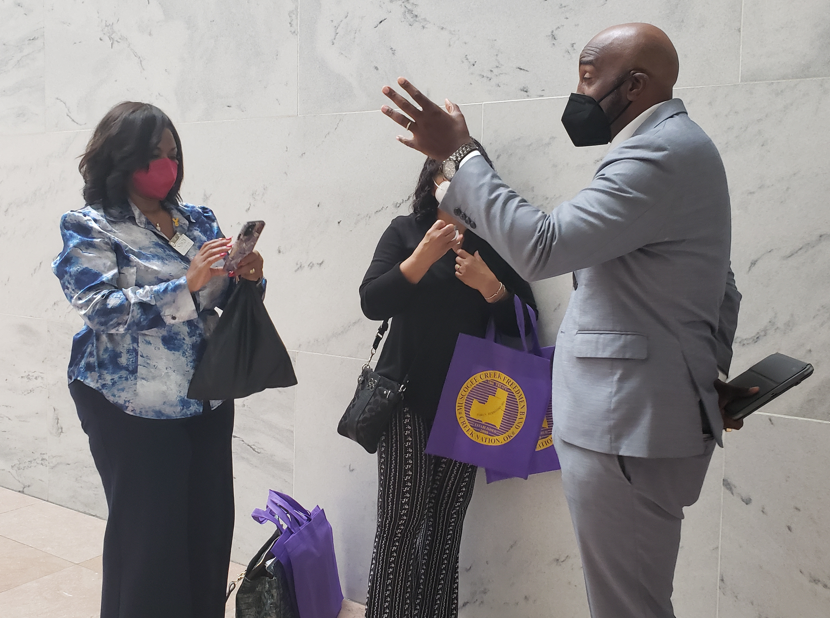
Muscogee Creek Freedmen Band members before hearing


Choctaw/Chickasaw and Muscogee
descendants sharing info. 
Terry Ligon, and Calvin Osborne

Tribal officials soon arrived, generally keeping apart from others. Some arrived wearing traditional native necklaces and generally awaited the opening of the doors to the Hart building, near the entrance. Most were quiet and not much inter-tribal interaction or talking among each other before entering the Hart building.

                                        
Tribal officials gather outside the Senate buidling


                                                                                     Before the Senate hearing

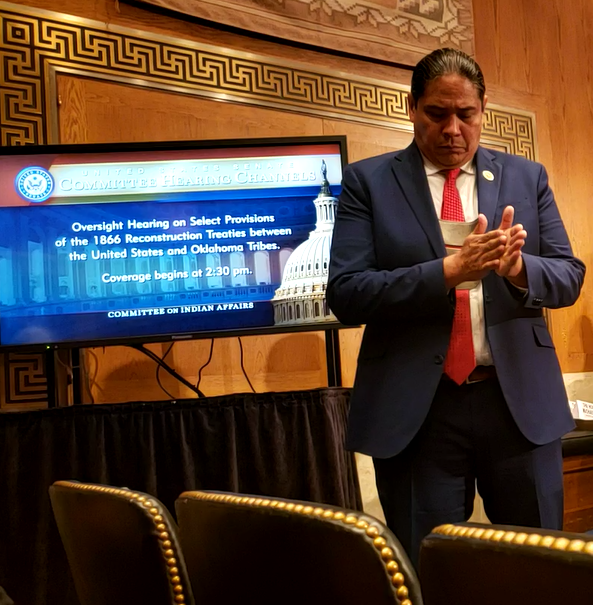
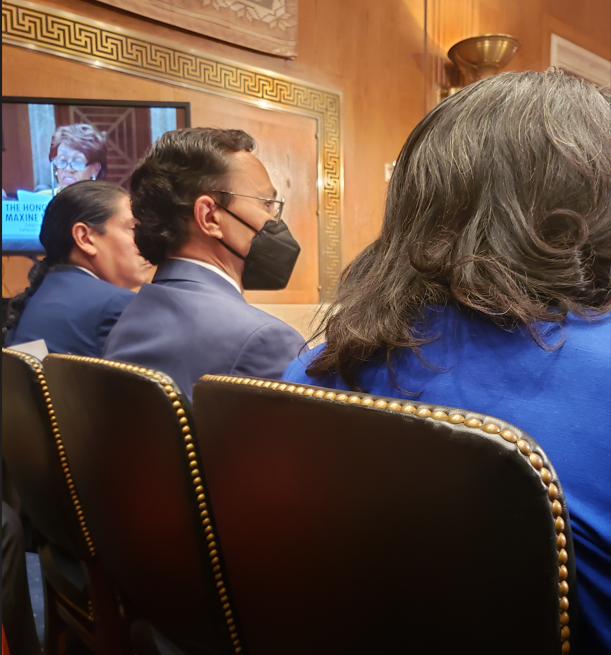
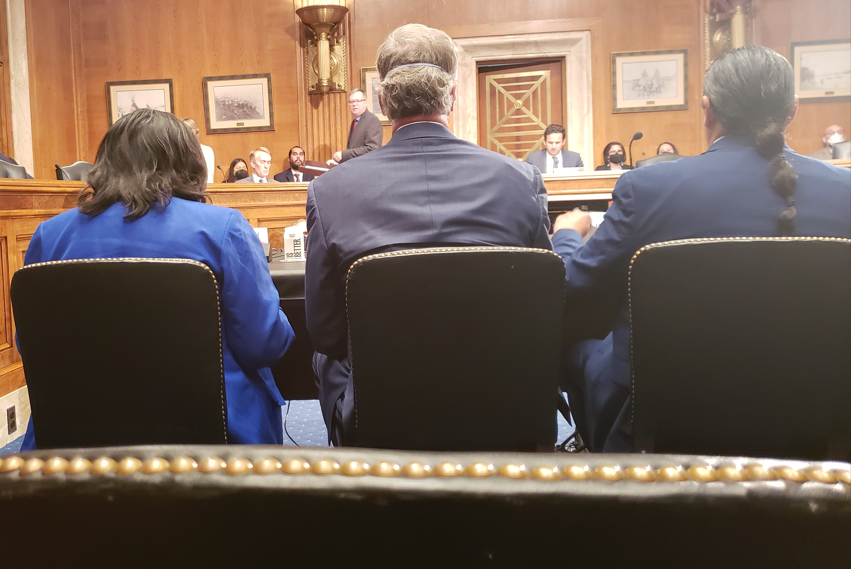
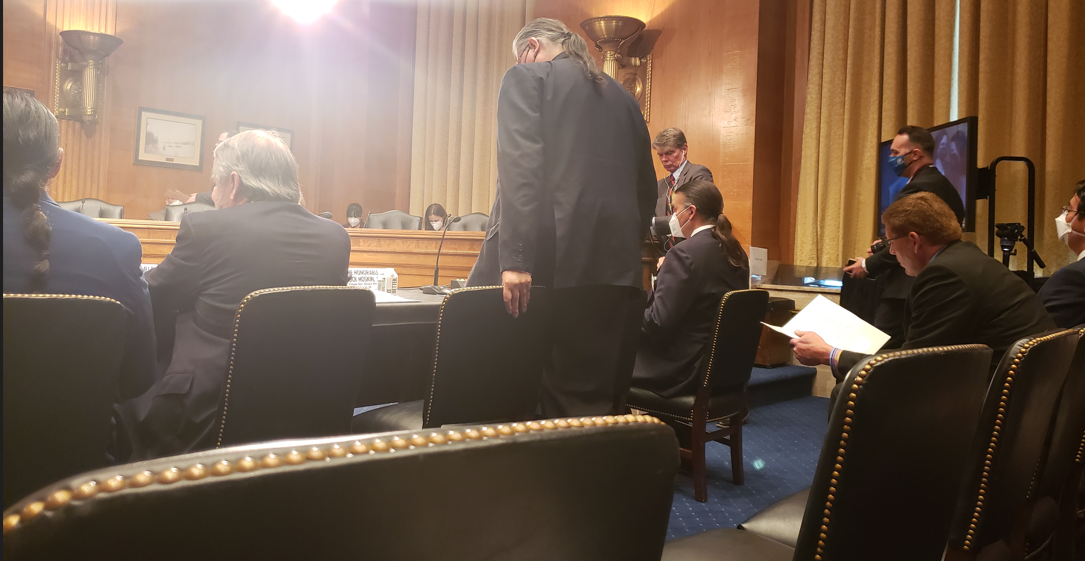
Once the doors opened, the small group of about a dozen of us were directed to the room for the senate hearing once we were cleared and names of invited guests were confirmed. The hearing room contained  some large television monitors so that those of us seated behind the speakers could actually see their faces as they spoke.

Freedmen descendants sat behind listening to the spesakers. Only one spoke with honesty and heartfelt sincerity about their history and historical mis-treatment of Freedmen and then offered a sincere apology to descendants. That was Cherokee Chief Hoskins who also mingled freely with Freedmen before and after the hearing. 

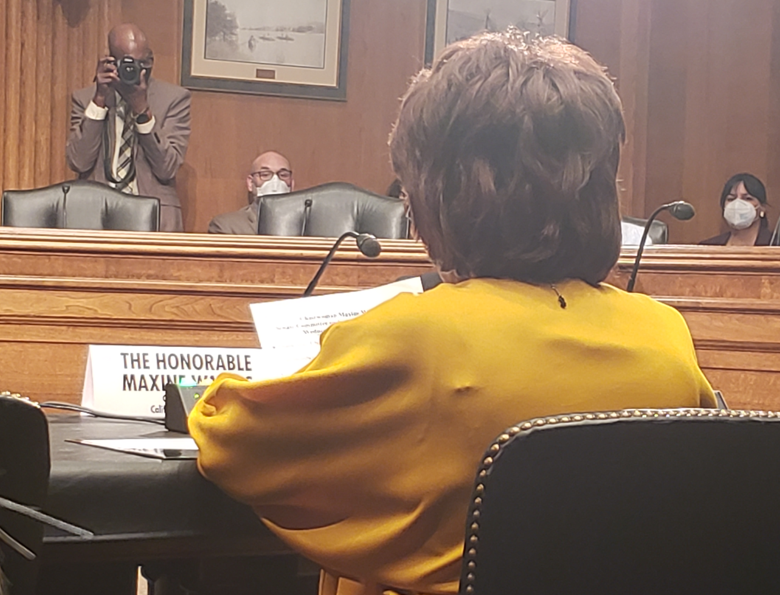
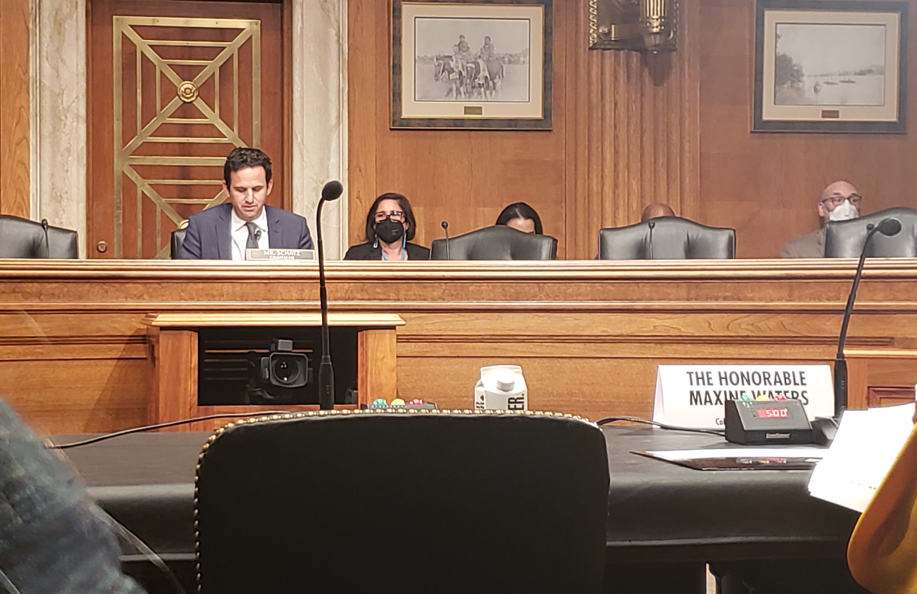
The hearing began with Congresswoman Maxine Waters addressing the Senate Committee. She was then followed by others representing the BIA, and the various tribes. The only speaker on behalf of the Freedmen was Marilyn Vann long time Freedman advocate, and now an enrolled Cherokee citizen.


Maxine Waters addressing the Senate Committee


                                                        Panelists listen to Congresswoman Waters address.

Other speakers spoke about blood--ignoring that they also prevented Freedmen who were connected  by blood to them, from being placed on the blood rolls. One after another they spoke, some never answering the questions asked, and others simply clinging to their security blanket of "sovereignty" as sssomething to hide their race-based biases behind.

Only one voice was heard speaking on behalf of the disenfranchised Freedment descendants. Ms. Marilyn Vann spoke and was the lone voice speaking for Freedmen descendants. Ms.Vann is now an enrolled Cherokee citizen, so technically no voices of disenfraned Freedmen were heard, while tribal officials sent attorneys, ambassadors, and even BIA officials who uphold tribal policies and who also spoke against any concept of Freedmen equal treatment.


Marilyn Vann, Cherokee citizen addressed the committee


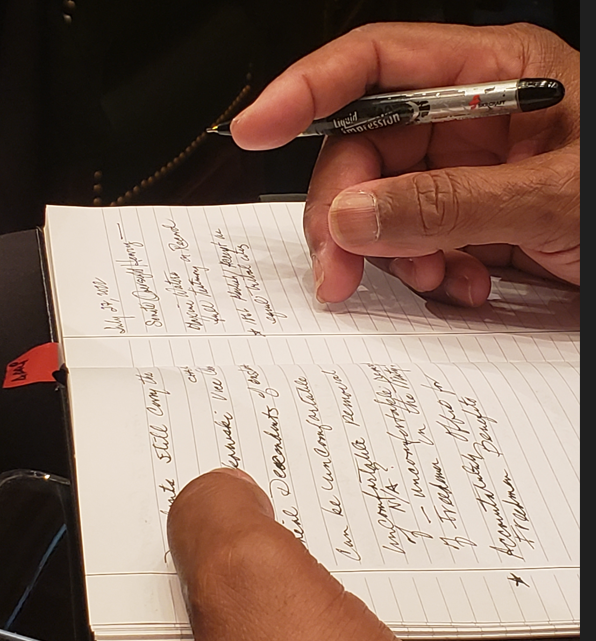
Several of the Freedmen took vigorous notes during the hearing as the panelists spoke.

                                                
                                                       Note taking during the hearing.

After the hearing only a few of the tribal speakers conversed or had dialogue who with Freedmen descendants, and most of them quickly left after the hearing. Later, a smaller group of 9 Freedmen descendants (pictured at the top) from all of the Five Tribes met with Senator Schatz in his office for a brief discussion about moving ahead.


Atty. Demario Solomon-Simmons discussing Freedmen issues with Muscogee Ambassador 


Reflections After the Hearing

Moving ahead, today, 156 years after the treaties were signed by each tribe,  the descendants of the Freedmen are still seeking justice. Why? Because four federally recognized tribes prevent them from having basic rights coming from their own family ties to them. These nations claim to be "sovereign" nations, while they refuse to offer services to all who are part of them.

Freedmen descendants are those  whose ancestors lived with them, were enslaved by them, remained with them when later freed, abided by the same laws created by them, and were part of them. However, today---the descendants of only those who have a certain "blood" are allowed to be a part. Sadly that blood policy also means that if you have a blood tie to a slave, then you are less than they and are to be shunned and forced to remain so--forcing people to carry a "stain" of slavery--a status they never sought.

In Oklahoma today in these nations, educational doors are opened for children, summer camps prevail, STEM educational training abounds, and scholarships and educational grants, are offered, and so much more. There are health benefits for the elderly, housing assistance for those in need, mental health assistance for those also in need, all of which are funded by US Federal dollars.---but the black children have no such access, nor do the elderly black people, many of whom are related to their lighter-skinned enrolled tribal members. Those light to white skinned members are welcomed into the nation, and live with these enriching benefits because they are allowed to have association with the tribe of their ancestors. But the Freedmen cannot have association with the tribe of their ancestors---some of whom are the same as enrolled members. That is the irony and the bittersweet aftermath of American slavery and Indian tribal practice of black chattel slavery.

 Today the struggle continues. It is noted that when post Civil-Rights years-- in the 1970s and 1980s these former slave-holding tribes had now embraced the the same "old-south" racist feelings to black citizens, and with the aid of friends and colleagues who had become federal BIA workers. They simply changed their constitutions and quietly removed descendants of slaves from eligibility.

Since then, these same tribes  have been able to execute racist policies in the name of  "sovereignty" and have been able to ride on national sympathy as victims of the Trail of Tears, bringing in millions of tourist dollars and wealth from casino monies. Their wealth is enhanced by federal funds, and now these slave-holding tribes have become wealthy, large employers, and "good neighbors" to Oklahomans, as long as the neighbors are not Freedmen descended people. 

The resilience of the Freedmen from the past is found in the resilience of their descendants today. The fight for equal opportunity continues to fight for the same opportunities that are their birthright. Freedmen never imposed themselves upon tribes it was the tribes that imposed their laws and culture upon them. Today thousands of Freedmen descendants still have a strong identity to the same tribes--simply because that is what they are. 

Descendants seek to live full lives complete with the same opportunities that their fellow neighbors, friends and even kin have. This struggle continues because "it is the right thing to do."

Thursday, July 28, 2022

The Hearing on Capitol Hill


Senator Schatz Chairman of the Committee on Indian Affairs

July 27th 2022 was a landmark date. For the first time in history a hearing on the status of Freedmen of the Five slave-holding tribes, occurred to address the neglicence of both tribal officials and Congress in issues pertaining to those once enslaved.

Focus of the hearing:  
Oversight Hearing on 1866 Reconstruction Treaties Between United States and Oklahoma Tribes.

The hearing was chaired by Senator Brian Schatz (D. Hawaii) and in attendance were descendants of Freedmen from all five tribes, whose ancestors were once enslaved in those nations. The tribes sent their own representatives to testify on their behalf. Representatives from the Cherokee, Choctaw, Chickasaw, Creek and Seminole Nations were all present. Each represenataive was given 5 minutes to present an official statement. Only one speaker on behalf of Freedman was included.

The first panel consisted of only one presenter--Congresswoman Maxine Waters, who had long recognized the issues affecting descendants of Freedmen, many of whom now live in her district in California. 

Congresswoman Maxine Waters speaks to Senate Committee

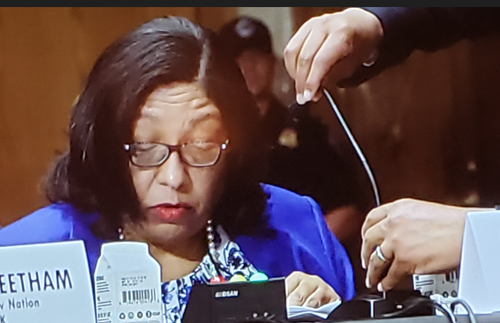
The second panel consisted of multiple speakers from the Five Tribes, in addition to a representative from the Department of the Interior, Bryan Newland, and the sole speaker from Freedmen, Marilyn Vann an enrolled citizen of the Cherokee Nation and President of the Descendants of Freedmen Association. 

The audience consisted of Freedmen from all five tribes, many of whom met and gathered prior to the hearing outside of the Hart Building on Capitol Hill and who met for the first time. The hearing was historic because Freedmen who have ancestors documented ties to each tribe were present for the first time in Washington to attend an event addressing their issues.


Dorris Burris Williamson and Terry Ligon


Attendees Gathering Before Hearing


Creek Freedmen in Discussion Before Session


Panel 2 Listening as Congresswoman Waters speaks

It did appear that there was a strong interest expressed by the committee as they listened to the presenters. In addition some of the questions asked by the committee members were left unanswerable because the issues such as the size of the Freedmen descendant popultation have never been studied.


Senator Lankford of Oklahoma Listened intently to presenters


Partial view of Panel 2


Another view of Panel as seen by audience


Speakers from the Seminole Nation of Oklahoma


Speaker Representing the Choctaw Nation of Oklahoma


Speaker Representing the Muscogee (Creek) Nation


Speaker Represnting the Chickasaw Nation of Oklahoma


Speaker Representing the Oklahoma Freedmen 

The hearing began shortly after 2:30 pm and lasted until about 4pm. Some evaded questions directed to them and others answered questions when directly asked. The outstanding voice pertaining to the treaty and its history came from Principal Chief Chuck Hoskins of the Cherokee Nation of Oklahoma. who addressed the past as well as the present. Since the ruling in 2017 that confirmed the status of the Freedmen in the Cherokee Nation, Hoskins pointed out that close to 12,000 descendants of Freedmen have been admitted to citizenship in the nation and he was quoted as saying that they are a better nation because of it.

There will clearly be multiple disussions in many forums and platforms over the next few weeks. It is hoped that the hearing will be a new beginning in the movement to create awareness of the history of the Oklahoma Freedmen, and many more of the stories that pertain to their presence on the soil of Oklahoma will emerge.


Friday, December 29, 2017

The Family of Doran and Mary Ann Bruner- Seminole Freedmen

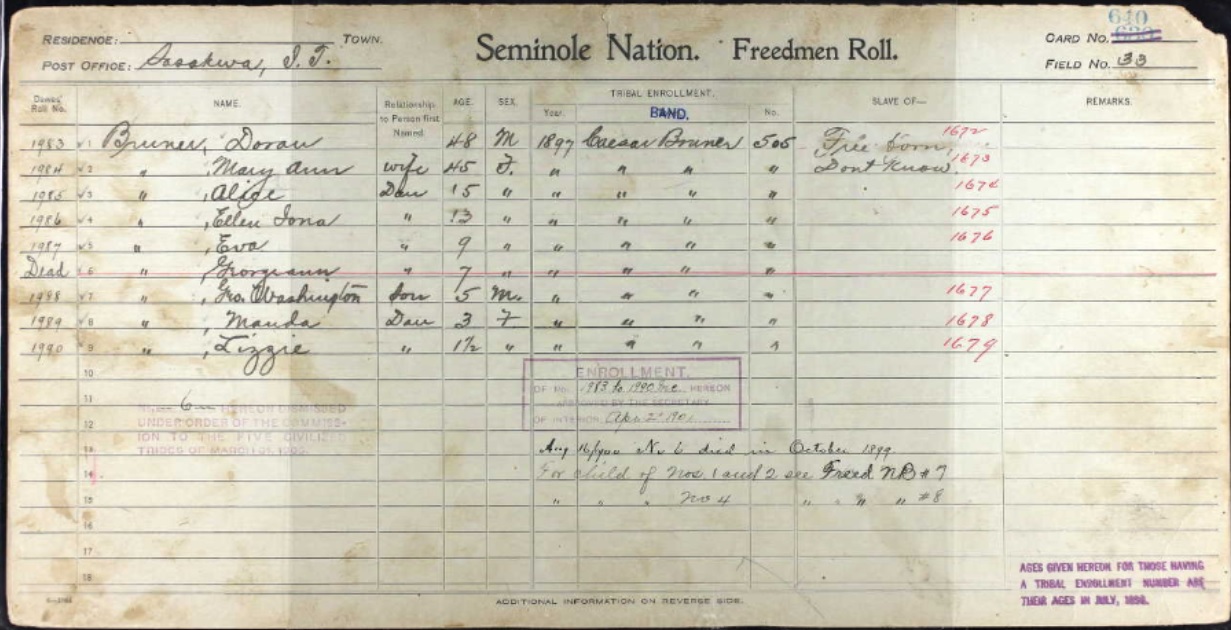
From the town of Sasakwa, the family of Doran and Mary Bruner appeared in front of the Dawes Commission to enroll as Seminoles. On the enrollment card, the father Doran was born a free man in the Territory, yes, as was done with so many--he was placed on the Freedman Roll. Their children were Alice, Ellen Iona, Eva, Georgeann, Geo. Washington, Manda and Lizzie. Another child was born in 1905 named Parah Bruner, whose enrollment card is the third image below. This entire family was part of the Ceasar Bruner band of Seminoles.

Seminole Freedman Card #640 Field Card #33
The National Archives at Ft. Worth, Ft. Worth Texas 1868-1914,  NAI Number: 251747
Record Group Title: Records of the Bureau of Indian Affairs, Record Group 75


Doran Bruners' father was Dan Bruner and his mother was Rachel Bruner, and like so many especially those from the Sasakwa settlement, his parents had at one time been enslaved by John Jumper. Doran. Mary Ann's father was Ginford Thompson and  her mother's name was Minerva. Both of her parents were once enslaved by Judge Thompson.


Son Parah's name was placed on Seminole New Born Freedman card #7. Both parents' names appear on the card. The "new born" category appears in most of the tribes, but in many cases some names were simply added on the front of the original family enrollment cards, and in other cases they were placed on new born cards such as this case.

Seminole New Born Freedman Card #7
The National Archives at Ft. Worth, Ft. Worth Texas 1868-1914,  NAI Number: 251747
Record Group Title: Records of the Bureau of Indian Affairs, Record Group 75

Thankfully, a small interview does exist for this family. There was most likely additional data, because the only focus of this one interview pertains to the death of one of the children. Clearly questions, about the history and parentage of the father and mother would have been taken at the time, but in this case the only document to remain in the file pertains to proving the death of one of the children.

Like many of the Seminole Freedmen a spokesman was called to testify on their behalf. In this case, the band chief Caesar Bruner himself came to testify to verify that one of the children had died. Caesar confirmed that Georgeann had died, and that he was at the family home after the funeral. Also note that Ben Bruner also came to testify for the family. Ben Bruner was also an officer for the Bruner band of Seminoles.


Application for Enrollment NARA Publication M1301 Seminole Freedman #33
(Also accessed from Fold3.com, Native American Collection)

Thankfully there were no complications in the enrollment of this Bruner family. They were allowed to enroll without any challenges made by the Dawes commissioners. Their enrollment however, was that of Seminole "freedmen" although the father was born a free man. Nevertheless, having been approved, they were eligible for the allotment of land they which they accepted. 

Land Allotment Records

The names of the family are shown on this first image as they applied for their land allotment.


Ancestry.com. Oklahoma and Indian Territory, Land Allotment Jackets for Five Civilized Tribes, 

1884-1934[database on-line]. Provo, UT, USA: Ancestry.com Operations, Inc, 2014.


Much of the data found in the allotment records contain legal description 

(Source: Same as above)

(Source: Same as above)


Most importantly the end of this story is summed up in the final question asked, "Will you accept these lands for yourself, your wife and children as final allotments to the Seminole Nation?" His response was clear, "Yes sir."
(Source: Same as above)

Like the story of many, the family was now a land-owning family, and were able to face their future moving ahead. Statehood came and like all families they now faced a new future in a new state of Oklahoma, and new country--The United States to call their own. Their legacy however, as Seminoles, like those of all of the Five Tribes was one well documented through complicated years of war, peace and challenge. This Bruner family, like others of their band, like others of the same nation, and like others from Indian Territory, have a richly documented history, reflecting legacy, endurance and continuity. May they always tell their story.

 This is the 50th article in a 52-article series devoted to sharing histories of families once held as enslaved people in Indian Territory, now known as Oklahoma. The focus is on the Freedmen of the Five Civilized Tribes, and these posts are part of an ongoing project to document 52 families in 52 weeks.

Thursday, December 21, 2017

Dosar Barkus, Seminole Leader

Though little is known of his early life, Dosar Barkus emerged as one of the leaders in the Black Seminole community of Indian Territory in the late 1890s. Living in the town of Sasakwa at the time, Dosar Barkus appeared in front of the Dawes Commission. The purpose was to enroll himself, wife Sookie, sons Daniel and Sango, daughters Amy and Dolly, and youngest son Jackson, all to be enrolled as Freedmen. He at at one time been enslaved by John Jumper. 


Seminole Freedman Card #660 Field Card #53
The National Archives at Ft. Worth, Ft. Worth Texas 1868-1914
NAI Number: 251747, Record Group Title: Records of the Bureau of Indian Affairs, Record Group 75


His father was Joseph Barkus and his mother was Nancy Barkus, and both had been enslaved also by John Jumper. Sookie's father was Nicholas Patterson, and her mother was Katie Payne. All had been members of the same band.

(Source: Same as above

Sookie's mother was Katie Payne and she was still alive at the time of the Dawes Commission and she also had an enrollment card. On Seminole Freedman card #55 her name is recorded along with the name of her granddaughter Bessie Dosar. She was at that time 70 years old. She like many other Seminoles had come to the Territory after the Seminole wars, and was originally from Florida.

Seminole Freedman Card #662 Field Card #55
The National Archives at Ft. Worth, Ft. Worth Texas 1868-1914
NAI Number: 251747, Record Group Title: Records of the Bureau of Indian Affairs, Record Group 75

Bessie was the child of Dosar Barkus and another mother known simply as "Tena" who was by that time, deceased. 

 (same as above)

They both lived in Sasakawa and Katie, the elder, had also been enslaved by John Jumper. Many of the Barkus band who had been enslaved and who lived in Sasakwa were at one time enslaved by Jumper. She named her father, as Dick, but sadly as was with many who were once enslaved--the name of her mother was unknown.

Dosar Barkus's Mother Nancy

Upon closer inspection, Dosar's mother Nancy was also still living. They were among some of the oldest Seminole Freedmen still living. Nancy Barkus also lived in Sasakwa. She had been enslaved by Seminole Mos-ca-diet-chee. Her father and mother were Dick and Tena. Living with her was an adult daughter Mary, the daughter of both Nancy and Joseph Barkus. With Mary having the same parents, as Dosar, clearly they were siblings. 
Seminole Freedman Card #804 Field Card #197
The National Archives at Ft. Worth, Ft. Worth Texas 1868-1914
NAI Number: 251747, Record Group Title: Records of the Bureau of Indian Affairs, Record Group 75

(same as above)


During the Dawes commission era, and after taking leadership of the Noble Freedman band, Dosar Barkus became a spokesperson for many of the African Seminoles going through the Dawes admissions process. By the time of the Dawes hearings he was a man of 50 years, and one who had a strong constituency in the Seminole nation.  This constituency would later depend upon him to get them through the Dawes Commission hearings. He witnessed more than 50 interviews for the Dawes Commission and he was part of their final interview process, vouching for the character and reliability of the data provided, for the Commission.  It is clear by this respect accorded him at the hearings that his word was to be listened to and followed.  

Dosar Barkus, alongside the other African Seminole band leader Caesar Bruner, both became leaders with a very strong level of influence with lasting legacy. The two African bands in the Seminole nation today carry have their names after 100 years. Barkus resided in a largely black settlement in Sasakwa, Indian Territory with his wife, Sookie, and their children Daniel, Sango, Amey, Dolley , and Jackson. 

Land Allotment Records
Barkus went through the land allotment process without difficulty and nothing was contested by anyone regarding his land. Thankfully the one interview with Dosar Barkus is found with the allotment jackets.

Ancestry.com. Oklahoma and Indian Territory, Land Allotment Jackets for Five Civilized Tribes, 1884-1934[database on-line].
Provo, UT, USA: Ancestry.com Operations, Inc, 2014.

(Source: same as above)

The Dosar Barkus band is active to this day and there is even a presence of the band that is found on social media with small descriptions of their history, whose origins begin with William Noble who led the band from 1870 to 1898. At that time Dosar Barkus took over the leadership and the band flourishes well into the 21st century.

The Seminole Freedmen in recent years have had their challenges and had to take legal actions to insure their continued status in the nation. They won partially, although still struggle for equal treatment by the nation that is their birthright. Clearly through men like Caesar Bruner and Dosar Barkus the legacy of the Seminole Maroons, live through members of both bands. Their history is one to study, honor and celebrate. The Barkus descendants are numerous and the history of their band leader, will forever be a part of Seminole history.

**********

This is the 45th  article in a 52-article series devoted to sharing histories of families once held as enslaved people in Indian Territory, now known as Oklahoma. The focus is on the Freedmen of the Five Civilized Tribes, and these posts are part of an ongoing project to document 52 families in 52 weeks.

Thursday, December 14, 2017

Caesar Bruner - Seminole Band Leader


(Photo courtesy of Susie Moore, Oklahoma City, Oklahoma)

One cannot present a profile of Seminole families without mention of the name, Caesar Bruner. He was the leader of the Bruner band--the band chief in fact. And, in addition, his legacy is one that continues to this day. Bruner is also one of the few leaders from Indian Territory for whom there is also a photo image of him that survives.

At the time of the Dawes Commission, Ceasar was already an old man, who had arrived with the contingent of Seminoles from Florida. He like Abraham and others lived among the maroons, and later with the Indians who later arrived in the Territory after the Seminole wars. Bruner, like another compatriot, Dosar Barkus ended up being not only a band leader, but also spoke on behalf of many Freedmen who appeared in front of the Dawes Commission in the 1890s and early 1900s. His word was accepted when he spoke on their behalf.

Little is written however, about Bruner's own family history and it is seldom mentioned. in particular his own parents and siblings if they are known. As a result I decided to give a brief overview about his life.


From The Dawes Card

Caesar Bruner lived his life before the Civil War as a free man. He was the son of parents from Alabama and Florida, who came to the Territory during the years of removal. Having been born and having lived among Seminoles as well as Creeks Bruner spoke the language of both the native people as well as English.

 His parents at one time were said to have been enslaved, although that can be disputed to a great degree as well. However, the status given to him on the Dawes Card is interesting. This man, a leader in the tribe, a free man, never enslaved, was still put recorded as a "Freedman". So his placement as a "freedman" is seemingly incorrect, because he was not "freed" from bondage, having not been enslaved. His name was recorded on Seminole Freedman card, #740, Field #133.On his card in fact in the column reflecting the name of the slave holder, it is clearly written that he was a free man.


Seminole Freedman #740 Field Card #133
The National Archives at Ft. Worth, Ft. Worth Texas 1868-1914

NAI Number: 251747

Record Group Title: Records of the Bureau of Indian Affairs, Record Group 75


His parents were said to have been William Bruner and Affie Bruner. According to the information on the Dawes card, they had once been enslaved by Tom Bruner a Seminole. 

Siblings of Caesar Bruner
Of course many of the interviews are missing and not available for examination. Thankfully from an interview of a nephew of Caesar Bruner a bit more is learned about the family. 
From the 1937 interview with Benjamin F. Bruner, the names of some of the siblings of Caesar were learned. Ben F. Bruner was interviewed as part of the Indian Pioneer project. He spoke about his life, and his own family.

Ben Bruner was part of the Bruner clan and like Caesar, was he too born free. And at the time of the Dawes enrollment, he lived in the same community as Caesar.


In the interview with the Pioneer project, he spoke of his own father John, and when they came to Indian Territory. His interview also reflects a more intimate relationship between Seminoles enslaved and free, and of the contact between those who were enslaved and those who were identified as full Seminoles. In addition, the relationship between Seminoles and Creeks is also noted in this excerpt from his interview. And in that interview he mentions his father John's siblings by name.


From this excerpt we learn that Ben's father John, and had siblings who were Perry, Caesar and Will. Clearly Caesar is among them. It also has to be pointed out that the brother "Perry" he mentions is actually Paro Bruner, often called Perry even some by Bruner descendants today.

But note---Paro Bruner was actually enrolled as a Creek and he was the very first Creek Freedmen to enroll on Census Card #1. Also he is another Freedman leader for whom a rare photo image actually exists as well. When examining the card for Paro Bruner---it is clear that he and Caesar Bruner were siblings--same father and the same mother. His parents were William Bruner and Affie Bruner--the same two people who were the parents of Caesar Bruner.

(Courtesy of Oklahoma Historical Society)


Enrollment Card for Paro Bruner front and back
Creek Freedman Card #1
(Source: Same as for  census card images above)


The interview with Ben Bruner also left another significant clue about Caesar Bruner. He mentioned that Caesar along with Perry and Will left Indian Territory,and went north (meaning into Kansas) during the Civil War. I checked to see if Caesar served in the military in the Union Army. What a surprise that to see that he did not serve in the military as a soldier, but worked for the military as an official interpreter.

National Archives and Records Administration. U.S., Civil War Pension Index:
General Index to Pension Files, 1861-1934
 [database on-line]. Provo, UT, USA: Ancestry.com Operations Inc, 2000.

General Index to Pension Files, 1861-1934
. Washington, D.C.:
National Archives and Records Administration. T288, 546 rolls.


He filed for a pension later in life, but was not awarded the pension, however, the record shows that he applied for his service having been an interpreter. After his death his wife Nancy also applied, but she too was later denied a widow's pension. And a second card reflects the brother William, who was a soldier. He enlisted in the 1st Kansas Colored Infantry. That unit was later re-designated as the 79th US Colored Infantry. In his own case, he applied for a pension and received it.

(Source: Same as above image)

Application Jacket

Usually the Dawes Commission records contain an application jacket that corresponds with the enrollment card. However, similar to that of the Creeks many of the Seminole files are empty. The jackets exist, but they are clearly marked empty and unfortunately in the case of this band leader, his file was also empty. Although he was interviewed many times when other Freedmen members of his band applied, his file was an empty one years later.

National Archives Publication M1301

Applications for Enrollment

(Also accessed from Fold3.com, Native American Collection, Choctaw Freedmen)


It is difficult to imagine how the words of a tribal leader would be lost, but some of his words were preserved in the interview when he appeared to select his land allotment.
Ancestry.com. Oklahoma and Indian Territory, Land Allotment Jackets for Five Civilized Tribes, 

1884-1934[database on-line]. Provo, UT, USA: Ancestry.com Operations, Inc, 2014.

Original data: Department of the Interior. Office of Indian Affairs. Five Civilized Tribes Agency. 

Applications for Allotment, compiled 1899–1907. Textual records. Records of the Bureau of Indian Affairs, Record Group 75. 

The National Archives at Fort Worth, Texas.


(Source: same a above)

And sure enough each member of his immediate family was able to select their small 40 acre parcels of land, each. On this particular document one can see Caesar's name along with wife Nancy, and granddaughter Effie on this land record. Although they received only 40 acres each, it should also be pointed out that Bruner had other adult children as well. However, it does appear that in some other cases from other bands that Seminoles identified as "by blood" their acreage was larger. How extensive that pattern was is not known. But the large Bruner clan did occupy much land after the process ended.
(Source: Same as above)
It is well known that the large extended family of Bruners settled in the lands around Turkey Creek. An older settlement area known as Brunertown was the area where this large clan of Seminoles lived for many years and then after the allotment process ended they lived around Turkey Creek. He died in 1923 and is buried at Mt. Zion Cemetery in Seminole County Oklahoma. His descendants live around the country.

(Courtesy of Charles Gibson)

The legacy of Caesar Bruner is an interesting one, going back to his own family in the Seminole Nation, in Florida, and also part of Alabama. By following the footprints that he left in the records, his journey was massive. His parents and siblings all survived the Seminole wars, and began a new life with family in Indian Territory. He was a leader to his community and was a major patriarch to his family and clan.

As one who spoke the Muscogee language of the area, and served the Union army as an interpreter, and was able to move comfortably among both Seminole and Creek communities. His brother Paro Bruner was a leader among Creek Freedmen while Caesar himself became band chief of the Bruner band. His life spanned a good portion of the 19th century during a period of disenfranchisement and hardship, and extended into the early years of the 20th century. He lived to see the world change, to make a difference, and because of him an amazing legacy remains. 


This is the 40th article in a 52-article series devoted to sharing histories of families once held as enslaved people in Indian Territory, now known as Oklahoma. The focus is on the Freedmen of the Five Civilized Tribes, and these posts are part of an ongoing project to document 52 families in 52 weeks.