Showing posts with label Oklahoma Black History. Show all posts

Sunday, June 19, 2022

Celebrating Freedom in Indian Territory


For many years in the late 1800s Freed people from the Five Tribes celebrated freedom throughout the summer months. Many Indian tribal Freedmen, in the eastern most part of the Cherokee and Choctaw Nations, started celebrating Freedom the same time their neighbors did in nearby Arkansas. Some in the southern part of the Choctaw and Chickasaw Nations started celebrating Freedom the same time their neighbors did in nearby north Texas.  

However, the most interesting part of the Freedom story is reflected in the fact that throughout many parts of Indian Territory, a celebration of Freedom actually occurred for many years on August 4th. Several references to the August 4th celebrations were mentioned by former slaves when interviewed in the1930s and their intervviews were captured in the Indian Pioneer Papers. The day was celebrated for many years and believed by many to be the day that Freedmen came to their families, but so far, the actual choice of August 4th still is unexplained. Nevertheless, Freedom was embraced and honored and celebrated by those once enslaved and freed from bondage. 

In the 1930s Elizabeth Ross, a field worker for the Indian Pioneer project, spoke with several former slaves about the celebrations they frequented during their lifetime. She spoke with two individuals who provided her with rich information, E. P. Harris and Dennis Hendricks. Here are some excerpts from her article about Freedom celebrations. (1)

 Cherokee Nation

"During a number of years when Cherokee government was in existence, it was a custom of the Freedmen or former slaves of Cherokees and their descendants to observe August 4th as the anniversary of their emancipation. As a matter of historical fact, the Cherokee emancipation was issued in the month of February 1863. Just why the August date was selected is not clear, but no doubt many were of the belief that the fourth day of that month was the date up which freedom became their possession."

In the Cherokee Nation, large outdoor picnics unfolded in Talequah, Fort Gibson and other large Freedmen settlements, consisting of speakers, singing events, and of course large amounts of food for the celebrations. Many of the invited speakers were local leaders, of all background, whites, tribal leaders, and well known preachers.

One of the larger events was observed in Tahlequah in the late 1870s where a long line of horsemen formed part of an impressive parade. Ross describes the event:

"A long line of horsemen formed on the banks of a small stream nearly a mile south of the town, and then a procession headed by a man with drawn sword, beside whom rode another man carrying a United States flag, rode back and through the main street of Tahlequah." 

Years later celebrations were occurred on the "May Party Grounds" the same spot where the 7th of May anniversaty celebrations occurred. Years later, large events were also noted in communities like Four Mile Branch in Fort Gibson.

Creek Nation:
Aaron Grayson was interviewed in the 1930s and described the celebrations that he recalled from the 1870s till the early 20th century. (2)

"There was an annual celebration held each year from the period from 1870 on up until the early part of 1900, which was held by negroes and freedmen. The white people observed Independence day on July 4th, while the colored people observed the Emancipation Day on August 4th. The observance of this Emancipation proclamation was mainly for and by negroes and freedmen, yet the Indians and whites were welcome to attend the celebrations.

There were always good times, because no one became drunk, quarrelsome or tried to pick a fight, but only a feeling of good comradeship was felt by all who participated in the events. Of course the Lighthorsemen and the United States marshals were present to check any trouble and to keep peace and order. Many new acquaintances and lasting friendships were often made at these gatherings.

..."When the day of the big celebration arrived, the people did not come poking around one by one but they came in groups or by bands, such as the Bruner band, the Topkafka band, etc. These people had assembled at one of the tribal towns from where they had come to the celebration as early as they could. They came on horses at a gallop, laughing joking and  yelling and were heard miles away before they finally came to the chosen place of the event."

Aaron Grayson goes on to describe how the various bands arrived and the cannons would be fired as they arrived and marched in circles around the flag pole signaling their arrival. The food was prepared by the women which was a massive barbecue feast. All in attendance, native Creeks, whites as well as Freedmen and state negroes who all shared in the massive amounts of food. Grayson also described events such as selection of the day's queen, and his descriptions of the clothing worn by many of the horsemen was quite colorful. Many of these events were held at Wetumka and Wewoka, and the last major event occurring in Tuskegee town.

Choctaw Nation

In August of 1938. Sallie Henderson Moss was interviewed by James Russell Gray of the Pioneer project. She desribed her life in the Skullyville district near Brazil Station, in the Choctaw Nation. In her interview, she recalled the celebrations of emancipation in August. (3)

"The colored people used to have picnics on the 4th of August. They would have big barbecues with lemondade, stick candy and everything. They were celebrating the freeing of the slaves. The Choctaws freed their slaves, you know on August 4th. They would kill hogs and beeves, and have dances and general good times"

Sometimes the colored people would take sacks full of herbs called "devil's shoestring" and put the stuff in the creek the way the Indians taught them to. This devil's shoestring made the fish drunk and the fish floated to the top of the water and could be caught. We would have fish fries for our picnics."


The stories about the celebration of emancipation is an interesting one, particularly because so many embraced August 4th as the day to commemorate freedom, although freedom was actually not uniformly in August. Each of the tribes eventually abolished slavery officially when the treaties of 1866 were signed. However, it should also be remembered that many found freedom much earlier than that time.

Many had become free during the Civil War when some had joined various regiments of the union army. And sadly, at the same time, in some parts of the Chickasaw Nation many did not enjoy freedom until at least two years after the war, as there was much resistance in parts of the Chickasaw Nation to allowing their enslaved people to taste freedom.

Nevertheless, now that there is a legal holiday where descendants of the enslaved perhaps some of the long forgotten traditions will emerge again. To think that there has never been before now, any effort to celebrate freedom from slavery is quite incredible. We must celebrate our freedom, like the people of Galveston. Freedom is a basic right of all people, and truly we must find ourselves among those celebrants. Our own ancestors truly knew the value of being free to make one's own choices in life. Whether it it June 19th or August 4th or all days in between---we must embrace the joy of Juneteenth and how at some point in the lives of our ancestors--the trajectory of their lives changed when Freedom came.

H a p p y  J u n e t e e n t h ! ! ! 


Citations:


1 Digital Collections, University of Oklahoma, Western History Collections, Indian Pioneer Collections, Elizabeth Ross, Volume 109,  Interview ID 6764 Freedom Celebrations

2 Ibid  Volume 35, Interview ID 7458 Aaron Grayson

3 Ibid Volume 65 Interview ID 13620 Sallie Henderson Moss

Sunday, February 21, 2021

Honoring Black Soldiers of the Indian Home Guards in the CivilWar

There are many men from Indian Territory who were enslaved in the Civil War. They escaped with Opotholeyahola into Kansas. Some joined the Kansas Colored Regiments, and they later became part of the US Colored Troops.  But there were many who also remained with the Creeks and they too enlisted in the Union Army. The would participate in every major battle of the Civil War. From Cabin Creek, to Honey Springs, and points in between.

It is important to know that the Home Guards (1st, 2nd and 3rd) were the only Indian Union Regiments.
The remaining 20+ Native American regiments from the Five Tribes, were Confederates. 

The following is a partial list of soldiers who were of African descent. who served with the Indian Home Guards.  May their legacy as freedom fighters in the Civil war be added to those of the Kansas Colored infantries and the regiments of the US Colored Troops.  May they always be remembered.


Index to Pension File of Sugar George, Company H, 1st Indian Home Guards

Black Soldiers of the Indian Home Guards 

Sugar T. George 
Wheat Baldridge
Adam Dyle
Samuel Barnett
Dennis Harrod
George Marshall
Green McGilvray
Saucer Bradley
Robert Benjamin
Abram Colonel
Harry Stedham
Jacob Bernard
Snow Sells
Simon Brown
George Monday
Abe Prince
Billy Caesar
William Hawkins
John Cooks
Jacob Perryman
Dennis Marshall
Manam Marshall
Troy Stedham
Sage Barnwell
Toby Drew
Thomas Marshall
James Quabner
William Peter
Love Jimboy
Tally Lewis
Thomas Al 
Gabriel Jimison
Solomon Renty
Jacob McGilvray
Pickett Renty
Charles Renty
August Deer
George McGilvray
Thomas Bruner (Identified as a free man of color)
August Deer
Abraham Caesar
Latah Harjo
Benjamin Ab
Scipio Sancho
Morris Kernell
James Kernell
Ben Sancho
Redman Kernell
Peter Stedham
Joseph Sambo (Sango)
Billy Hawkins (Identified as free man of color)
John Kernell
Jim Barnett (Identified as free man of color)
Aaron Sancho
Samuel Wade 
Joe McGilvray
William Grayson
Isaac Smith
Tucker (This was Silas Jefferson)
Adam (Identified as free man of color)
Alex Hawkins
York McGilbra


(courtesy Oklahoma Historical Society)
Silas Jefferson (enlisted as Tucker) was also a leader within the Creek Nation


Tuesday, February 16, 2021

Honoring Cherokee Freedmen Civil War Freedom Fighters


 In the US Civil War, men of African Descent were active in the quest for freedom.  Some had followed Creeks into Kansas. While there, some found themselves in a new status--that of free men. The opportunity to engage in the battle for freedom, several enlisted in one of three groups--Indian Home Guards, 1st and 2nd Kansas Colored Infantries, or the US Colored Troops. Note that the 1st and 2nd Kansas Colored regiments were later re-designated as the 79th and 83rd US Colored Infantries, respectively.

Cherokee Freedmen are found mostly among US Colored Troops, in both 79th and 83rd regiments.  However, a few names are found in other regiments as well. 

To honor Cherokee Freedmen Civil War Soldiers a partial list is placed here. Additional research is much needed to compile a comprehensive list, and hopefully someday such a project will be undertaken. Many of these men died during the war, and others died prior to the Dawes enrollment era, so many names have simply been forgotten with time. And some were born and enslaved in the Cherokee Nation, but moved away from the Territory in later years. Thankfully, Civil War records reflect their names, and their place of birth, their names can still be called and should be remembered.

Partial List of Cherokee Freedmen Civil War Soldiers

Indian Home Guards
Buck Bushyhead

11th US Colored Infantry
Aron Alberty 
George Bench

79th US Colored Infantry

Moses Carter
Wiley Carter
Thomas Daniels
George C. Davis
Isaac Rogers
Franklin Ross
Nelson Ross
Thomas Ross

83rd US Colored Infantry

Amos Adair
Andrew Brewer
Jacob Brewer
George Bushyhead
Moses Fields
Zachary Foreman
William Funkhauser
James Geary
Ephraim Isaac
Andrew Johnson
George Johnson
Israel Johnson
Moses Johnson
Henry Kidd
Dick Linch (Lynch)
George Martin
Hugh Martin
Toby Martin
Melton Washington
Edward Peter
Lewis Theodore
Burgess Thomas
John Webb
Daniel Webster
David Whitman
William Anderson
Aughter Williams

May the service of these men of the Cherokee Nation who served honorably in the Civil War and the quest for freedom, be remembered and honored. 

Monday, February 15, 2021

Honoring I.T. Freedmen Civil War Veterans


Painting Depicting 1st Kansas Colored Infantry
This unit consisted of many men from both Cherokee and Creek Nations
Image accessed from Black Past.org

Among the missing stories fromt Oklahoma and it pre-staehood history are the stories of slavery, the quest for freedom and the stories of the Freedmen. Embedded in the quest for freedom comes the story of men both enslaved and free, who enlisted in the Union Army during the Civil War. This untold Oklahoma story is rich reflecting stories of courageous of these black freedom fighters who joined the battle for freedom. They are honored this week during Freedmen History Month

Almost 200,000 men of African descent served in the American Civil War. Within that large number were men who served in several portions of the Union Army--the United States Colored Troops, the Indian Home Guards and the 1st & 2nd Kansas Colored.

Within these units were men who had a background that distinguishes them from other soldiers. These men had lived in Indian Territory, within Five native tribes. Many had been slaves while in these tribes, and some or their parents had come to the Territory on the forced migration known widely as the Trail of Tears. The tribes from which they came are Cherokee, Choctaw, Chickasaw, Creek and Seminole Nations.

Many of these men have their names inscribed on the Civil War monument in Washington DC. Their participation in the Civil War is not widely known, even by many who descend from them. However, their legacy is a strong one, and as a result they are to be honored throughout this week, of Freedmen History month.

The Regiments in Which They Served

1st Indian Home Guards
2nd Indian Home Guards
3rd Indian Home Guards

1st Kansas Colored Infantry
2nd Kansas Colored Infantry

11th US Colored Infantry
54th US Colored Infantry
79th US Colored Infantry
83rd US Colored Infantry

Battles in Which They Fought

Baxter Springs, October 6, 1863 Kansas 2nd US Kansas Colored Infantry
Boggs Mills, January 11, 1864  Arkansas  11th US Colored Infantry
Cabin Creek, Cherokee Nation July 1-2 1863 and Nov 4,1865  2nd Kansas Colored, & 83rd US Colored Infantry
Clarksville January 18th 1865  79th US Colored Infantry
Cow Creek, Kansas November 14th  1864  54th US Colored Infantry
Ft. Gibson, September 16,1864  79th US Colored Infantry
Horse Head Creek Arkansas February 17, 1864  79th US Colored Infantry
Honey Springs July 17m 1864 1st Kansas Colored Infantry
Island Mound, Missouri October 27th & 29th 1862 1st Kansas Colored Infantry
Jenkins Ferry Arkansas April 30th 1864 83rd US Colored Infantry
Lawrence Kansas July 27th 1869  79th US Colored Infantry
Lotus Steamer (near Dardanelle) Jan 16, 1865 83rd US Colored Infantry
Poison Springs Arkansas  April 18th 1864  1st Kansas Colored Infantry
Prairie D'Ann  April 13th 1864  1st & 2nd Kansas Colored Infantries
Timber Hills, November 19th 1864  1st Kansas Colored Infantry

May the forgotten freedom fighters from Indian Territory long be remembered. Their legacy should no longer be overlooked.


Monday, February 8, 2021

Caesar Bowlegs Seminole Freedman Card #1


Courtesy Kevin Mulroy


Caesar Bowlegs was a man of influence and importance in the Seminole Nation. He served the nation in many capacities, but is best known as an interpreter being fluent in Creek and he moved easily between both Creek and Seminole communities. Bowlegs had traveled during the Civil War into Kansas according to historian Kevin Mulroy. After the war, he worked for some time as a mail carrier between Ft. Gibson and Wewoka, and he later operated a toll bridge over Wewoka Creek as well. 

Because of his language skills, he served as a personal interpreter for Dr. C. P. Lynn, and later Dr. Virgil Berry. He instructed the doctors about medicinal practices of Seminoles and Freedmen, and he was later the personal assistant to Dr. Berry accompanying him on medical calls. During an epidemic of smallpox, after inoculating themselves, Caesar Bowlegs and Dr. Berry traveled throughout the nation with the goal of vaccinating the entire nation. 

As stated by scholar Mulroy, "Bowlegs helped gain widespread acceptance for scientific principles and medical technology among the Seminoles and freedmen.  Caesar Bowlegs died in 1912 in Seminole County, Oklahoma."


The National Archives at Ft Worth; Ft Worth, Texas, USA; Enrollment Cards for the Five Civilized Tribes, 1898-1914; NAI Number: 251747; Record Group Title: Records of the Bureau of Indian Affairs; Record Group Number: 75


(Source: Same as above)


He was the first enrolled as a Seminole Freedman due to his status and influence. He is not forgotten and should be remembered by all who study Oklahoma Freedmen history. 

Saturday, December 30, 2017

The Family of Joe and Belle Davis -Cherokee Freedmen

Sons of Joe and Belle Davis, Cherokee Freedmen, Courtesy of Steve Spencer Top row: Willie Davis, Joseph Davis, Curtis Dan Davis, Middle Row: Jim Davis, Thomas Davis, Bottom Row: Carl Davis, Charles Davis, John Davis

The Davis family of Vinita, in the Cherokee Nation has a very rich history. Joe Davis the patriarch appeared in May 1901 to enroll his family as Cherokee Freedmen. He provided the names of each of his children, Sadie, Willie, Thomas, Joseph, Dan, Carl, and Charles. Two other sons not on the card were adults and had enrolled on their own card. It is recorded that Joe had at one time been enslaved by Kinnie Davis.

There are additional notes on the card referring to more information on the family. The Davis family names had also appeared on the Kern Clifton Roll--referred to at the K.C. roll. In the lower left part on the page it is noted that there are other relatives to be found on Cherokee Freedmen cards #1200-1204.

The National Archives at Ft. Worth, Ft. Worth Texas 1868-1914
NAI Number: 251747, Record Group Title: Records of the Bureau of Indian Affairs, Record Group 75

His father was Tom Faught and his mother's name was Betsy Davis. Tom Faught had been a slave and was enslaved by Peggie Faught, and his mother Betsy was once enslaved by Wm. A. Davis. The family resided at that time in the Cooweescoowee District of the Cherokee Nation. It can be assumed that Joe took the name of his mother as the family name was not Faught. No other information is provided on Tom Faught, other than the name of the slave holder.

Also note--the family was originally placed on the "Doubtful" card as there was a concern about their eligibility for enrollment. Their names were later moved to an approved card in 1904.

(Same as above)

Application Jackets

Joe Davis was interviewed on May 16, 1901 in Vinita, Indian Territory in the Cherokee Nation. The questions began immediately about Joe Davis and his status as a recognized Cherokee Freedman. His name dd not appear on the 1880 roll of authenticated Cherokee Freedmen, which immediately made the commissioners willing to find reason to prevent his enrollment as a Cherokee citizen. He identified his wife and children when asked, and identified also the name of the Cherokee who enslaved him--Kinney Davis. His mother Betsey had died before 1880. 


National Archives Publication M1301,
Applications for Enrollment
(Also accessed from Fold3.com, Native American Collection, Choctaw Freedmen)

In front of the committee, he presented a record of the family, and he indicated that the record that he had was abandoned by the Davis slave holding family when they had left it the estate at the end of the war. This is more than significant----Joe because he shared a document--a book that contained the names of all of the slaves held by the his family's slaveholders. The document is not found in this packet, and it can be assumed that he took it back and kept it. But on this page it is clearly stated, that he shared a book with the examining committee.

It should be pointed out, that few if any slave records from Indian Territory have ever survived, and at this time, , the Davis family still retained what they were able to found--a record confirming their own enslavement. It this record still exists by the descendants it should be preserved or placed in a county or state archives or museum, because its is a very rare slavery era record coming from Indian Territroy before it became Oklahoma. 

On that page, Joe Davis was asked about the slave owner Kinney Davis. The document states:
Q. You were a slave of Kinney Davis?
A. Yes sir.
Q. Is Kinney Davis here?
A. No sir. Here is his family record, every slave that was on there. (Produces a book.)
Q. How did you happen to get Kinney Davis family record?
A. We was the last ones that left the place, me and my mother, and we carried this off, my mother give it to me.
 This is probably the only case that may exist where a man once enslaved was able to prove the status of enslavement by producing the record that bore his name on the page!

 Joe Davis was then asked about his name not being on the authenticated 1880 roll of Cherokee citizens. His tone is one again of confidence. When pointed out that it was strange that his name did not appear on that roll, he replied that it as not that strange to him.


A beautiful expression of love

The most striking remark then follows when asked about his marriage to wife Belle. He was asked when they married, and he produced a marriage certificate from 1876. He was asked if this was his first marriage.

Q. Was Bell Davis your first wife?
A. Yes sir, she was the only woman I ever loved in my life.
Q. You love her yet, do you?
A. I love her yet, still harder.


This kind of tenderness is rarely seen in Dawes interviews, particular since many of the commissioners were known to be harsh and hostile to the Freedmen being interviewed.


(Same as above)

In this file, one gets a remarkable story of the movement of Joe Davis after the war. He pointed out in the previous page that he learned the barbering trade in the early 1870s and continues to document the various places where he lived and where. Between Vinita, Fort Gibson, Cabin (Cabin Creek), Texas and other places he lived and moved throughout the Territory.


(Same as above)

As much as Davis was moving around over the years, he was also resourceful. He acquired property and had owned one piece of land since the late 1860s.

(Same as above)

Others were called in to testify for Joe Davis--George Vann, William Tucker, and Amy Bean. There was a need to verify that he was truly recognized as a Cherokee and that people had recognized him over the years.
(Same as above)

 Another fascinating interview occurs when Amy Bean was sworn in. Joe Davis himself becomes the interviewer. He asks Amy how long they had known each other. She says that they knew each other during the time of the Civil War. Interestingly he also asks a fascinating question regarding where and what they did during the Civil War. Her reply again was remarkable and their exchange in general was amazing.

Q. What did we do during the war?
A. You know what we done, we hid in the mountains to keep the rebels from taking us off. 


A long analysis of the status of the family followed with the decision to remove their names off the doubtful roll and to enroll them as Cherokee Freedmen.

(Same as above)

Three birth affidavits are included in the file for the younger children, Dan, Carl and Charles.

Birth Record for Dan Davis(Same as above)

Birth Record for Carl Davis(Same as above)

Birth Record for Charlie Davis
(Same as above)

A final interview in the file appears with Emmet Skinner. He was a close acquaintance of Joe Davis and spoke of how they met first in Texas and later back in the Cherokee Nation. Again like the other interviews, the reader gets an amazing glimpse of life in a western frontier town in a small Cherokee town such as Vinita. Skinner himself was not a Freedman and possibly not a Cherokee citizen, as he appears in some census years as white and confirms that he was from Texas. Nevertheless his interview also reflects movement and life on the frontier as his father was a cattleman.

(Same as above)

He clearly knew Joe Davis well, and he spoke even with knowledge about the location of Joe Davis's barber shop. This was a clear friendship and relationship that was one of two who had known each other for many years.
 (Same as above)

(Same as above)

The file ends with other smaller memos including one with the resolution to enroll the family of Joe Davis as Cherokee Freedmen.

(Same as above)

Also an interesting recruitment poster also appears in this file. This flyer was widely distributed and one ended up in the Davis family's application jacket and is included here.


(Same as above)


Courtesy of Steve Spencer

There is much more that can be shared about this family, but these basic items are share here to record their story. Special thanks to the late Steve Spencer, great grandson of Joe and Belle Davis, who allowed me to research and document his history in 2007. Hopefully these records from the Cherokee Nation, will be a part of the family's narrative permanently and that their story will endure. May they be forever remembered and these stories are shared in Steve's memory.

**********

This is the 51st article in a 52-article series devoted to sharing histories of families once held as enslaved people in Indian Territory, now known as Oklahoma. The focus is on the Freedmen of the Five Civilized Tribes, and these posts are part of an ongoing project to document 52 families in 52 weeks.

Friday, December 29, 2017

The Family of Doran and Mary Ann Bruner- Seminole Freedmen

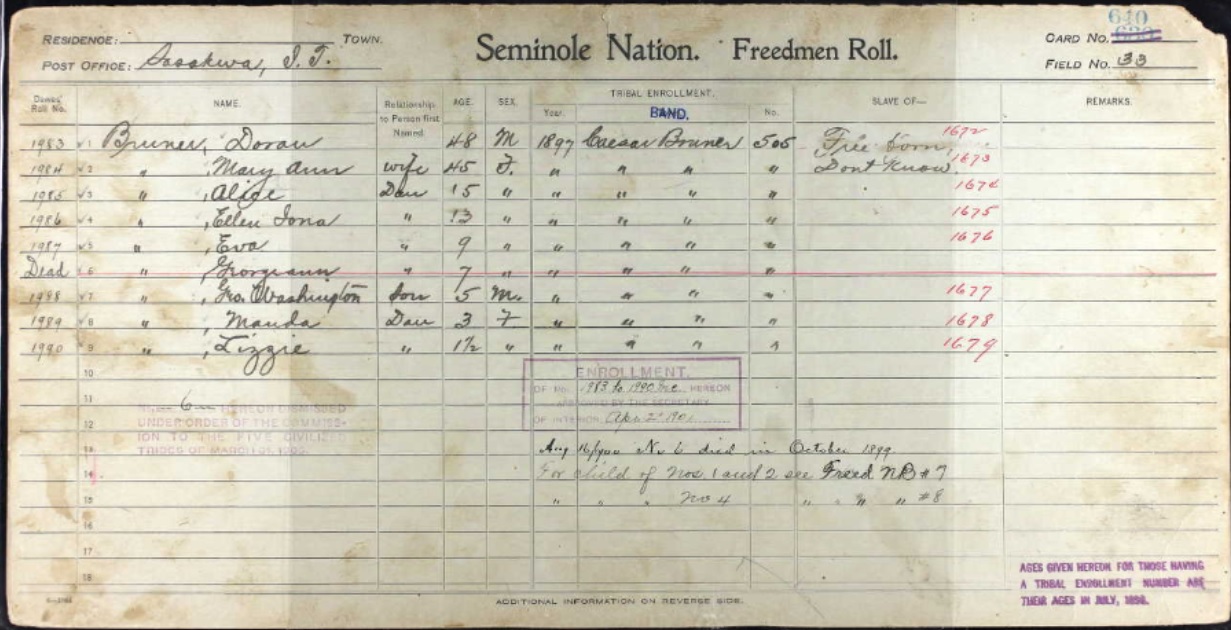
From the town of Sasakwa, the family of Doran and Mary Bruner appeared in front of the Dawes Commission to enroll as Seminoles. On the enrollment card, the father Doran was born a free man in the Territory, yes, as was done with so many--he was placed on the Freedman Roll. Their children were Alice, Ellen Iona, Eva, Georgeann, Geo. Washington, Manda and Lizzie. Another child was born in 1905 named Parah Bruner, whose enrollment card is the third image below. This entire family was part of the Ceasar Bruner band of Seminoles.

Seminole Freedman Card #640 Field Card #33
The National Archives at Ft. Worth, Ft. Worth Texas 1868-1914,  NAI Number: 251747
Record Group Title: Records of the Bureau of Indian Affairs, Record Group 75


Doran Bruners' father was Dan Bruner and his mother was Rachel Bruner, and like so many especially those from the Sasakwa settlement, his parents had at one time been enslaved by John Jumper. Doran. Mary Ann's father was Ginford Thompson and  her mother's name was Minerva. Both of her parents were once enslaved by Judge Thompson.


Son Parah's name was placed on Seminole New Born Freedman card #7. Both parents' names appear on the card. The "new born" category appears in most of the tribes, but in many cases some names were simply added on the front of the original family enrollment cards, and in other cases they were placed on new born cards such as this case.

Seminole New Born Freedman Card #7
The National Archives at Ft. Worth, Ft. Worth Texas 1868-1914,  NAI Number: 251747
Record Group Title: Records of the Bureau of Indian Affairs, Record Group 75

Thankfully, a small interview does exist for this family. There was most likely additional data, because the only focus of this one interview pertains to the death of one of the children. Clearly questions, about the history and parentage of the father and mother would have been taken at the time, but in this case the only document to remain in the file pertains to proving the death of one of the children.

Like many of the Seminole Freedmen a spokesman was called to testify on their behalf. In this case, the band chief Caesar Bruner himself came to testify to verify that one of the children had died. Caesar confirmed that Georgeann had died, and that he was at the family home after the funeral. Also note that Ben Bruner also came to testify for the family. Ben Bruner was also an officer for the Bruner band of Seminoles.


Application for Enrollment NARA Publication M1301 Seminole Freedman #33
(Also accessed from Fold3.com, Native American Collection)

Thankfully there were no complications in the enrollment of this Bruner family. They were allowed to enroll without any challenges made by the Dawes commissioners. Their enrollment however, was that of Seminole "freedmen" although the father was born a free man. Nevertheless, having been approved, they were eligible for the allotment of land they which they accepted. 

Land Allotment Records

The names of the family are shown on this first image as they applied for their land allotment.


Ancestry.com. Oklahoma and Indian Territory, Land Allotment Jackets for Five Civilized Tribes, 

1884-1934[database on-line]. Provo, UT, USA: Ancestry.com Operations, Inc, 2014.


Much of the data found in the allotment records contain legal description 

(Source: Same as above)

(Source: Same as above)


Most importantly the end of this story is summed up in the final question asked, "Will you accept these lands for yourself, your wife and children as final allotments to the Seminole Nation?" His response was clear, "Yes sir."
(Source: Same as above)

Like the story of many, the family was now a land-owning family, and were able to face their future moving ahead. Statehood came and like all families they now faced a new future in a new state of Oklahoma, and new country--The United States to call their own. Their legacy however, as Seminoles, like those of all of the Five Tribes was one well documented through complicated years of war, peace and challenge. This Bruner family, like others of their band, like others of the same nation, and like others from Indian Territory, have a richly documented history, reflecting legacy, endurance and continuity. May they always tell their story.

 This is the 50th article in a 52-article series devoted to sharing histories of families once held as enslaved people in Indian Territory, now known as Oklahoma. The focus is on the Freedmen of the Five Civilized Tribes, and these posts are part of an ongoing project to document 52 families in 52 weeks.

Wednesday, December 27, 2017

Julia Hershey and Family - Creek Freedmen

Researching families from the Creek Nation is not without its difficulties. This is particularly when one finds that so many of the interviews of families are simply missing. They were misplaced, and never microfilmed and now lost to time. Therefore when one finds some remarkable stories in the application jackets that were preserved they should be share as they provide so many insights in the lives of people in the 19th century in Indian Territory.

Such is the case of Julia Hershey (Hersche) from Muskogee. She appeared in front of the Dawes Commission in September 1898. Data from her enrollment card is simply and one might think that hers was an uncomplicated case.

She was 54 years of age when she applied for enrollment as a Creek Freedman. On Field Card #1222 her name is found along with that of her son John Pyles who was 18. Was a member of Arkansas Town and had been enslaved by Lookin Barnett. Some notations on the front of the card indicate that she had been placed on earlier rolls over many years.

Creek Freedman Card #1222
The National Archives at Ft. Worth, Ft. Worth Texas 1868-1914
NAI Number: 251747
Record Group Title: Records of the Bureau of Indian Affairs, Record Group 75

On the reverse side of the card the names of her parents are found. Her father was Alex Barnett and her mother was Rosa Barnett who had died during the years of the Civil War. Lish Pyles was her son's father, and he was not a citizen of the Creek Nation. 

(same as above)

The Application Jacket

To say that the data contained in her application jacket was plentiful does not say enough. There is information about her as an applicant, but the 33 pages contained in the jacket go far beyond the ordinary that one typically sees. Personal data about her life was there. But in addition, one can read about the process that people went through, the various  people that they met and even some of the witnesses on her behalf reflect the relationships that people had with others from beyond their family circle and even their community. Many had formed relationships and friendships with those from other tribes as well.

Personal Data about the applicant.
Initially personal data about Julia and her life was extracted. Her mother was Rosa Black who had married Alex Barnett. It also turns out that at one time Julia also used the name Pyles, which was the surname of Rosa's husband. Julia had already said that her son's father was Lish Pyles, but the question was asked if her son's surname was taken after her mother's husband which she replied, "yes".

There was also an interest in the surname Black and that sometimes the name Blackdirt was used. This would be asked again later.


National Archives Publication M1301
Applications for Enrollment
(Also accessed from Fold3.com, Native American Collection, Choctaw Freedmen)

The next witness on her behalf was a Cherokee woman whose name was Nannie Murray. Nanny Murray was asked about her knowledge of Julian and the family and she pointed out that she knew that Julia's mother was enslaved by Granny Black. (The reference to Granny Black also appears in the first interview above.) She was then asked to confirm the relationship of Julia to Granny Black the slave holder. Nannie pointed out that she never was at the home of Granny Black, but her own grandmother used to visit Granny Black and Granny Black used to visit them. She learned from those visits in her childhood that Granny Black owned her mother "Rhody" and that Rhody had three children.

(same as above)

Again there were questions about the tie of Julia to the Blacks and Nannie confirmed that Granny Black used to make references to "her colored folks" frequently. She was then asked if she knew Charlotte Blackdirt, which she said at first she did not know. But then she replied that she knew that Charlotte had married a Lewis, but was not sure if Granny Black had owned Charlotte. When asked why she referred to her as "Aunt Charlotte" she pointed out that many people of color referred to other in that way.

(same as above)

Arkansas Town Officials Testify for Julia

Willie McIntosh was the next witness. It turns out that he had an official role in his town as he served as Secretary for the Arkansas Colored Town. He was present when citizens came to draw the various payments over the years and verified that he knew her. He also asked if he knew a Julia who was part of the Derishaw family, which he did not. He verified that he knew that Julia drew the money and was asked more than one time how he was certain of it. He was then presented with a document and asked if it was in his hand-writing. He pointed out that it was not done by his hand, but it was copied from his own book. There then seemed to be satisfaction enough that Julia was qualified for enrollment.
(same as above)

A year later, Julia appeared again in front of the commission. She was asked about her parents. Alex was Barnett was enslaved by Larkin (Lookin) Barnet and her mother was enslaved by Granny Black. Her mother died before the war ended, although it was not mentioned where.

(Same as above)

Julia then tells the story of her life during and after the war. She was taken south to Texas, but after peace was declared and the treaties signed, she traveled with a group of scantily clad Indians back to Fort Gibson. She remained there for a while before making her way to the Old Agency in Muskogee.
(Same as above)


The questions continued and Julia was then asked to tell other parts of her story, describing when she married Lish Pyles, and where she moved. She mentioned several places that she had lived and the details were more detailed than one would usually find. Others who knew her were called. and the reader gets a glimpse not only of Julia's life, but of life after the Civil War for many former slaves.

As a reader one can see the movement of people across the country side, some to Fort Gibson, and others to other settlements. Some were in search of family and others in search of a way to make their life. Julia described how she had moved from Fort Gibson to Muskogee, and how many times she appeared for payments to Creeks. She also described having her name put on the Dunn Roll. Following that were multiple pages about her receiving various payments over the years. Various payments from "Bread money" and other payments made over the years. She was grilled continuously about who distributed the funds to her, and where. Then witnesses were called to verify that she was truly the same Julia. These questions continued for pages in the file.

The Town King Testifies

One of the more fascinating interviews in Julia's file came from Gabriel Jamison was called. He was the town king for Arkansas Colored Town. The line of questioning was focused on Julia's name on the Arkansas  Colored Town roll. When asked if her name was there and how it was done, he decided to describe the entire process of creating the town roll. His description provides for the reader a clear insight into exactly how things happened from inside of this Creek town.
(Same as above)

Many pages were devoted to why Julia's name was left off several rolls from the  $29 payment roll to the "Omitted" Roll. and for those whose ancestors went through the process it will be worthwhile to explore each and every page of this lengthy file.

Oddly, as detailed as the file was, the ending to the case was abrupt. Julia was recalled again, and was asked about the exact age of her son, and why some data conflicted with other data. She pointed out that at times her mind would come and go and she was not sure. She was then directed to present any additional testimony on June 12th for her next interview. And thus the file ended.

(Same as above)

The abrupt ending of the file does not diminish the file, nor the case. In fact the rich data contained on those pages far outweigh the seemingly short ending. Julia Hershey was clearly a woman of the Creek Nation and clearly her case was eventually approved and not rejected. She left behind an amazing narrative describing her life from the end of the war, her travels back to Fort Gibson and her life over the years. As the nation changed, her status changed, and she was a witness to the many changes within Indian Territory.

She got her land as did her son. This Creek woman whose education was limited survived. From her file, we see part of her life described before emancipation. We see the early days of freedom as her life was changed. We also see the years spent as circumstances required movement sometimes for word and other times to find something better. Her relationship with the tribe is apparent, and the relationship of former slaves to the land and the community was strong. From this simple woman's files, so much can be learned. May her Creek descendants come to read, embrace and grow from her story.

(The entire file of Julia Hershey can be found in Application Jacket #1222, in microfilm collection M1301 at the National Archives. It can also be accessed online at Ancestry.)


**********
 This is the 49th article in a 52-article series devoted to sharing histories of families once held as enslaved people in Indian Territory, now known as Oklahoma. The focus is on the Freedmen of the Five Civilized Tribes, and these posts are part of an ongoing project to document 52 families in 52 weeks.