Showing posts with label Chickasaw Nation. Show all posts

Tuesday, June 20, 2023

"Yall as Free as I am."


Juneteenth and a Season of Freedom

We celebrated Juneteenth yesterday, which is a national holiday honoring the end of slavery and beginning of freedom in the United States for millions of people. However, for several thosand people just to the west, in Indian Territory, slavery continued. A full year after the Civil War the five slaverholding tribes finally abolished slavery by signing a treaty with the United States. Four different treaties were signed, with 3 tribes signing their own treaty--Cherokee, Creek and Seminole Nations. Choctaws and Chickasaws signed the same exact treaty, and at last slavery was abolished in Indian Territory.

There are not many stories written explaining how freedmen came to the various communities. However, years later a few of the formerly enslaved people referred to their experiences when freedom came to them. Below are a few of these memories shared in the 1930s when the WPA (Works Progress Administration) launched the Slave Narrative Project. Thankfully a few of the stories of Freedmen from the Five Tribes were also captured in that process.

Below are a few words documented by the project. Note that the final piece is the only reference made to freedom of an ancestor who was enslaved in the Choctaw Nation. It is a reference simply to my gr. gr. grandmother, and who had freed her. Though her own words are not there---the word "freed" is still there as part of our own family's story of freedom. 

Those enslaved in Indian Territory should never be forgotten. Though many were told that they were not worthy, and that their blood did not count--it needs to be said: It did count! They did count! And their history is there to find.

Although our ancestors were not freed on Juneteenth, we still celebrate the beginning of the end. It would take a full year in the territory and for many such as the Choctaw Freedmen, it would be 19 years before citizenship was finally given to them. 

* * * * *
 
~~Phyllis Pettit~~
Cherokee Nation

"But one day Old Master stay after he eat breakfast and when us negroes come in to eat, he say: 'After today I ain't your master any more. Yall as free as I am.' We just stand and look and don't know what to say about it."1

After while Pappy got a wagon and some oxen to drive for a white man who was coming to the Cherokee Nation because he had folks here. His name was Dave Mounts and he had a boy named John.

We come with them and stopped at Fort Gibson, where my own grand mammy was cooking for hte soldiers at the garrison. And I was named after her. She had a good Cherokee master. My mammy was born on his place.

We stayed with her about a week and then we moved out on Four Mile Creek. She died on Fourteen-Mile Creek about a year later. 

When we first went to Four Mile Creek we saw some negro women chopping wood and asked them who they worke for and I found out they didn't know they was free yet."

* * * * *

~~Charlotte Johnson White~~
Cherokee Nation

"Near as I ever know I was born in the year 1850 away back in dem hills east of Tahlequah; the Cherokees called it the Flint District and old master Ben Johnson lived somewheres about ten miles east of  theh big Indian town Tahlequah.

Never did know jest where his farm was and when de new towns of this country spring up, it make it dat much harder for me to figure out jest where he lived and where I was born."

...I hear about the slaves being free when maybe a hundred soldiers come to de house. Dey was a pretty sights settin' on their horses, and de men had on blue uniforms wid little caps. "All de slaves is free," one of de men said, and after dat, I jest told everybody, "I is a free Negro now and I ain't goin to work for nobdy."

A long time after de war is over and everybody is free of dey masters I get down to Muldrow (Okla) and dat's where I join de church. For 58 year I belong to the colored Baptists and I learn dat everybody ought to be good while dey is livin', so 's dey will have a better restin' place when dey die." 2

* * * * * 

 ~~Kiziah Love~~
Choctaw Nation

...I  married Isom Love, a slave of Sam Love, another full-blood Indian that lived on a a jining farm. We lived on Masater Frank's farm and Isom went back and forth to work fer his aster and I worked ever day fer mine. I don't 'spect we  could of done that way iffen we hadn't had Indian masters. They let us do a lot ike we pleased jest so we got our work done and didn't run off.

I was glad to be free. What did I do and say? Well, I just clapped my hands together and said thank Gof Almith, I'se free at last."3

* * * * * 

~~Sallie Walton~~
(Dawes Interview for Walton Family)


In 1899, my great grandparents from the Walton family appeared in front of the Dawes Commission to be interviewed. Basic information was collected, and a member of the Perry family was present and testified on behalf of my great grandmother Sallie. One sentence stood out for me, that referenced how freedom came to the Perry slaves. This is the only reference to freedom from family records. and they are shared here as well.

"The mother of Sallie Walton was freed under my sister Emeline Perry."4
Q. Was your sister a Choctaw?
A. Yes sir

* * * * * 

Clearly, a critical task awaits us---to find our freedom story!

 1 Federal Writers' Project: Slave Narrative Project, Administrative Files. 1936. Manuscript/Mixed Material. Retrieved from the Library of Congress, <www.loc.gov/item/mesn001/>
2
Ibid
3
Ibid
4
National Archives Publication M1301, Applications for Enrollment of the Five Civilized Tribes

Sunday, August 21, 2022

Reflections on the Senate Hearing & Meeting With Descendants of Oklahoma Freedmen


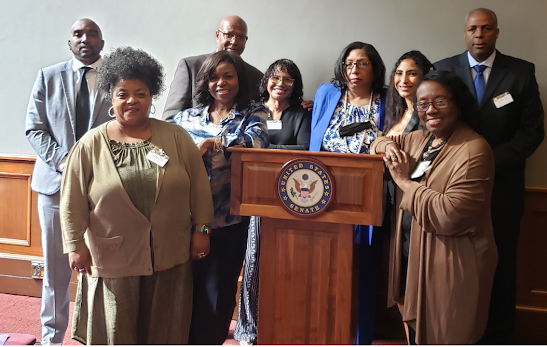
Women (left to right): LeEtta Osborn Simpson (Seminole); Rhonda Grayson (Muscogee); Sharon Linzy Scott (Muscogee), Marilyn Vann (Cherokee), Rosie Khalid (Cherokee); Angela Walton-Raji (Choctaw)
Demario Solomon-Simmons, (Muscogee), Terry Ligon (Chickasaw), Calvin Osborne (Creek)
(This group met in Senator Schatz's office after the Senate Hearing)

On July 27th, the Senate Committee on Indian Affairs met in Washington DC to listen to input from the five slave-holding tribes. These tribes are the Cherokee, Choctaw, Chickasaw, Creek and Seminole Nations. The purpose of the hearing was to discuss issues pertaining to the descendants of Freedmen--the African people once held in bondage in those nations. I was fortunate to be able to attend this hearing.

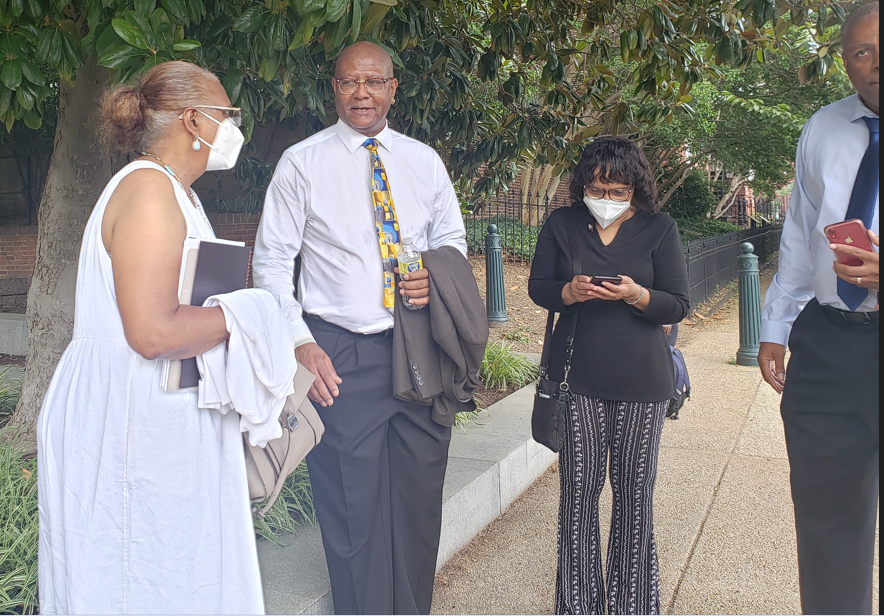
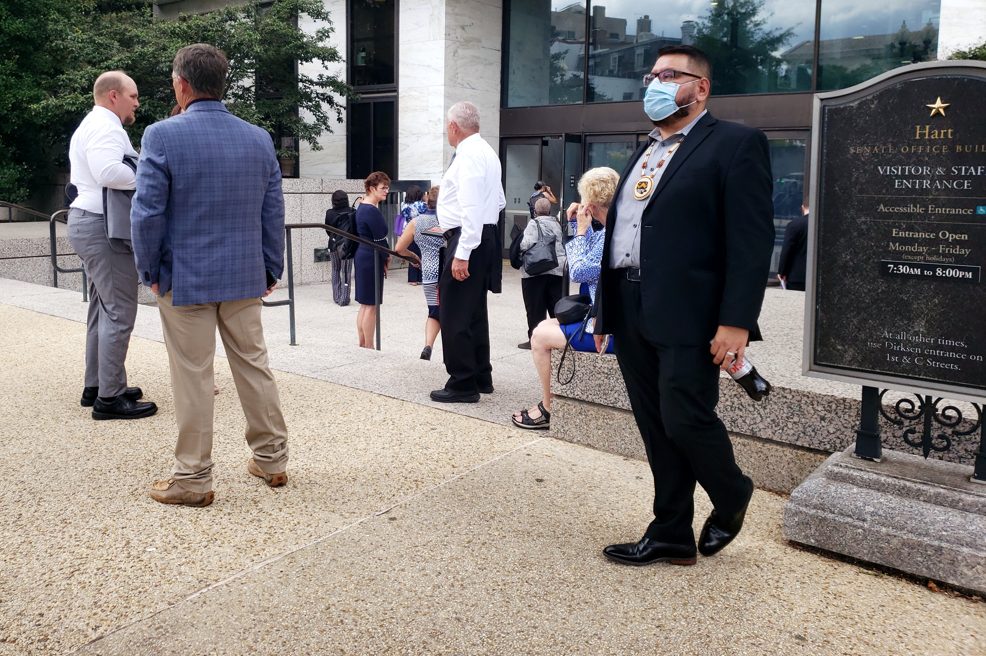
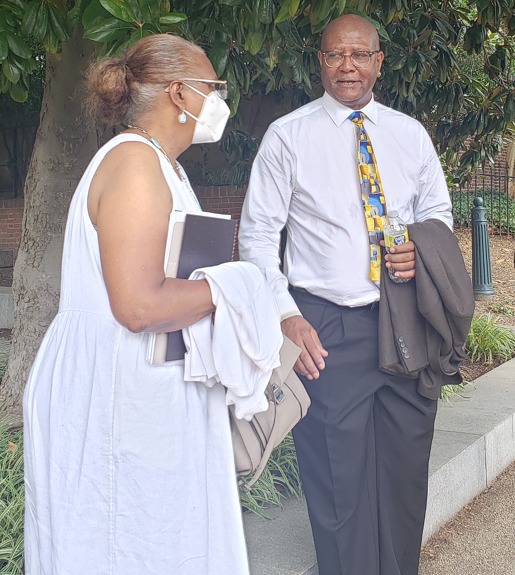
Upon arrival at the Hart Senate building, Freedmen descendants gathered in front of the building before shortly before 2:00 pm when doors were opened. For them, it was an opportunity to meet descendants from other tribal nations, for the first time. Interactions were congenial, friendly, among the small group of descendants some of whom were meeting in person for the first time. 

Before the committee convened, all in attendance gathered in front of the Hart building. There was little interaction between tribal representatives among themselves, and the gathering in front of the building was extremely quiet. But for Freedmen representatives all five tribes were present, and this was only the second time since 1866, that Freedmen descendants from all five nations were present in Washington for a hearing pertaining to their status within their own respective nations. The first time was in 2021 when descendants gathered for a hearing in the House of Representatives.

No others were present at the Senate building, except the Freedmen descendants and invited speakers.


Choctaw, Chickasaw and Muscogee chatting before hearing
Lto R: Doris Burris Williamson, Terry Ligon, Sharon Linzy-Scott, Calvin Osborne

                                                
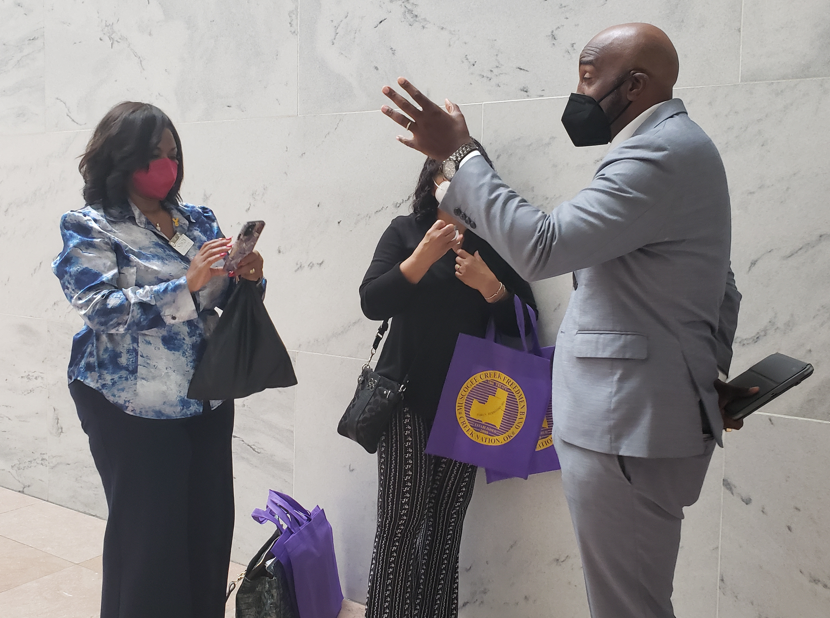
Muscogee Creek Freedmen Band members before hearing


Choctaw/Chickasaw and Muscogee
descendants sharing info. 
Terry Ligon, and Calvin Osborne

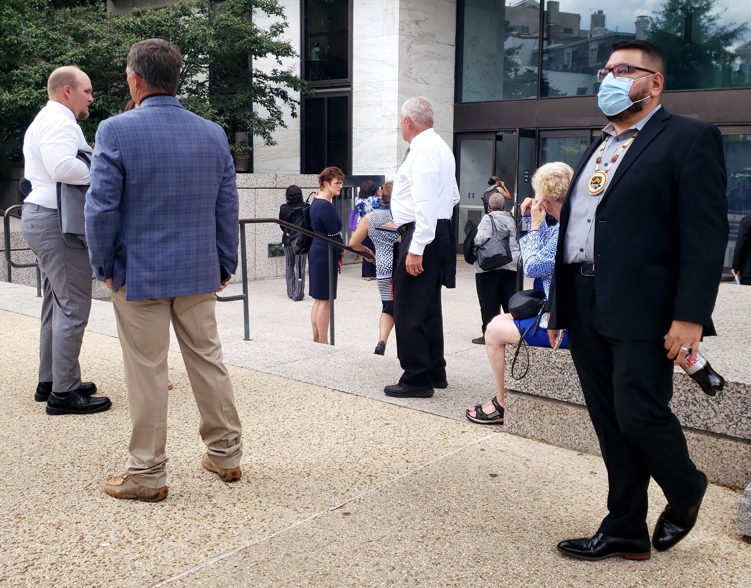
Tribal officials soon arrived, generally keeping apart from others. Some arrived wearing traditional native necklaces and generally awaited the opening of the doors to the Hart building, near the entrance. Most were quiet and not much inter-tribal interaction or talking among each other before entering the Hart building.

                                        
Tribal officials gather outside the Senate buidling


                                                                                     Before the Senate hearing

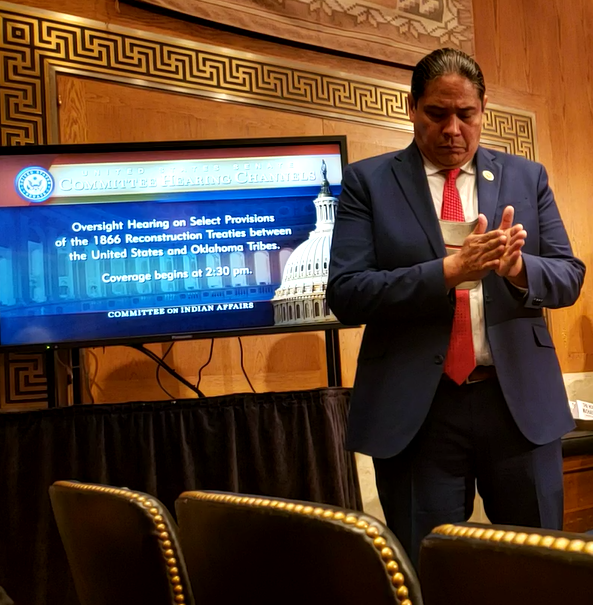
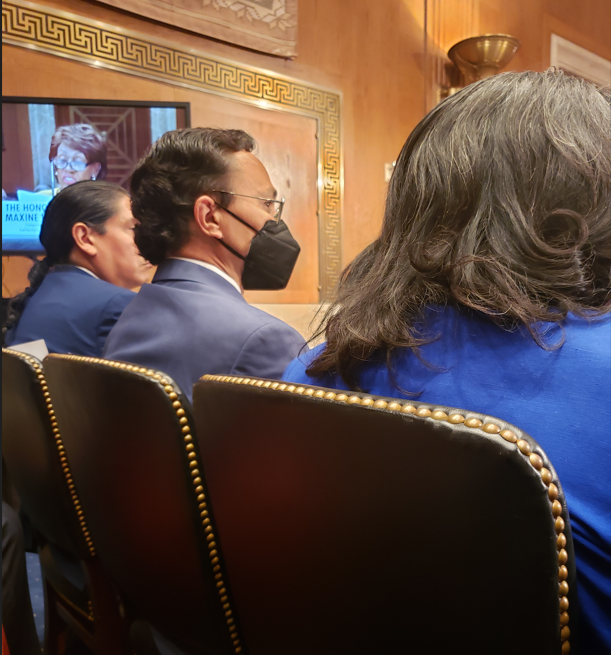
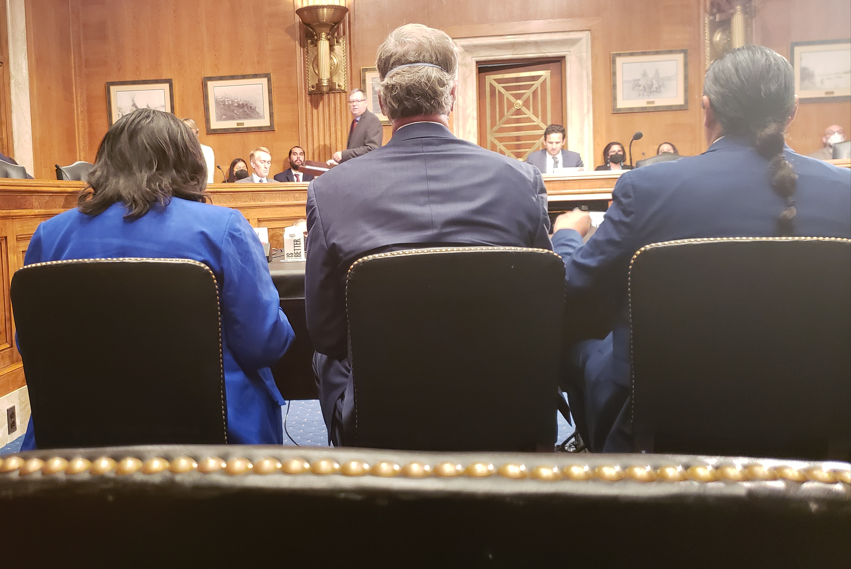
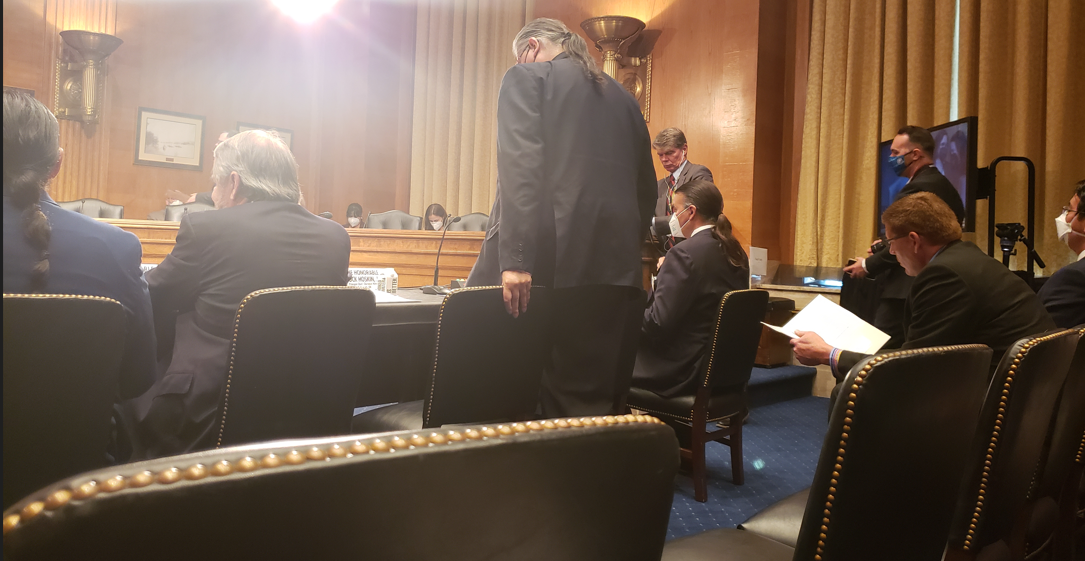
Once the doors opened, the small group of about a dozen of us were directed to the room for the senate hearing once we were cleared and names of invited guests were confirmed. The hearing room contained  some large television monitors so that those of us seated behind the speakers could actually see their faces as they spoke.

Freedmen descendants sat behind listening to the spesakers. Only one spoke with honesty and heartfelt sincerity about their history and historical mis-treatment of Freedmen and then offered a sincere apology to descendants. That was Cherokee Chief Hoskins who also mingled freely with Freedmen before and after the hearing. 

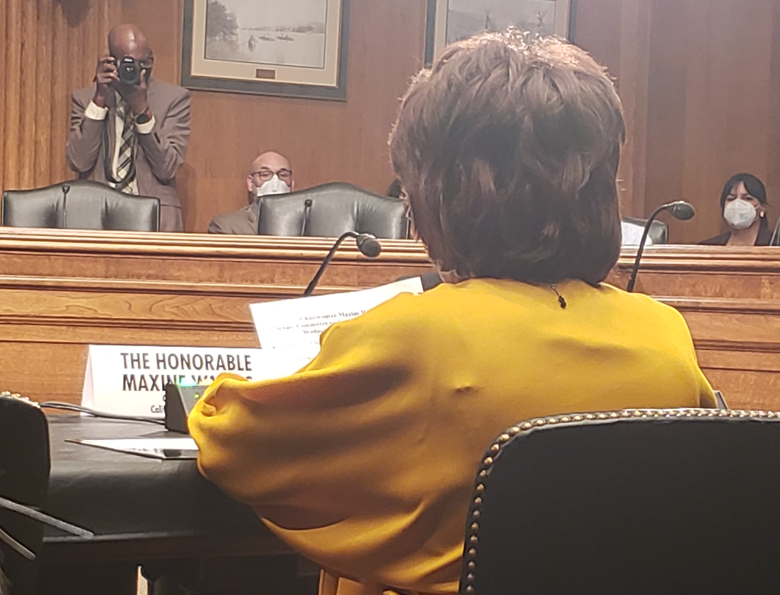
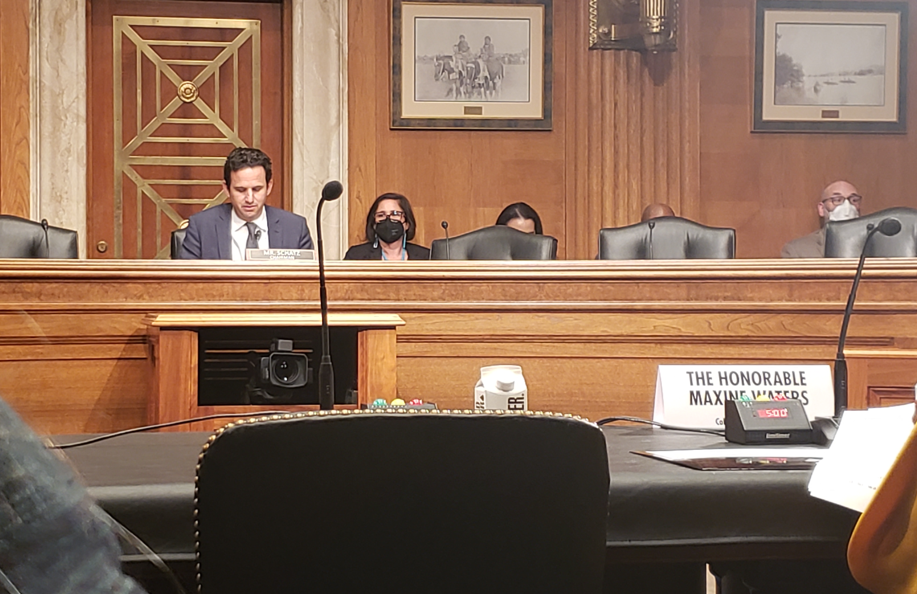
The hearing began with Congresswoman Maxine Waters addressing the Senate Committee. She was then followed by others representing the BIA, and the various tribes. The only speaker on behalf of the Freedmen was Marilyn Vann long time Freedman advocate, and now an enrolled Cherokee citizen.


Maxine Waters addressing the Senate Committee


                                                        Panelists listen to Congresswoman Waters address.

Other speakers spoke about blood--ignoring that they also prevented Freedmen who were connected  by blood to them, from being placed on the blood rolls. One after another they spoke, some never answering the questions asked, and others simply clinging to their security blanket of "sovereignty" as sssomething to hide their race-based biases behind.

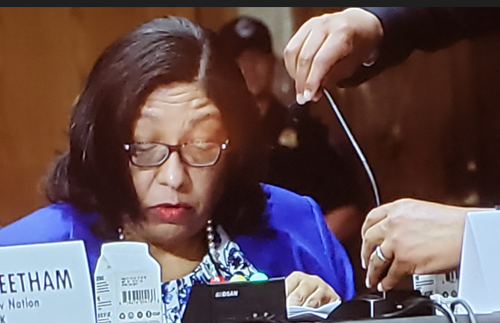
Only one voice was heard speaking on behalf of the disenfranchised Freedment descendants. Ms. Marilyn Vann spoke and was the lone voice speaking for Freedmen descendants. Ms.Vann is now an enrolled Cherokee citizen, so technically no voices of disenfraned Freedmen were heard, while tribal officials sent attorneys, ambassadors, and even BIA officials who uphold tribal policies and who also spoke against any concept of Freedmen equal treatment.


Marilyn Vann, Cherokee citizen addressed the committee


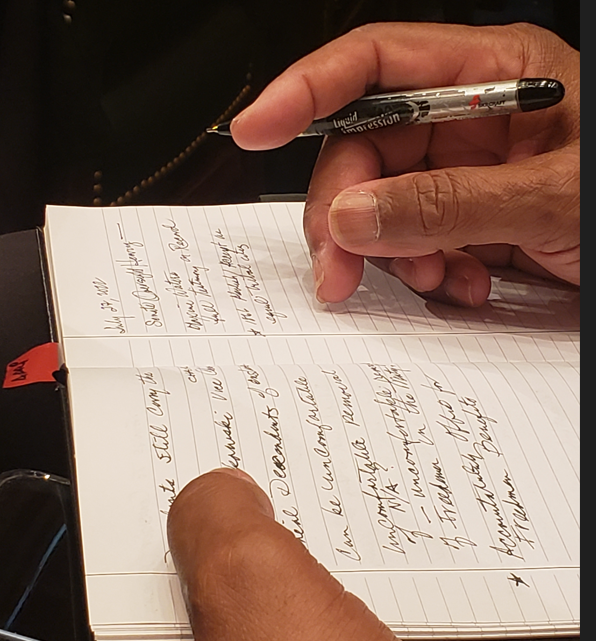
Several of the Freedmen took vigorous notes during the hearing as the panelists spoke.

                                                
                                                       Note taking during the hearing.

After the hearing only a few of the tribal speakers conversed or had dialogue who with Freedmen descendants, and most of them quickly left after the hearing. Later, a smaller group of 9 Freedmen descendants (pictured at the top) from all of the Five Tribes met with Senator Schatz in his office for a brief discussion about moving ahead.


Atty. Demario Solomon-Simmons discussing Freedmen issues with Muscogee Ambassador 


Reflections After the Hearing

Moving ahead, today, 156 years after the treaties were signed by each tribe,  the descendants of the Freedmen are still seeking justice. Why? Because four federally recognized tribes prevent them from having basic rights coming from their own family ties to them. These nations claim to be "sovereign" nations, while they refuse to offer services to all who are part of them.

Freedmen descendants are those  whose ancestors lived with them, were enslaved by them, remained with them when later freed, abided by the same laws created by them, and were part of them. However, today---the descendants of only those who have a certain "blood" are allowed to be a part. Sadly that blood policy also means that if you have a blood tie to a slave, then you are less than they and are to be shunned and forced to remain so--forcing people to carry a "stain" of slavery--a status they never sought.

In Oklahoma today in these nations, educational doors are opened for children, summer camps prevail, STEM educational training abounds, and scholarships and educational grants, are offered, and so much more. There are health benefits for the elderly, housing assistance for those in need, mental health assistance for those also in need, all of which are funded by US Federal dollars.---but the black children have no such access, nor do the elderly black people, many of whom are related to their lighter-skinned enrolled tribal members. Those light to white skinned members are welcomed into the nation, and live with these enriching benefits because they are allowed to have association with the tribe of their ancestors. But the Freedmen cannot have association with the tribe of their ancestors---some of whom are the same as enrolled members. That is the irony and the bittersweet aftermath of American slavery and Indian tribal practice of black chattel slavery.

 Today the struggle continues. It is noted that when post Civil-Rights years-- in the 1970s and 1980s these former slave-holding tribes had now embraced the the same "old-south" racist feelings to black citizens, and with the aid of friends and colleagues who had become federal BIA workers. They simply changed their constitutions and quietly removed descendants of slaves from eligibility.

Since then, these same tribes  have been able to execute racist policies in the name of  "sovereignty" and have been able to ride on national sympathy as victims of the Trail of Tears, bringing in millions of tourist dollars and wealth from casino monies. Their wealth is enhanced by federal funds, and now these slave-holding tribes have become wealthy, large employers, and "good neighbors" to Oklahomans, as long as the neighbors are not Freedmen descended people. 

The resilience of the Freedmen from the past is found in the resilience of their descendants today. The fight for equal opportunity continues to fight for the same opportunities that are their birthright. Freedmen never imposed themselves upon tribes it was the tribes that imposed their laws and culture upon them. Today thousands of Freedmen descendants still have a strong identity to the same tribes--simply because that is what they are. 

Descendants seek to live full lives complete with the same opportunities that their fellow neighbors, friends and even kin have. This struggle continues because "it is the right thing to do."

Thursday, July 28, 2022

The Hearing on Capitol Hill


Senator Schatz Chairman of the Committee on Indian Affairs

July 27th 2022 was a landmark date. For the first time in history a hearing on the status of Freedmen of the Five slave-holding tribes, occurred to address the neglicence of both tribal officials and Congress in issues pertaining to those once enslaved.

Focus of the hearing:  
Oversight Hearing on 1866 Reconstruction Treaties Between United States and Oklahoma Tribes.

The hearing was chaired by Senator Brian Schatz (D. Hawaii) and in attendance were descendants of Freedmen from all five tribes, whose ancestors were once enslaved in those nations. The tribes sent their own representatives to testify on their behalf. Representatives from the Cherokee, Choctaw, Chickasaw, Creek and Seminole Nations were all present. Each represenataive was given 5 minutes to present an official statement. Only one speaker on behalf of Freedman was included.

The first panel consisted of only one presenter--Congresswoman Maxine Waters, who had long recognized the issues affecting descendants of Freedmen, many of whom now live in her district in California. 

Congresswoman Maxine Waters speaks to Senate Committee

The second panel consisted of multiple speakers from the Five Tribes, in addition to a representative from the Department of the Interior, Bryan Newland, and the sole speaker from Freedmen, Marilyn Vann an enrolled citizen of the Cherokee Nation and President of the Descendants of Freedmen Association. 

The audience consisted of Freedmen from all five tribes, many of whom met and gathered prior to the hearing outside of the Hart Building on Capitol Hill and who met for the first time. The hearing was historic because Freedmen who have ancestors documented ties to each tribe were present for the first time in Washington to attend an event addressing their issues.


Dorris Burris Williamson and Terry Ligon


Attendees Gathering Before Hearing


Creek Freedmen in Discussion Before Session


Panel 2 Listening as Congresswoman Waters speaks

It did appear that there was a strong interest expressed by the committee as they listened to the presenters. In addition some of the questions asked by the committee members were left unanswerable because the issues such as the size of the Freedmen descendant popultation have never been studied.


Senator Lankford of Oklahoma Listened intently to presenters


Partial view of Panel 2


Another view of Panel as seen by audience


Speakers from the Seminole Nation of Oklahoma


Speaker Representing the Choctaw Nation of Oklahoma


Speaker Representing the Muscogee (Creek) Nation


Speaker Represnting the Chickasaw Nation of Oklahoma


Speaker Representing the Oklahoma Freedmen 

The hearing began shortly after 2:30 pm and lasted until about 4pm. Some evaded questions directed to them and others answered questions when directly asked. The outstanding voice pertaining to the treaty and its history came from Principal Chief Chuck Hoskins of the Cherokee Nation of Oklahoma. who addressed the past as well as the present. Since the ruling in 2017 that confirmed the status of the Freedmen in the Cherokee Nation, Hoskins pointed out that close to 12,000 descendants of Freedmen have been admitted to citizenship in the nation and he was quoted as saying that they are a better nation because of it.

There will clearly be multiple disussions in many forums and platforms over the next few weeks. It is hoped that the hearing will be a new beginning in the movement to create awareness of the history of the Oklahoma Freedmen, and many more of the stories that pertain to their presence on the soil of Oklahoma will emerge.


Friday, November 8, 2019

Open Letter to Curriculum Developers of Oklahoma History


Several weeks ago an erroneous message came forth from the Chickasaw Nation of Oklahoma. On their website there was a statement that "slaves found refuge in the Chickasaw Nation."


Images from Chickasaw.tv website

This statement was placed on the official website until finally word was passed to those in charge that the statement was not simply incorrect. It was, in fact, placing a false narrative about the relationship between Chickasaws and people who were enslaved by most of their leaders in the 19th century.

In recent days information was shared in a social media history research group for descendants of Choctaw and Chickasaw Freedmen, about the curriculum for use as part of the Chickasaw elementary school curriculum. The text has a statement that does not address the history of  slavery to any degree. The piece was shared to the group, actually painted slave holders as the victims in the one small piece that mentioned slavery.

(excerpt from Chickasaw Elementary School Curriculum)

This focus of this appeal, is not to malign the Chickasaw Nation, nor the Chickasaw people. Nor it is a piece intending to put forth an angry narrative about the lives and treatment of Freedmen  in the difficult post Civil War era.

The goal of this piece  is to address the fact that several thousand people lived, worked, toiled, and died among Chickasaw people, as Chickasaw slaves, and later as Chickasaw Freedmen. And a similar story is found among the other slave holding tribes, that also brought their southern culture with them to the Territory--- they brought their language, foodways, burial practices, and among those who could afford it--the enslavement of human beings.

After Freedom, Chickasaw Freedmen remained in the Territory---it was their home. They spoke the Chickasaw language, ate the Chickasaw food, and practiced the culture as a Chickasaw-influenced people. And many Chickasaws today have Freedmen descendants among their friends, neighbors, coworkers, and classmates. Many Chickasaws today have Freedmen descendants in their families, and some have Freedmen descendants as husbands, as wives, and also as children. Those relatives, those family members deserve to be a part of the history that is theirs.

Most educators would agree with the following:

*To tell the story of the United States of America, without the mention of the practice of slavery would be a lie---of omission.

*To tell the story of pre-statehood Oklahoma without mention of the Trail of Tears would be a lie of omission.

But I must add to that agreement:

*To tell the story of pre-statehood Oklahoma without the mention of slavery would be a lie of omission.

*To tell the story of the Chickasaw Nation and all of the Five "Civilized" without their own involvement in the practice of slavery would be a lie of omission.


Descendants of those enslaved people who fought for freedom and won---they too are Oklahomans, living on Oklahoma soil and trusting their educators to tell them the story of the amazing land where they live. Yet, at the same time, the descendants of those Freedmen, who still remain in Oklahoma are finding that their own history is being omitted. There were thousands of Freedmen in Oklahoma at the beginning of statehood.

For reference this was the population in 1906 before statehood:
Cherokee Freedmen 3,982
Choctaw Freedmen 5254
Chickasaw Freedmen 4995
Creek Freedmen 5585
Seminole Freedmen 857 + 93 later added
Total Indian Tribal Freedmen:  20, 766
(Source of data: Muskogee Cimeter, January 4, 1906 page 2)

After more than a century since statehood, there are now hundreds of thousands of Freedmen descendants. And it is known that those Freedmen descendants who are native born Oklahomans, who speak with pride about their ancestry--they are not permitted to enroll in their ancestral nation today due to a bias against those of their race. But despite this---surely those children deserve to have their ancestors become more than a footnote in Oklahoma history. Those children who descend from over 20,000 Freedmen, deserve not to have their history overlooked and erased from the pages of their state.

Many who live in Oklahoma often see the "Friendly neighbor" advertisements coming from the Chickasaw Nation and how relations with fellow Oklahomans is so important. Yet, many young people learning their history, whose ancestors were Freedmen, see nothing of their own presence mentioned by the same "friendly" people who are influencing the curriculum.

Oklahoma African American history did not being with the Tulsa Massacre of 1921, and it did not begin with the Oklahoma Land Rush in 1889. African presence in Indian Territory began seven decades before statehood because many arrived during the years of the Trail of Tears in the 1830s. Their stories are captured in the Indian Pioneer Papers at the University of Oklahoma, and the WPA Oklahoma slave narratives of the 1930s, and the interviews of the Dawes Commission 1898-1914.

Likewise, the institutions built by Freedmen deserve more than a footnote----

-Tushka Lusa
-Oak Hill Academy
-Dawes Academy
-Evangel Mission (Now the Five Tribe Museum in Muskogee)
-Tullahassee Mission School
-Cherokee Colored High School
...........and dozens of Freedmen neighborhood schools.

They are long gone, and perhaps forgotten by the tribes, but not forgotten by those of us whose ancestors attended these schools.

There is much that can be done from the education community, and hopefully the curriculum of Oklahoma will reflect that. And hopefully Freedmen descendants will not see the lives of 20,000 people from the Five Civilized Tribes, swept under the proverbial rug as if they did not exist, and were not a part of the land that became Oklahoma.

And Chickasaw Freedmen children, whose ancestors were disenfranchised by their own tribe after the war, will not see once again, no mention, no story, no acknowledgement of their existence from the nation in which their history is rooted.

As a descendant of one whose ancestors lived in the Choctaw Nation, and who arrived in Indian Territory with the Perry clan from Yalobusha Mississippi, I can only hope that the someday the children of those who remain in the state of Oklahoma will have their history told.

I am an independent researcher, and an educator by profession, and many for whom I conduct research, live in Oklahoma. They are often quite shocked when I share records with them, reflecting that their ancestors were slaves right there where they live They then ask me, why they were never taught that in school. I can only respond by telling them to talk to their educators and talk to their leaders.

An Opportunity
This is a wonderful time and a wonderful opportunity for scholars of multiple disciplines, (history, sociology , anthropology and archaeology) to allow their spirit of academic inquiry to expand into other arenas. Tell those stories of Freedmen settlements, find this historic sites where the Freedmen schools once stood, research their past--and tell the stories of the people who made these events unfold.

But this can't happen, if the state of Oklahoma cannot even teach the history correctly. Without the full story, historians cannot truly explore the many unwritten chapters in its history. Without the full story, a false narrative emerges, and entities will create false myths such as slaves seeking refuge in the tribes that were, in fact slave owning tribes.

My appeal is that the full history be included as the curriculum is developed, so all of the sons and daughters of Oklahoma----native people, Freedmen descendants, and pioneers--will all find their story put back on the historical landscape where it occurred.

Monday, January 21, 2019

Irony and Opportunity from the Chickasaw Nation

A recent post from Chickasaw TV website recently reflected a revised version of their history, presenting the Chickasaw community as a place where enslaved people found "refuge".


Knowledge of this statement came while I was in the midst of a conversation with a young college student who is ardently researching his own family of Chickasaw Freedmen, In the midst of our cordial dialogue he was casually surfing and suddenly exclaimed "Whoa, the Chickasaw Nation has an article about slavery on their website! When did that happen?" He went to the then scrolled and was shocked to see what was stated, and suggested that I also get on the site, which I did.

And there is was, with the blatant headline:

"Runaway Slaves Found Refuge With the Chickasaw People."


What in the world was this?

A former slaveholding tribe, the same tribe that produced 4 regiments of Confederate soldiers that fought in the Civil War to keep people enslaved, is now "rebranding" their history to become a people who gave runaway slaves "refuge"!


History shows that this is the tribe that produced: 
-1st Regiment of Chickasaw Infantry

-1st Regiment of Chickasaw Cavalry 
-1st Battalion of Chickasaw Cavalry
-Shecoe's Chickasaw Battalion of Mounted Volunteers

These are all Confederate regiments who fought for the South in the Civil War. They fought in various battles and skirmishes, but clearly not to continue to offer "refuge" to runaways. In fact it is clear that many of the enslaved ran away from the Chickasaws to join the Union Army, and to fight for their freedom.


It is not clear when this was placed on the website of Chickasaw TV, but for those of us who today celebrate and honor the legacy of Dr. Martin Luther King Jr., to see this post on this holiday is more than disappointing. It dishonors the history and legacy of Dr. King, and it dishonors those whose ancestors were enslaved in Indian Territory.

This is clearly the first time, any website pertaining to the Chickasaw Nation made even a mention of slavery, but depicting the nation as a place where runaway slaves fled to and took refuge is a distortion and simply not true. But sure enough there on the  Chickasaw website is a fabricated story of runaways who found their way to Chickasaw country for refuge, as they fled bondage from white slave masters.


If the goal of the webmaster and the Chickasaw Nation is to present slaveholders and kinder and gentler than southern white slaveholders, the words of those once enslaved will refute that. Kiziah Love, a former Chickasaw slave interviewed in the 1930s as part of the slave narrative project spoke of many cruelties experienced by those enslaved around her.

"The slaves lived in log cabins scattered back of the house. He wasn't afraid they'd run off. The didn't know as much as the slaves in the states, I reckon. But Master Frank had a half-brother that was as mean as he was good. I believe he was the meanest man the sun ever shined on. His name was Buck Colbert an he claimed he was a patroller. He was sho' bad to whup Negroes. He'd stop a Negro and ask him if he had a pass and even if they did he'd read it and tell them they had stayed over time and he'd beat em most to death. He'd say they didn't have any business off the farm and to get back there and stay there."

One time he got mad at his baby's nurse because she couldn't git the baby to stop crying and he hit her on the head with some fire tongs and she died. He wife got sick and she sent for me to come a take care of her baby. I sho'd did't want to go and I begged so hard for them not to make me that they sent an older woman who had a baby of her own so she could nurse the baby if necessary.


In the night the baby woke up and got to crying and Master Buck called the woman and told her to git him quiet. She was sleepy and was sort of slow and this made Buck mad and he made her strip her clothes off to her waist and began to whip her. His wife tried to git him to quit and he told her he'd beat her iffen she didn't shut up. Sick as she was she slipped off and went to Master Frank's and woke him up and got him to go and make Buck quit whipping her. He had beat her so that she was cut up so bad she couldn't nurse her own baby anymore.


Her words are sobering and painful to read. And while  it is known that every slave holder was not prone to such violent acts of physical cruelty, but the very act of "ownership" of another human being in and of itself is the a cruelty. And to depict Chickasaw community before and after removal as a place of "refuge" is an effort distort history.

It is noted that everyone did not own slaves, and this is true for Chickasaws as well as others on the American continent. But to suggest that there was an anti-slavery, "come-to-me-my-brother" sentiment in an Indian nation that fought for the south in the Civil War, and that refused to grant their former slaves citizenship after freedom is simply wrong.

There is more honor in admitting to history, acknowledging that history,  and making the effort to know the people who later become Freedmen as well as to get to know those who descend from the enslaved. Truly that is the better way to tell the story. And it is essential that the descendants of the enslaved tell their stories and present their ancestors in the light of dignity that they deserve. The slaveholder descendants in the Chickasaw Nation do not need to "dress up" slavery. It can never be made a pretty part of history. The better gesture is  to acknowledge it, without "dressing it up" 

Chickasaws owned slaves, as did many others in North America. But to paint and to distort one's own history as a place of refuge, clearly makes even current tribal policies of excluding descendants of those same slave completely even more incomprehensible.

The confederate Chickasaw Mounted Rifles in the Civil War were surely not fighting to bring in more people of African ancestry and give them refuge, and nothing could be further from the truth. The anti-black sentiments were strong and they prevail to this day. Chickasaw Freedmen are fully aware that they have, at present no possible way of applying for citizenship and having it granted----although their presence in Chickasaw country predates the days of removal, from Mississippi.


An Interesting Irony
There is an interesting irony however, that prevails today. Many descendants of Chickasaw Freedmen, and nearby Choctaw Freedmen, have relatives who are enrolled in the nations. As inter-racial marriages have occurred over the years, some have spouses, in fact who are enrolled Chickasaws, and even a well known politician from Oklahoma--a man of African Ancestry--is an enrolled Chickasaw. However, his enrollment comes from an ancestor on a blood roll, and not from one who was enslaved. 


The current policy of several of the former slave-holding tribes, is clear---the blood of the slaves meant nothing, and ties of the descendants of those who were enslaved, means nothing today. This is no secret to Chickasaw Freedmen descendants. Their blood and their life meant nothing while slavery prevailed, and it means nothing now, although Freedmen descendants have a direct blood tie to those who labored and sustained the wealth of the Chickasaw slaveholders.

And sadly, to date, there has yet to be a voice spoken on behalf of Chickasaw Freedmen descendants or Choctaw Freedmen descendants from those of African ancestry who are enrolled in their nations. No one has yet to point out the travesty of the disenfranchisement of their kinsmen from within. And to see a statement, that somehow Chickasaw-held African slaves were given refuge--and to see the statement coming from a tribal-sanctioned site is disturbing.

An Opportunity
Yet, as much as their statement is disturbing, it also presents an opportunity for a new dialogue. There is an opportunity for those in the Chickasaw Nation who wish to mention slavery in the Territory, to truly address it with honesty and clarity. There is an opportunity for there to be dialogue between the Freedmen of both Choctaw-and Chickasaw Nations, to engage in dialogue with descendants of Choctaw and Chickasaw slave holders.

On this day, honoring the legacy of Dr. Martin Luther King we can learn much from the words of this wise man, on this day. And perhaps someday on the soil of Tuskahoma to Tishomingo, as Dr. King said, that perhaps "the sons of former slaves and the sons of former slave owners will be able to sit together at the table of brotherhood."


If there is such a desire to extend an olive branch, the opportunity should be seized.


Tuesday, January 8, 2019

1896 Roll and Chickasaw Freedmen


When the 1896 Roll was compiled, prior to the official Dawes enrollment process, there were many Chickasaw Freedmen who had begun to be interviewed.  Many were aware of their status as Freedmen, and were wishing to make sure that their status as having the blood of their fathers be acknowledged. Many appeared and went into great detail about their family background. They knew that they were "Negro" as stated in many of the records, but they also went into significant detail about their Chickasaw heritage, hoping that their possession of " Indian blood" would be recognized.

However, their possession of African blood was evident and was a point that the Chickasaw Nation chose to point out was the basis of their exclusion. In the case of Aaron Simon, who was applying as a Chickasaw citizen, the attorneys for the Chickasaw Nation replied and pointed out clearly that there was no place for people from the "Negro race" among their citizens by blood, even if the applicant contained the coveted "Indian blood." The response is seen clearly in this official statement by Chickasaw Nation attorneys that follows.

The first reason to reject all freedmen states clearly: "The laws of the Chickasaw Nation forbid the inter-marriage between a Chickasaw Indian by blood with any negro."

The letter points out that the nation refused to adopt the Freedmen according to the treaty, and that they were vehemently against this and because they refused to do so, once again, the Freedmen with Indian blood were not to be considered as Chickasaws by blood. In case after case, the applications made by Freedmen unfolded, until they were suddenly as a policy brought to an end. The result was that Freedmen applications were to simply be "summarized" as the concept of family units consisting of Indians and Freedmen was not to be tolerated within their nation. The applications of Freedmen seeking admission by blood contains useful data for historical as well as genealogical research. Hopefully many will start to look at these records.

These records are part of National Archives record group M1650

Tuesday, December 26, 2017

Chawanochubby Family - Chickasaw Freedmen by Law, & Family By Blood

From Pontotoc County in the Chickasaw Nation, comes a very interesting family, and the family history of of Samuel Chawanochubby is one that reflects the complexity of life in Indian Territory. His father was a Chickasaw Indian known by many as simply as Chawanochubby. His mother Lena, was enslaved by Chawanochubby. But the relationship between the man and the woman who bore his son went beyond that of master/slaves. They had an ongoing relationship, and they were perceived by those who knew them to be husband and wife.

The two cards are shown below, one on top of the other as there is only one name on the front. The front of Samuel's card clearly shows that he was born enslaved and the name of his slave holder is reflected as Chawanochubby. The second side of the card (see second card below) clearly illustrates that the slave holder and the father of Samuel were indeed the same man. Chawanochubby was his father.


The National Archives at Ft. Worth, Ft. Worth Texas 1868-1914
NAI Number: 251747, Record Group Title: Records of the Bureau of Indian Affairs, Record Group 75


Close up of front of card


Close up of back side


The Application Jacket

When examining the application jacket one can learn so much more about the historical context and circumstance in which Samuel, the applicant lived. First of all Samuel lived as a Chickasaw, and was considered to be Chickasaw by those who knew him. There were witnesses who spoke on his behalf and those witnesses verified that he was raised by both his father and his mother together and that his parents were considered to be a married couple. There were other siblings, and they were all raised in the same household as Chickasaws.

National Archives Publication M1301
Applications for Enrollment
(Also accessed from Fold3.com, Native American Collection, Choctaw Freedmen)

Samuel had a sister who was still living and she too was applying for enrollment. She spoke only Chickasaw and required the assistance of a translator to assist her. She told her story and it was interpreted as part of the record.


(Same as above)


The interpreter was Munroe Clark who was fully bilingual in both English and Chickasaw.

(Same as above)

Mollie Parker Chickasaw Witness

(Same as above)


The Decision

The basic request was that Samuel wished to be placed on the blood roll as the son of his father, a Chickasaw Indian. However, the request for both Samuel and his sister was denied. The reasoning was that they were slaves, since their mother was a slave. Of course their status at birth was not of their own control, but the decision to punish people for being born into bondage began and is a policy that continues to this day. The file was quickly closed after the decision to deny was made.

Source: Same as above

Source: Same as above

In spite of  the blood and the cultural ties to their nation, and even the need for interpreters for sister Mason Clark, they were placed on the Freedmen roll. The record however speaks to an amazing richness in their history. The file itself reflects relationships that developed between people, even in spite of the legal and cultural demands of a hostile south, a hostile slave holding Indian tribe, and the larger community from the nearby United States.

Descendants of Mason Clark and Samuel Chawanochubby have clear documentation of their ties, and direct lineage to their nation of Chickasaw people, by culture, by langage and by blood. They were and they are Chickasaws.

The story of what happened to this family is a small story, but the story of what happened to the larger community of Freedmen is the greater story. For the descendants of this family it is the story of what happened to their ancestors. But for many more it a hidden story of part of Oklahoma. Regardless of where the family names were placed, today--100 plus years later, it must be stated that all of the histories are important. And this must be said-- One status does not out-weigh nor have greater value over another. The hope is that someday all will acknowledge their shared past.

From this story of Samuel Chawanochubby that argument against African-Chickasaw ancestored people, this man and his story is simple. He was a man who was clearly tied to the tribe through his father's blood, through his mother's toil and her blood and through his own tie to the land and soil upon which he lived his life. He was Chickasaw.

**********

This is the 48th article in a 52-article series devoted to sharing histories of families once held as enslaved people in Indian Territory, now known as Oklahoma. The focus is on the Freedmen of the Five Civilized Tribes, and these posts are part of an ongoing project to document 52 families in 52 weeks

Monday, October 2, 2017

Fannie Ewing & Martha Moore, Two Chickasaw Women

The stories of these two women are presented here, because they could be forgotten in time. They were both born enslaved by Chickasaws and lived their entire lives as Chickasaws. By the time of the Dawes Commission, they appeared to have lived alone but both appeared in front of the Dawes Commission in the spring of 1899.

And both of their stories reflect how important it is to study the community where ancestors lived. By studying the community it is evident that these women were not living in isolation, and did have people within a social and family circle that were part of their lives. The actual residence of both of these women was in Red River County in the Choctaw Nation, but they lived full lives nevertheless as Chickasaws.

From the card of Fannie Ewing, it is learned that she was enslaved by Robert Jones, and Martha was enslaved by W. A. Welch. Fannie Ewing was born in the 1840s and the slave holder was Robert Jones, an extremely wealthy Choctaw Indian. Jones' wife Susan was Chickasaw, and it is through her that many slaves were held by Jones. But years later after the war and after freedom, by the 1890s Fanny  lived in Janis, Indian Territory in Red River County of the Choctaw Nation.

The National Archives at Ft. Worth, Ft. Worth Texas 1868-1914

NAI Number: 251747

Record Group Title: Records of the Bureau of Indian Affairs, Record Group 75
Fannie's parents were Jerry Graham and Daphne Jones, and both were deceased at the time of Dawes enrollment.
(Source: same as above.)
Living in the town of  Harris, I. T., was Martha Moore, once enslaved by W. A. Welch. (I recognized the name of W. A. Welch, because he testified on behalf of my great grandparents in June of 1899 in Skullyville when they appeared in front of the commission.) Like Fanny Ewing, she was in her 50s and seemingly alone when appearing in front of the commission.

The National Archives at Ft. Worth, Ft. Worth Texas 1868-1914
NAI Number: 251747
Record Group Title: Records of the Bureau of Indian Affairs, Record Group 75

Martha's parents were Daniel Mason and Charity Mason. Her mother Charity had been enslaved also by W. A. Welch.
(Source: same as above)


Application Jackets
Fannie's application jacket was slim offering a small interview. But in this case it was pointed out that Fannie's enslavement came to Robert Jones through his wife Susan. Susan Colbert Jones was a Chickasaw and she apparently brought some slaves with her into the marriage. In the interview one of the relatives of Susan Colbert testified that she had known Fannie since her birth and in fact had even known Fannie's mother before she (Fannie) was born. 

This is one of several cases where a relative from the slave owning family came to testify on behalf of their former slave in front of the Dawes Commission. Although many details are not revealed it is clear that some kind of relationship did exist with the former slaves even years after freedom had come. In this case, Lin Colbert was adamant that not only did he know Fannie but knew her mother as well.

Ancestry.com. U.S., Native American Applications for Enrollment in Five Civilized Tribes, 1898-1914[database on-line].
Provo, UT, USA: Ancestry.com Operations, Inc., 2013.


Martha Moore's Application Jacket
In the case of Martha Moore, this was the first time that I have seen a former slave holder from Indian Territory testify on behalf of one of the former slaves. 

In the 1-page interview from the application jacket, the witness was asked, "Was she a slave?" He replied, "Yes sir." Then when asked "who was her master?" He replied, "I was." He also admitted out that the Chickasaws never enrolled their former slaves, even though they had signed the treaty to do so. 

Ancestry.com. U.S., Native American Applications for Enrollment in Five Civilized Tribes, 1898-1914[database on-line]. 

Provo, UT, USA: Ancestry.com Operations, Inc., 2013.


Other Family
Living close by in Janis, I. T. was a young woman Mary Ewing. Mary was 25 years of age, not on any earlier rolls. Her father was Charley Williams and her mother turned out to be Fannie Ewing.

The National Archives at Ft. Worth, Ft. Worth Texas 1868-1914

NAI Number: 251747
Record Group Title: Records of the Bureau of Indian Affairs, Record Group 75

And also once again in the same community of Janis, I. T., in the household of Julia and Charlie Edd, another relation appeared. Julia Edd was another married daughter of Fanny Ewing.

The National Archives at Ft. Worth, Ft. Worth Texas 1868-1914
NAI Number: 251747
Record Group Title: Records of the Bureau of Indian Affairs, Record Group 75

Extended Family for Martha Moore
Likewise with the case of Martha, in the same community of Harris I.T., was the Cotton family. Mollie Cotton lived there with a fairly large family. She lived nearby with her husband Tom, her grown children and some grandchildren in the household. All of these were a part of Martha Moore's extended family. Mollie was the daughter of Martha Moore.


The National Archives at Ft. Worth, Ft. Worth Texas 1868-1914

NAI Number: 251747
Record Group Title: Records of the Bureau of Indian Affairs, Record Group 75

Though there is not a lot to go on with the actual application jackets of Fanny Ewing and Martha Moore, a bit more examination of the cards from the same community reflected other people who were indeed part of their familiar circles. They were survivors and there is no doubt that they influenced the lives of their families where they lived.

Small application jackets do not prevent the family story from emerging. These two Chickasaw Freedwomen who were registered alone, did have a thriving family life in their small corner of the Choctaw Nation where they lived, in Red River County. Their families, thrived and their names should not be forgotten nor overlooked.
**********
This is the 28th article in a 52-article series devoted to sharing histories of famlies once held as enslaved people in Indian Territory, nowknown as Oklahoma. The focus is on the Freedmen of the Five Civilized Tribes, and these posts are part of an on0going project to document 52 families in 52 weeks.