Reflecting the lives of Blended families from African & Native American families.
Showing posts with label Oklahoma genealogy. Show all posts
Tuesday, January 8, 2019
1896 Roll and Chickasaw Freedmen
When the 1896 Roll was compiled, prior to the official Dawes enrollment process, there were many Chickasaw Freedmen who had begun to be interviewed. Many were aware of their status as Freedmen, and were wishing to make sure that their status as having the blood of their fathers be acknowledged. Many appeared and went into great detail about their family background. They knew that they were "Negro" as stated in many of the records, but they also went into significant detail about their Chickasaw heritage, hoping that their possession of " Indian blood" would be recognized.
However, their possession of African blood was evident and was a point that the Chickasaw Nation chose to point out was the basis of their exclusion. In the case of Aaron Simon, who was applying as a Chickasaw citizen, the attorneys for the Chickasaw Nation replied and pointed out clearly that there was no place for people from the "Negro race" among their citizens by blood, even if the applicant contained the coveted "Indian blood." The response is seen clearly in this official statement by Chickasaw Nation attorneys that follows.
The first reason to reject all freedmen states clearly: "The laws of the Chickasaw Nation forbid the inter-marriage between a Chickasaw Indian by blood with any negro."
The letter points out that the nation refused to adopt the Freedmen according to the treaty, and that they were vehemently against this and because they refused to do so, once again, the Freedmen with Indian blood were not to be considered as Chickasaws by blood. In case after case, the applications made by Freedmen unfolded, until they were suddenly as a policy brought to an end. The result was that Freedmen applications were to simply be "summarized" as the concept of family units consisting of Indians and Freedmen was not to be tolerated within their nation. The applications of Freedmen seeking admission by blood contains useful data for historical as well as genealogical research. Hopefully many will start to look at these records.
These records are part of National Archives record group M1650
Saturday, December 1, 2018
Ancestors Beyond Indian Territory? Census, Slave Schedules and More
Many who have ancestors who were Freedmen from the Five Tribes, often have multiple challenges as they research their families. That is because they also have another line of the family that came from the United States and who migrated to Indian Territory and married Freedmen from the various tribes.
So those researchers are faced with learning how to research their Oklahoma Freedmen based families with Dawes and Pre-Dawes records, AND they have to learn the basics of African American Genealogy and learning how to research families who were once enslaved in the American south. At some point they will reach the "Wall of 1870" where they find their ancestor documented there and can go no further. That is because in the census years before that, their ancestors were enslaved and were not listed in the census by name? So what are the resources and what records are there?
Here is a useful list that might assist you in finding more of your family:
1) Records from The Era of Freedom -This includes records from the Freedmen's Bureau, the Freedman's Bank, Co-habitation Records, Civil War pension files, and various state census records
Pension Index card of Afr. Am Civil War soldier
2) 1860 and 1850 Slave Schedules - Though the names of the enslaved are not revealed, these documents can be used to learn more about the community where the family was enslaved, and there are clues about the size of the slave community, the number of dwellings, and data if some of the enslaved were fugitives. A detailed article about how to use slave schedules is provided here from the blog, "My Ancestor's Name".
3) Court Records One cannot emphasize the value of court records in genealogical research. The names of slaves are found in probate court records, where wills will often list the names of enslaved people. Also the transfer of slaves often from the slave holder to others in the family can be revealed in these records. Additional records such as tax records, deeds, bills of sale and much more can be found in the court records, especially prior to 1860.
List of slaves in Camden Co. GA being willed by slave holder to his daughter
4) Land Records - The acquisition of land was critical for people wishing to live independently. Many are unaware that their ancestors obtained land through the Homestead Act where federal lands were opened to those wishing to become land owners. A good way to find out if your ancestors were able to purchase acres of land, utilize the amazing database offered by the Bureau of Land Management. This free database is found HERE.
Image from the BLM Database
These are a few tools that are provided for those who have ancestors from states beyond Oklahoma. Many Freedmen researchers are not sure how to research their non-Oklahoma families, and these are provided as a guide to researching the extended family.
Hopefully the desire to tell the family narrative will extend beyond the boundaries of Oklahoma and these suggestions will assist researchers is expanding their options to tell more of the family narrative.
Sunday, April 2, 2017
The Legacy of Samuel & Betsey Mahardy, A Story of Seminole & Chickasaw Identity
The family of Betsey Mahardy of the Seminole Nation presents a very complicated and complex family from Indian Territory. The story is complicated not because of size, but because of the family's personal identity of itself, as well as the official label placed upon them. It is complex because of the many "types" of lives lived by the family and the generation that preceded them.
The family story is one of a family of free people of color, of enslaved people, of those who intermarried between tribes and of Africans who also had spouses who were Indians as well. The case also includes one of identity and affiliation that will be reflected in one of the more extensive interviews that can be found.
Betsey Mahardy and her family resided in Wynnewood, Indian Territory in the Chickasaw Nation. An application was made in 1899 in front of the Dawes Commission to enroll Betsey and her children as Seminoles. It was stated that she belonged to the Ceasar Bruner Band of Seminole Freedmen. She was 57 years old at the time and had once been enslaved by Seminole Sam Bruner.
Her sons were Richard Bruner, Samuel Mahardy and Lyman Mahardy. Betsey's parents were Charlie Stedham, and Eliza Canard. Her father was once the slave of Sallie Stedham, and her mother was a slave of Seminole Wiley Canard.
Her first husband, the father of her son, Richard Bruner, was Sam Bruner, a Seminole Indian, and thus, always free. He had died during the Civil War. Her second husband was Wyatt Mahardy, the father of her other two sons. The question arose when their son requested to be transferred to that as Chickasaw by blood. That would become the focus of much discussion that will be illustrated in the application jacket and series of complicated interviews to follow.
However, it should be noted that on the front of Betsey Mahardy's enrollment card, it was noted that Wyatt Mahardy was actually a Chickasaw by Blood. The reverse side of the card reflects that he was born free and had not been enslaved.
The National Archives at Ft Worth; Ft Worth, Texas,
USA; Enrollment Cards for the Five Civilized Tribes, 1898-1914;
NAI Number: 251747; Record Group Title: Records of the Bureau of Indian Affairs;
Record Group Number: 75
(Also microfilmed as National Archives Publication M1186 Seminole Card #843)
USA; Enrollment Cards for the Five Civilized Tribes, 1898-1914;
NAI Number: 251747; Record Group Title: Records of the Bureau of Indian Affairs;
Record Group Number: 75
(Also microfilmed as National Archives Publication M1186 Seminole Card #843)
Source: Same as above.
(Close up of image on front of Mahardy card)
The Interviews
The application jackets, contain one of the most complicated cases of identity, belonging, recognition and self identity, and several pages are included here. What appears on the surface by looking at the enrollment cards to be a simple case took many directions as the case of Wyatt Mahardy unfolded.
The outside cover of the file reveals the complicated nature, of the issues contained.
Several pages of letters appear in the front of the file, and I am presenting the "Statement of Case"that summarizes much of the case. Note that the focus was placed upon the son Samuel and the request made by the father to have him removed from Seminole Freedman status to that as Chickasaw by Blood.
Then, the interview begin. Betsey Mahardy points out that she was actually Creek, and thus casting doubt into data that appears about her on the enrollment card. She states that some relatives of her were the ones who had enrolled her as a Seminole Freedman, but she clearly states "No sir, no Seminole Indian ever owned me."
She pointed out that her sister "Ben Bruner's wife" was the relative who enrolled her, but her identity was that as being Creek, and not Seminole. The interview also goes on to inquire about her marriage to Wyatt Mahardy as well as her first marriage that was performed by John Ishtone, a well known Seminole preacher.
It was revealed during the interview that Wyatt Mahardy was now deceased, and had passed only a few months before.
An interesting exchange occurred about whether Betsey was Creek or Seminole. She explained how at the time the war began, she was visiting her sister who was Seminole, then all of them had to leave and go south into Chickasaw country to avoid the war.
Questions about her son by her first marriage then arose, and she explained how she was married to a Seminole, which brought about the question:
Q."What do you mean by saying you was a slave and married to this Indian? A. "Indians has slaves."
Q. "You said you were married to Bruner who was an Indian?" A. "I married him."
She went on to later describe issues about payments and life in the Territory, including whether the children attended Indian school.
A very strong statement of support for Samuel Mahardy came from John Thomas a Chickasaw by blood. He confirmed much of what Betsey had said about their coming into Chickasaw country during the war. He also confirmed that Samuel had attended Chickasaw schools and had boarded with him, while going to that school. He confirmed that Mahardy was always viewed as being Chickasaw. He also confirmed that Wyatt Mahardy had received payments on behalf of the boy Samuel, while attending school, and he, John Thomas has witnessed Wyatt Mahardy receiving payments.
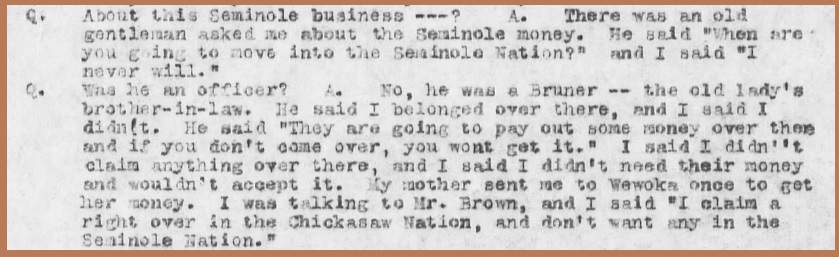
The interview with Samuel Mahardy himself is most revealing, and he tells a fascinating story about himself, his childhood and his identity as a Chickasaw. Having once been given land as a Seminole freedmen he returned the certificates awaiting correction or adjustment to his status as being Chickasaw.
He confirmed that his father collected Chickasaw money on his behalf, and pointed out how his father once purchased red boots for him and a fine saddle for his mother.
The most clear statement by Mahardy and how he identified himself was when the questioning went back to his status as a Seminole. He interrupted the questioner and made a powerful statement:
The entire portion of his interview appears below.
Samuel explains the confusion of how he came to seen as Seminole and his objection from his early years and insisting on his strong identity as Chickasaw.
The young Mahardy recalled how Chickasaw officials came to their home and even spent the night there, took down the names of the family, and he would later learn that their names were stricken from the Chickasaw rolls. Clearly the young Samuel wished to be officially recognized by the tribe where he lived, was a part of his entire life, and was adamant about his being recognized by the officials as part of the community in which he had been a member his entire life.
There were more pages in the file, but the final decision was not made in Samuel Mahardy's favor. His name remained on the Seminole Rolls.
Many times, the issue of whether one is "Indian" or not arises. In this case, clearly Samuel Mahardy was Chickasaw. Not only by blood, but by culture and identity. Yet, he was treated differently because of the "Negro" blood from a grandfather. The current practice of the day to insure that a perceived "stain" from African blood would be his identity, thus enforcing a racially influenced policy of racial "superiority" and a racist "inferiority" to be place on having an African presence.
Betsey would remain on the Seminole lists also though she stated that she was Creek and not Seminole. The nations were clearly close to each other geographically, and contact among people was fluid. The Mahardy family is clearly a family with blended cultures, blood lines, and tribal histories. Theirs is one that reflects a true "melting pot" that was the life of families in Indian Territory, and it is one that can be studied from many perspectives. The Mahardy legacy is richly rooted in multiple tribes, and is one that exemplifies the complexity of life in a pre-statehood land that would eventually become the state of Oklahoma.
* * * * * * * * * * * * * * *
This is the 10th article in a series devoted to sharing histories and stories of families once held as slaves in Indian Territory, now known as Oklahoma. The focus of the series is on the Freedmen of the Five Civilized Tribes, and these posts are part of a project with a goal of documenting 52 families in 52 weeks.
Wednesday, January 11, 2017
52 Families in 52 Weeks: The Family of Emma & William Davis, Cherokee Nation-Celebrating Freedman Families
(As part of a new series on this blog, a family from Indian Territory will be celebrated and a portion of their history will be shared. The goal is to honor 52 families in 52 weeks for the new year. With this being the second week there will be 2 families honored this week, and then 1 family per week afterwards. The intention is to illlustrate and share the amazing resilience of the families that descend from persons once enslaved in Indian Territory. Theirs is an amazing story of survival and adaptation to life on the frontier. Though seldom mentioned, the Oklahoma Freedmen have a rich story to tell, and this is a small effort to tell some of their stories.)
By looking at the enrollment card, Emma Davis appeared in front of the Dawes Commission on May 30, 1901 to enroll herself and her children as Cherokee Freedmen. Emma was 43 years of age and had been enslaved by George Whitmire. At the time of her appearance at the Dawes Commission, she was living in the Cooweescoowee District of the Cherokee Nation. Her enrollment card reflects a large family with her children Joseph, William Jr., Bertie, Chester, Julia, Jennette, Henry, Oscar, Carrie, and later, infant Lottie. (Lottie's name was added in October of that year, after birth affidavits were submitted.)
The family had been enumerated earlier, in the Cherokee Nation as evidenced by the notation of how they were previously on the Kern Clifton Roll, a roll taken several years earlier. The enrollment card also indicates that they had representation for them by attorneys Melette and Smith, in Vinita.
The reverse side of the card contains more data on the family. Emma was the daughter of Issac Glass, and Betsey Whitmire. Her father Isaac was a Freedman, who was deceased at the time she made her application, and her mother also deceased was at one time enslaved by George Whitmire of the Cherokee Nation.
Emma's husband was William Davis who was also a Cherokee Freedman of the Cooweescoowee District. He was at one time enslaved by Robert French.
The Interview that accompanies this file contains amazingly rich genealogical data. Also it appears that William Davis, Emma's husband was actually the one who spoke on behalf of the family. It is not certain why his name is not on the same card. Nevertheless the data is quite rich, because the exact dates of birth are included, in addition to specific questions about the children were addressed.
The file contained additional information including a birth affidavit for children, Oscar, Carrie and Lottie.
https://www.fold3.com/image/260/62914374
The Davis Family of Hayden, Cherokee Nation
Enrollment Card of Emma Davis Family
National Archives Publication Number (M1186 Cherokee Freedman Card No.936
The National Archives at Ft Worth; Ft Worth, Texas, USA; Enrollment Cards for the Five Civilized Tribes, 1898-1914; NAI Number: 251747; Record Group Title: Records of the Bureau of Indian Affairs; Record Group Number: 75National Archives Publication Number (M1186 Cherokee Freedman Card No.936
(Reverse side of card)
Source : Same as above
By looking at the enrollment card, Emma Davis appeared in front of the Dawes Commission on May 30, 1901 to enroll herself and her children as Cherokee Freedmen. Emma was 43 years of age and had been enslaved by George Whitmire. At the time of her appearance at the Dawes Commission, she was living in the Cooweescoowee District of the Cherokee Nation. Her enrollment card reflects a large family with her children Joseph, William Jr., Bertie, Chester, Julia, Jennette, Henry, Oscar, Carrie, and later, infant Lottie. (Lottie's name was added in October of that year, after birth affidavits were submitted.)
The family had been enumerated earlier, in the Cherokee Nation as evidenced by the notation of how they were previously on the Kern Clifton Roll, a roll taken several years earlier. The enrollment card also indicates that they had representation for them by attorneys Melette and Smith, in Vinita.
The reverse side of the card contains more data on the family. Emma was the daughter of Issac Glass, and Betsey Whitmire. Her father Isaac was a Freedman, who was deceased at the time she made her application, and her mother also deceased was at one time enslaved by George Whitmire of the Cherokee Nation.
Emma's husband was William Davis who was also a Cherokee Freedman of the Cooweescoowee District. He was at one time enslaved by Robert French.
The Dawes Interview
Interview from Application Jacket of Cherokee Freedman File No 936
National Archives Publication M1301
In the interview, William Davis goes into detail about the family's status, and points out how they were recognized as Cherokee citizens. He provides data about his slave holders Bob and Margaret French. Bob French, he pointed out was white and his wife was Cherokee. In addition, he also shares information about his own parents and siblings. He describes how they were taken to Ft. Gibson during the war, but returned to their own community at the end of the war.
There is much discussion and later analysis in the file that contains even more family data. Included was mention of William Davis' own father Jackson Davis who also has a card. (D463)
The file contained additional information including a birth affidavit for children, Oscar, Carrie and Lottie.
Birth Affidavit for Oscar Davis
Source: National Archives Publication M1301 Cherokee Freedman No 936
https://www.fold3.com/image/260/62914370
Source: National Archives Publication M1301 Cherokee Freedman No 936
Acccessed: https://www.fold3.com/image/260/62914372
Birth Affidavit for Lottie Davis:
Accessed on Fold3:https://www.fold3.com/image/260/62914374
A final interview is included in the Dawes file. Joseph Davis appears to be a grown son of Emma and William, and his interview is also included with this file.
Source of image: https://www.fold3.com/image/260/62914375
On the enrollment card (see 1st image above) William Davis's name does not appear. However, it turns out that he did have a card of his own, and was subsequently rejected by the Dawes Commission, however, it is still valuable to study and to include with the family data. (A future article will feature the extended Davis family.)
The file of the Davis family of Hayden, Cherokee Nation is a genealogically rich one. There are other records that will reflect more information that for the family, but this data from this initial file provides a rich beginning for the family research.
Tuesday, July 26, 2016
How Many Oklahoma Freedmen Were There?
- The Indian advocate. ([Sacred Heart, Okla.]), 01 Nov. 1900. Chronicling America: Historic American Newspapers. Lib. of Congress. <http://chroniclingamerica.loc.gov/lccn/45043535/1900-11-01/ed-1/seq-21/>
I have often wondered why there is not much in depth information about Oklahoma's amazing African American past. On many websites, one sees the African American history beginning with the attack upon Greenwood in Tulsa in 1921. However--black history did not begin with the attack in Tulsa. African American presence is well documented in the mid-1800s but still not spoken of widely. As early as the Indian Removal when Choctaws and Cherokees brought slaves with them, there was a black presence on the soil of what is now Oklahoma.
Someone asked me recently if the numbers of Freedmen were so small, if that would explain why there is so little information. I have become interested in the size of the population also, and recently ran into an article that appeared in the Indian Advocate in 1900 that addressed the size of the population, in Indian Territory.
Included in the numbers were the numbers of Freedmen from the Five Civilized Tribes. The population of Freedmen included in the article represented 4 of the 5 tribes. (Seminoles were reported as one general population and did not break out the Freedmen in their count.) But of the total population was 314,000 from the tribes, and more than 17000 were classified as "Freedmen".
The total numbers of the Indian Tribal Freedmen was notable, numbering over 17,000.
The numbers are approximate, and were rounded off, but they are still statistically significant:
Cherokee Freedmen: 4000
Creek Freedmen: 5000
Choctaw Freedmen: 4150
Chickasaw Freedmen: 4500
TOTAL: 17050
With over 17000 people there are many aspects of the people's lives that can be studied and examined by historians and scholars of many disciplines. There are several dozen black towns, hundreds of families, numerous schools, churches, cemeteries, newspapers, societies & associations that will reflect amazing histories still to be told of the Oklahoma Freedmen.
Hopefully more blogs, preservation and heritage associations, books and articles will be shared by those who are students of all of Oklahoma's history. Among the Freedmen were tribal leaders such as Stick Ross, George Vann, Henry Cutchlow, Sugar George, Harry Island, Cow Tom, Bettie Ligon, and so many more.
There are still stories to tell and I hope that more descendants of freedmen will tell their stories. Their legacy extends beyond the Dawes rolls, and their history predates even their freedom.
Let us all strive to tell all of Oklahoma's story!
Sunday, January 11, 2015
New Records on Ancestry Open Doors for Oklahoma Researchers
Ancestry: Oklahoma and Indian Territory Indian Census and Rolls:
Adopted Whites, Delawares, Shawnees and Freedmen
Tahlequah District
Adopted Whites, Delawares, Shawnees and Freedmen
Tahlequah District
On Ancestry, an amazing collection has been made available for Oklahoma researchers. But it can be tricky to learn how the records are organized and how they can be found. In the community reflected above, the image was found in a larger collection called, "Oklahoma and Indian Territory Indian Census and Rolls 1851-1959. That is a span of over 100 years. With such a span of years---it is recommended that first one confirms that the family is Oklahoma based and was for several decades before statehood, which occurred in 1907.
If the family did not live in the land that became Oklahoma for at least 4 decades prior to 1907, a search for an ancestor among these records, might be futile. (Of course there are exceptions, which included to those who migrated to the Territory, during the years of the Land Rush (1889) and other subsequent years.) However, most people found in this category of records, will be found in many other records, in particular the Dawes records. In other words, it is suggested that one not begin a search for an Indian ancestor with this collection, before exhausting the Federal Census, and then the Dawes. These records will be the beginning point for additional ties to the nations. Of course after obtaining the extremely data rich information with census and Dawes records, then earlier records such as the 1896 roll, reflected above will add additional flavor to the family narrative.
In the case of the collection above, this reflects the 1896 census of the Tahlequah District of the Cherokee Nation, and this particular collection included the populations adopted by the Cherokee Nation: Adopted Whites, Delawares, Shawnees and Freedmen--(former Cherokee slaves, and their children.)
Because of the enormity of this collection---it is important to look at all of the pages of the collection. In the case of Adopted Freedmen, about every four or five pages, a notation appears at the top of the page. A line is drawn through the words reflecting Blood quantum, and the notation points out that the data collected in that column reflects the data, "Where Born" in regards to the birthplace of the persons enumerated. C. N. is an abbreviation for Cherokee Nation. See the following illustration:
Top of page for 1896 Census showing Adopted Freedmen
Close Up of column reflects the data recorded in the "blood" column on page for Adopted Freedmen. The words "Where Born" reflect the information recorded. C. N. means "Cherokee Nation"
For the person who is just beginning Indian Territory research, it is important to know that everyone reflected on a census such as this one, there will be much for data on the family by researching the Dawes Rolls. Hopefully Dawes records have already been obtained. (Dawes records are found on Ancestry and Fold3
A word of Caution
If the genealogy process is new to you, then it is emphasized that you must look at 20th century records first and connect your family to the generation to preceded it. Connect yourself to your parents, your parents to your grandparents, the grandparents to the great grandparents. And there should be a sound geographic element for the family--even in the family migrated at some point in time.
This is mentioned because there can be a major temptation start the genealogy process by choosing to first look at 1800s Indian census records in order to "prove" Indian ancestry, before embarking on 20th century basic census and vital records research. Also remember to connecting the family year by year, to the community from which the family came. For example, if the family being researched always lived in Tennessee, but the name being researched appears on an "Indian census" in what is now Oklahoma, there is a possibility that there might be a coincidence of names, and the Indian Territory document might not be the Tennessee based family being researched. In fact it is most likely that the Indian Territory document is not the Tennessee based family.
Also note that many names are frequently common names. So surnames such as Williams, Jones, McIntosh, Ross, Davis etc. appear in many communities in Indian Territory and also in the United States. So it is important that one is certain of family ties to the Territory. If the family lived in Tahlequah District, then they will also be found in the 1900 and 1910 communities in the Tahlequah District. Always ask yourself: Is this your ancestor? Or is this someone who bears the same name?
Finding the Records
Since Ancestry has recently digitized many new records from Indian Territory and Oklahoma, it is important to know how to find them.The most efficient way is to go to the Card Catalog and type in the name of the collection, and when the search box opens, one can then place the names of the persons being researched. In the case below, by typing in the words "Oklahoma and Indian Territory" the image shown below will appear.
Finding Indian Territory Records on Ancestry via Card Catalog
This screen shot illustrates what will appear,
The new collections recently digitized have begun to open more doors for Oklahoma based researchers. Tjere are new records to examine and this newly digitized collection should assist many genealogists in exploring their pre-Dawes era ancestry.
Labels:
Cherokee,
Cherokee Nation,
Freedmen,
Oklahoma genealogy,
Tahlequah
Subscribe to:
Posts (Atom)