An interesting obituary recently share by history enthusiast and collector Rex Campbell of Oklahoma City recently caught my attention. It was a simple article about a man who had passed away in September of 1918. The deceased man was Dave Roberts, and he was simply described as a "Wealthy Negro" who had passed away.

Muskogee Times-Democrat
September 23, 1915, p 4

Muskogee Daily Phoenix, September 24, 1915 p. 1
(Accessed from Newspapers.com)
Uncertain about the exact location of the Concharty Mountain a reference to the area was found in an image owned by the Oklahoma State University and it was in an old periodical from 1922 called the Nation's Highways.

Courtesy of Oklahoma State University Digital Collections
Cyrus S. Avery Collections
The Nation's Highways, March 1922
Locating the Concharty Mountain on a modern map indicated that this area is located in what was the old Creek Nation. With this information, is most unlikely that Roberts migrated to the area, if he was born in a rural mountain area of the Creek Nation. So the next most likely question was whether or not he may have been a Creek Freedman.
Well sure enough there was a Dave Roberts, who was on the Dawes Roll. He was married and had several children at hte time they enrolled. He and his chilren were placed on the Dawes Roll as Creek Freedmen. And at the time of enrollment he was living in Muskogee as indicated on documents such as his Dawes enrollment card.
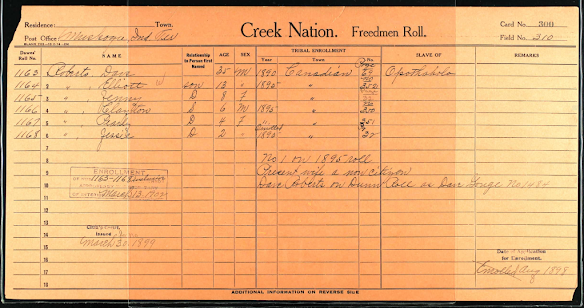
National Archive Publication M1186 Creek Freedman Card #300
Ancestry.com. Oklahoma and Indian Territory, U.S., Dawes Census Cards for Five Civilized Tribes, 1898-1914 [database on-line]. Lehi, UT, USA: Ancestry.com Operations, Inc., 2014.
From both front and back of the enrollment card it is noted that both Dave Roberts and his mother Silla had been enslaved at one time by Chief Opotholeyahola, a prominent man in the Muscogee Creek Nation. His wife at the time of enrollment, was Jenni, who was not a citizen of the nation. His first wife Eliza Yargee, and mother of his first son Elliott was deceased. All of the Roberts family listed on the card, belonged to Canadian Town, one of the Freedmen Tribal towns in the Creek Nation.

(back side of card #300)
Unfortunately, the Application Jacket for Dave Roberts is missing as many of the Creek Freedmen files are, and were therefore never microfilmed. However, so much more can be learned about Dave Roberts in the Land Allotment files as well as in the Federal Census. But it is also important to note that Dave appeared in front of the Dawes Commission in 1898 as indicated in the lower right hand corner of the Dawes Card.
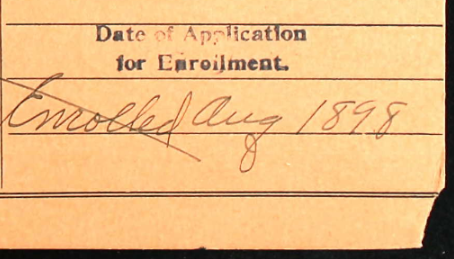
(notation from enrollment card)
And he resided in the Muskogee area at the time of enrollment as evidenced by the data in the upper left hand corner of the same card.

Notation from enrollment card

1900 Federal Census, Indian Territory, Creek Nation
(accessed from Ancestry)
By 1901, Dave Roberts was already selcting land allotments for his family members, as he has already done so for himself by that time. Although his application jacket is missing, his land allotment file is intact and one can read his testimony as he selected allotments for his children. His son Clayton was one of his children for whom his testimony is reflected.
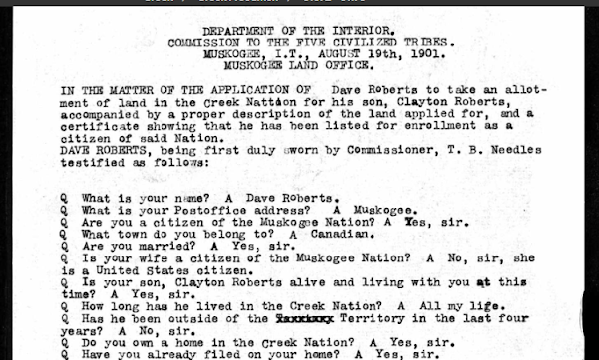
Exerpt from Allotment file of Dave Roberts for Clayton Roberts
Department of the Interior. Office of Indian Affairs. Five Civilized Tribes Agency.
Since Dave Roberts had already gone through the land selection process earlier, he realized quite early that he was at an advantage, now being a land owner. Some of the land being selected for his children were in Township 15N, and Range 18E. A platmap points to some of the land Davis was selecting. The small portion shaded in black represents some of the Roberts alloted land.
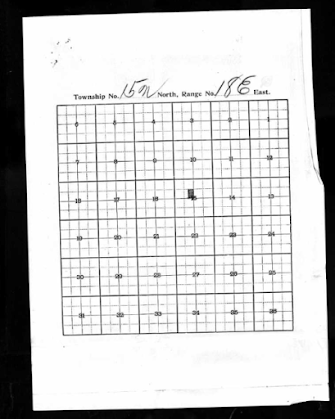
Upon an analysis of the Land Allotment maps provided by the Nationl Archives website, the exact portions alloted to some of the Roberts family is reflected in Township 15 N, and Range 18E.
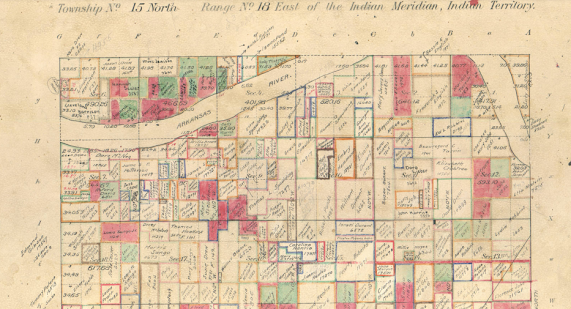
Allotment Map, National Archives
Township 15 North, Range 18 East of the Indian Meridian, Indian Territory
Zooming in, on the same map one can see some of the land alloted to two of Dave Roberts family members.

(closeup of prior image)
And zooming out on the same map it is clear that the lands were just north of Muskogee, not far from the Arkansas River. Today that area is all part of greater Muskogee.
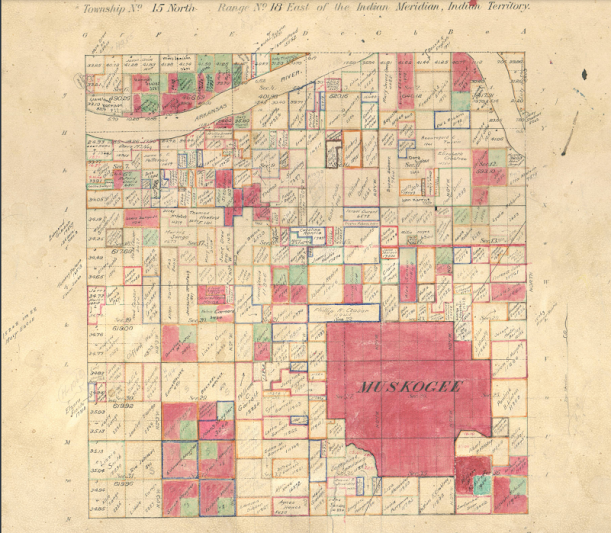
(same image zooming out)
It is not clear how many tenants Dave Roberts ended up having, however, he was able to amass a good amount of wealth from the rented properties that he owned. Or as it was said in his day, they were "well to do."
With his financial success, Dave Roberts had a major concern about his family, and that concern was about his son Clayton Roberts. Clayton was his third child, and he had become quite concerned that his son was becoming influenced by less industrious people in the area. Having warned the son about staying away from gamblers and land grafters, Dave feared that son Clayton might lose his land to land grafters. As a result, he made a very bold move. In 1909, when his son was now a young teenager, he was disappointed that the boy did not have a job, nor exhibit an interest in more industrious activities. The boy did not work, and the father feared that son Clayton would come under the influence of land sharks who frequented the Muskogee area where they lived.
Dave Roberts made an unusual appeal to local Muskogee Police Sergeant, Morrison, "Put him in jail and keep him there," he is quoted to have said. "Keep him away from these vampires who are trying to cheat him out of his land."


Muskogee County Democrat
16 September 1909 p 5
Not much more is known about Dave Roberts in the years that followed, but tragedy did strick the faimly in 1914 when son Clayton died, and a year later when Dave Roberts himself also died.
The story of Dave Roberts is not often mentioned today. He was a Creek Freedman with a vision, and who made his mark on the city of Muskogee where he lived, and hopefully his story will be remembered. He is buried at Harding Memorial Cemetery, in Muskogee Oklahoma. Thanks to the lost records that were recently found, we can now call his name. May he never be forgotten.

Headstone for Dave Roberts,
Harding Memorial Cemetery, Muskogee, Oklahoma
Courtesy of Orange Rex