Showing posts with label Creek Nation. Show all posts

Tuesday, June 20, 2023

"Yall as Free as I am."


Juneteenth and a Season of Freedom

We celebrated Juneteenth yesterday, which is a national holiday honoring the end of slavery and beginning of freedom in the United States for millions of people. However, for several thosand people just to the west, in Indian Territory, slavery continued. A full year after the Civil War the five slaverholding tribes finally abolished slavery by signing a treaty with the United States. Four different treaties were signed, with 3 tribes signing their own treaty--Cherokee, Creek and Seminole Nations. Choctaws and Chickasaws signed the same exact treaty, and at last slavery was abolished in Indian Territory.

There are not many stories written explaining how freedmen came to the various communities. However, years later a few of the formerly enslaved people referred to their experiences when freedom came to them. Below are a few of these memories shared in the 1930s when the WPA (Works Progress Administration) launched the Slave Narrative Project. Thankfully a few of the stories of Freedmen from the Five Tribes were also captured in that process.

Below are a few words documented by the project. Note that the final piece is the only reference made to freedom of an ancestor who was enslaved in the Choctaw Nation. It is a reference simply to my gr. gr. grandmother, and who had freed her. Though her own words are not there---the word "freed" is still there as part of our own family's story of freedom. 

Those enslaved in Indian Territory should never be forgotten. Though many were told that they were not worthy, and that their blood did not count--it needs to be said: It did count! They did count! And their history is there to find.

Although our ancestors were not freed on Juneteenth, we still celebrate the beginning of the end. It would take a full year in the territory and for many such as the Choctaw Freedmen, it would be 19 years before citizenship was finally given to them. 

* * * * *
 
~~Phyllis Pettit~~
Cherokee Nation

"But one day Old Master stay after he eat breakfast and when us negroes come in to eat, he say: 'After today I ain't your master any more. Yall as free as I am.' We just stand and look and don't know what to say about it."1

After while Pappy got a wagon and some oxen to drive for a white man who was coming to the Cherokee Nation because he had folks here. His name was Dave Mounts and he had a boy named John.

We come with them and stopped at Fort Gibson, where my own grand mammy was cooking for hte soldiers at the garrison. And I was named after her. She had a good Cherokee master. My mammy was born on his place.

We stayed with her about a week and then we moved out on Four Mile Creek. She died on Fourteen-Mile Creek about a year later. 

When we first went to Four Mile Creek we saw some negro women chopping wood and asked them who they worke for and I found out they didn't know they was free yet."

* * * * *

~~Charlotte Johnson White~~
Cherokee Nation

"Near as I ever know I was born in the year 1850 away back in dem hills east of Tahlequah; the Cherokees called it the Flint District and old master Ben Johnson lived somewheres about ten miles east of  theh big Indian town Tahlequah.

Never did know jest where his farm was and when de new towns of this country spring up, it make it dat much harder for me to figure out jest where he lived and where I was born."

...I hear about the slaves being free when maybe a hundred soldiers come to de house. Dey was a pretty sights settin' on their horses, and de men had on blue uniforms wid little caps. "All de slaves is free," one of de men said, and after dat, I jest told everybody, "I is a free Negro now and I ain't goin to work for nobdy."

A long time after de war is over and everybody is free of dey masters I get down to Muldrow (Okla) and dat's where I join de church. For 58 year I belong to the colored Baptists and I learn dat everybody ought to be good while dey is livin', so 's dey will have a better restin' place when dey die." 2

* * * * * 

 ~~Kiziah Love~~
Choctaw Nation

...I  married Isom Love, a slave of Sam Love, another full-blood Indian that lived on a a jining farm. We lived on Masater Frank's farm and Isom went back and forth to work fer his aster and I worked ever day fer mine. I don't 'spect we  could of done that way iffen we hadn't had Indian masters. They let us do a lot ike we pleased jest so we got our work done and didn't run off.

I was glad to be free. What did I do and say? Well, I just clapped my hands together and said thank Gof Almith, I'se free at last."3

* * * * * 

~~Sallie Walton~~
(Dawes Interview for Walton Family)


In 1899, my great grandparents from the Walton family appeared in front of the Dawes Commission to be interviewed. Basic information was collected, and a member of the Perry family was present and testified on behalf of my great grandmother Sallie. One sentence stood out for me, that referenced how freedom came to the Perry slaves. This is the only reference to freedom from family records. and they are shared here as well.

"The mother of Sallie Walton was freed under my sister Emeline Perry."4
Q. Was your sister a Choctaw?
A. Yes sir

* * * * * 

Clearly, a critical task awaits us---to find our freedom story!

 Federal Writers' Project: Slave Narrative Project, Administrative Files. 1936. Manuscript/Mixed Material. Retrieved from the Library of Congress, <www.loc.gov/item/mesn001/>
2
Ibid
3
Ibid
4
National Archives Publication M1301, Applications for Enrollment of the Five Civilized Tribes

Thursday, July 28, 2022

The Hearing on Capitol Hill


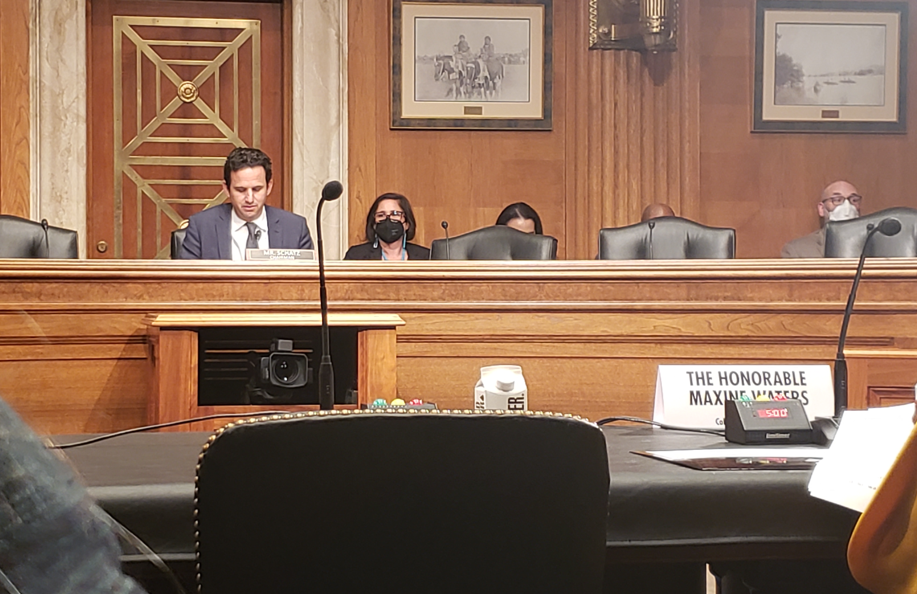
Senator Schatz Chairman of the Committee on Indian Affairs

July 27th 2022 was a landmark date. For the first time in history a hearing on the status of Freedmen of the Five slave-holding tribes, occurred to address the neglicence of both tribal officials and Congress in issues pertaining to those once enslaved.

Focus of the hearing:  
Oversight Hearing on 1866 Reconstruction Treaties Between United States and Oklahoma Tribes.

The hearing was chaired by Senator Brian Schatz (D. Hawaii) and in attendance were descendants of Freedmen from all five tribes, whose ancestors were once enslaved in those nations. The tribes sent their own representatives to testify on their behalf. Representatives from the Cherokee, Choctaw, Chickasaw, Creek and Seminole Nations were all present. Each represenataive was given 5 minutes to present an official statement. Only one speaker on behalf of Freedman was included.

The first panel consisted of only one presenter--Congresswoman Maxine Waters, who had long recognized the issues affecting descendants of Freedmen, many of whom now live in her district in California. 

Congresswoman Maxine Waters speaks to Senate Committee

The second panel consisted of multiple speakers from the Five Tribes, in addition to a representative from the Department of the Interior, Bryan Newland, and the sole speaker from Freedmen, Marilyn Vann an enrolled citizen of the Cherokee Nation and President of the Descendants of Freedmen Association. 

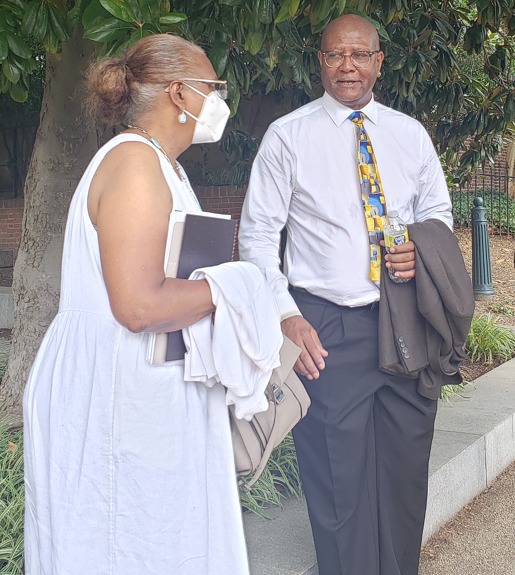
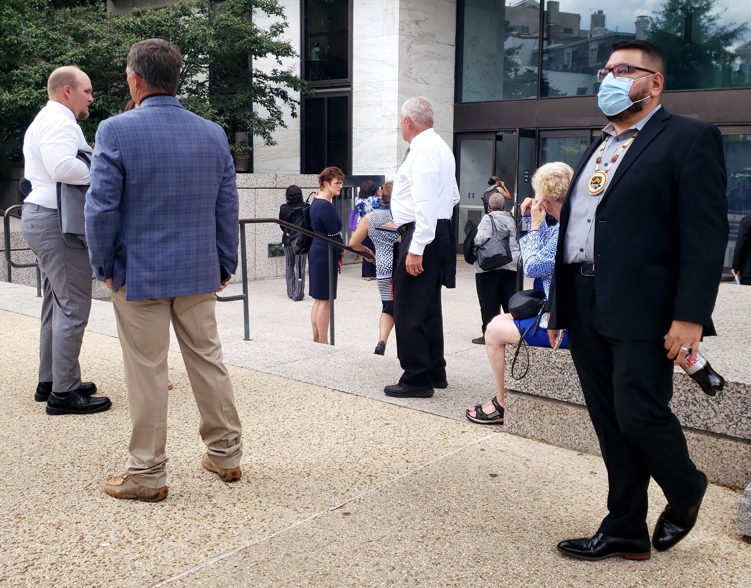
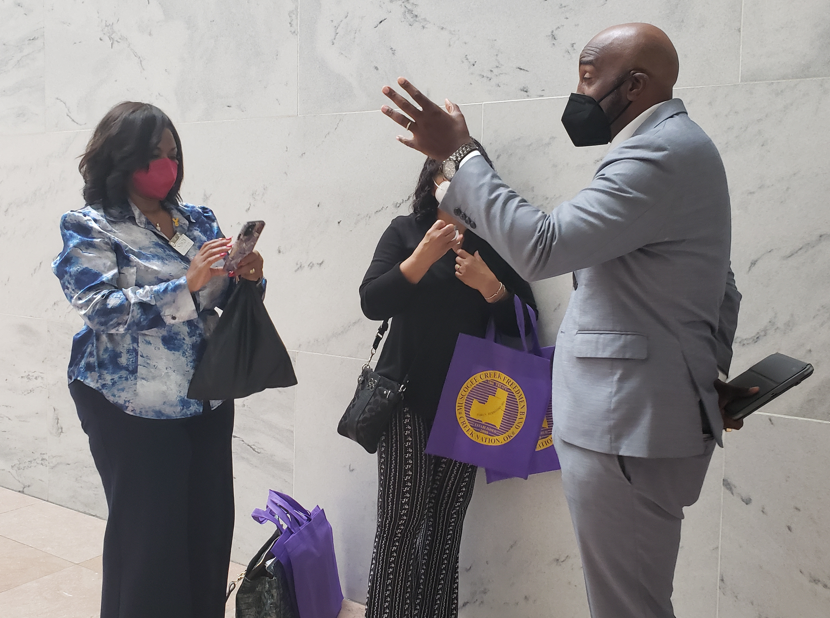
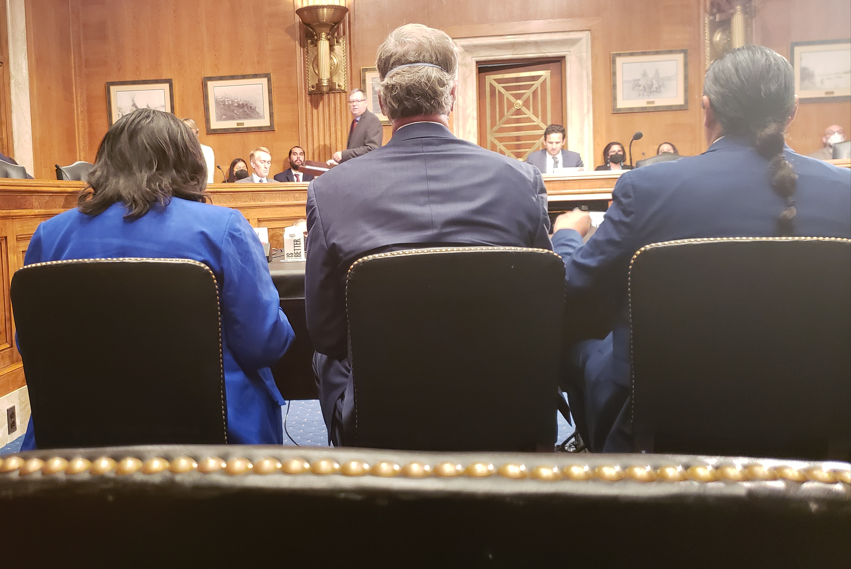
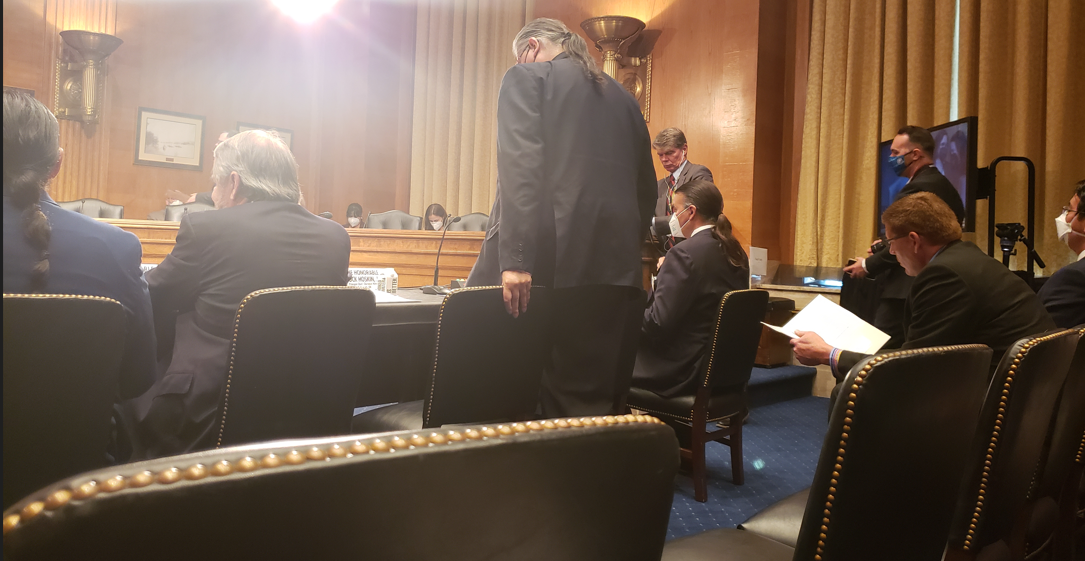
The audience consisted of Freedmen from all five tribes, many of whom met and gathered prior to the hearing outside of the Hart Building on Capitol Hill and who met for the first time. The hearing was historic because Freedmen who have ancestors documented ties to each tribe were present for the first time in Washington to attend an event addressing their issues.


Dorris Burris Williamson and Terry Ligon


Attendees Gathering Before Hearing


Creek Freedmen in Discussion Before Session


Panel 2 Listening as Congresswoman Waters speaks

It did appear that there was a strong interest expressed by the committee as they listened to the presenters. In addition some of the questions asked by the committee members were left unanswerable because the issues such as the size of the Freedmen descendant popultation have never been studied.


Senator Lankford of Oklahoma Listened intently to presenters


Partial view of Panel 2


Another view of Panel as seen by audience


Speakers from the Seminole Nation of Oklahoma


Speaker Representing the Choctaw Nation of Oklahoma


Speaker Representing the Muscogee (Creek) Nation


Speaker Represnting the Chickasaw Nation of Oklahoma


Speaker Representing the Oklahoma Freedmen 

The hearing began shortly after 2:30 pm and lasted until about 4pm. Some evaded questions directed to them and others answered questions when directly asked. The outstanding voice pertaining to the treaty and its history came from Principal Chief Chuck Hoskins of the Cherokee Nation of Oklahoma. who addressed the past as well as the present. Since the ruling in 2017 that confirmed the status of the Freedmen in the Cherokee Nation, Hoskins pointed out that close to 12,000 descendants of Freedmen have been admitted to citizenship in the nation and he was quoted as saying that they are a better nation because of it.

There will clearly be multiple disussions in many forums and platforms over the next few weeks. It is hoped that the hearing will be a new beginning in the movement to create awareness of the history of the Oklahoma Freedmen, and many more of the stories that pertain to their presence on the soil of Oklahoma will emerge.


Monday, November 6, 2017

The Family Legacy of Philip A. Lewis from the Creek Nation


The Lewis family of Muskogee Oklahoma has already been profiled with much focus on the maternal side of the family. Philip and Elzora Lewis applied in front of the Dawes Commission in 1898 and Elzora's family story was outlined in an earlier post. However, the story of Philip Lewis is as detailed and one can go back even further when examining his own family history.

As presented before, the Lewis family resided in Muskogee, and appeared in front of the Dawes Commission in 1898 to enroll themselves and their children as Creek Freedmen.


Creek Freedman Card #105
The National Archives at Ft. Worth, Ft. Worth Texas 1868-1914
NAI Number: 251747

Record Group Title: Records of the Bureau of Indian Affairs, Record Group 75

(Reverse side of card)
Source: Same as above

Like so many cases, others, the Application Jackets for many Creeks simply do not exist, were never microfilmed, and have possibly been destroyed or hidden from the public domain. But thankfully a far better interview does exist for Philip Lewis, and like his wife Elzora, the Indian Pioneer project in the 1930s provided an opportunity for him to speak freely about his own family history. In addition, the full interview reflected an expansive knowledge of Creek history.


University of Oklahoma, Western History Collection
Interview with Phillip A. Lewis
Indian Pioneer Papers Digital Collection


Source: Same as above


Source: Same as above

Source: Same as above


From the interview, some glimpses into the lives of his family can be gleaned. Philip spent much of his youth in the care of his beloved grandmother Rachel. She was a caregiver to many and she nurtured many in her Creek community, though yet, enslaved. Rachel continued care for multiple children even during the post war years when they were now free, and allowed to attend school when of age. 

Philip attended school at Fountain Church for primary education, and later he attended the Tullahassee Mission School for Creek Freedmen. Education was a priority in the with Philip, and he became himself an educator, later teaching at the Tullahassee himself.

Image Source: Same as above


Tullahassee School
Courtesy Oklahoma Historical Society


Source: Same as above

Philip Lewis was one of the earliest known Freedmen who became an educator at the school that he once attended. Also it is noted that the Lewis interest in education continued well into the 20th century, for it was noted in the 1920 census, that Philip and Elzora's daughter Melvina worked as a school teacher at a unnamed "rural" school.

(part of 1920 Federal Census, Muskogee, Ward 4, District 94)


They lived mostly around the city of Muskogee, well into the 20th century. Phillip and Elzora's names are also found in a city director for Muskogee Oklahoma in the mid 1940s.


The Story of the Grandparents of Phillip A. Lewis

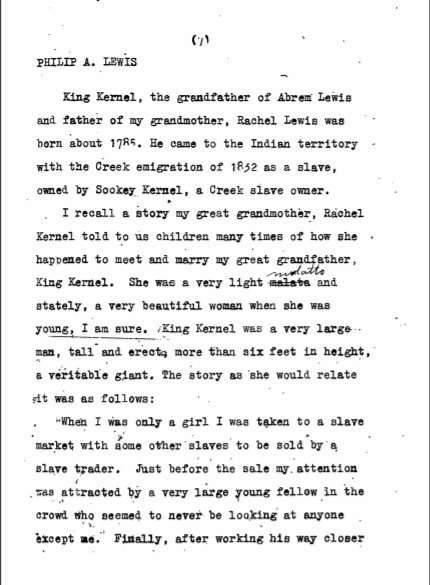
One of the many fascinating features in the narrative of Philip Lews was the story of his grandmother Rachel, and how she became the wife of King Kernal. The story is more than unusual, because it takes place at a place of sorrow and heartbreak---a slave auction.

He recanted the story that grandmother Rachel often told---of how she was being auctioned off to be sold to the highest bidder at a slave auction. One man in the crowd--another man enslaved, in fact, addressed her, and asked if his master purchased her, he asked if she would be willing to become his wife.  This is one of the stories in Indian history where the actual purchase of a slave is told from the perspective of the enslaved person's family.

In spite of it being a time of heartbreak, there was a degree of love that emerged between the two--enslaved people, King, and Rachel, and the love that grew from their union endured for decades, through enslavement, intro freedom, and to the cusp of statehood.


University of Oklahoma, Western History Collection
Interview with Phillip A. Lewis
Indian Pioneer Papers Digital Collection

Image Source: Same as Above

Image Source: Same as above


The Lewis family thrived well into the 20th century, with both Philip and Elzora living into the 1950s. Both of them had seen many changes from the era of slavery, the Civil War, the post Civil War years in the Creek Nation, to the years of westward expansion, the Dawes Commission era, into statehood and their eventual life as US Citizens. Their history is a rich one, going back over 200 years, and this strongly rooted Oklahoma family has a legacy that is honored and to celebrated.

Both are buried in Booker T Cemetery in Muskogee Oklahoma.

Image Source: Find a Grave


Image Source: Find a Grave

* * * * * * * * * *

This is the 34th article in a 52-article series devoted to sharing histories of families once held as enslaved people in Indian Territory, now known as Oklahoma. The focus is on the Freedmen of the Five Civilized Tribes, and these posts are part of an ongoing project to document 52 families in 52 weeks.

Tuesday, March 21, 2017

The Family and Legacy of Lucinda Davis, Creek Freedwoman

Photo: Courtesy of Oklahoma Historical Society


National Archives Publication M1186
Creek Freedman Card #825
Color image accessed through Ancestry

(Source same as for above image)

The Davis family of Broken Arrow is a family with an amazingly rich history, and Muscogee Creek culture. Much of the history and rich culture of the family is found apart from the cards above and will be discussed.

Anderson Davis appeared at the Dawes Commission hearings with the purposed of enrolling his family as Creek Freedmen. He was 45 years of age at the time, but it appears that quite possibly, Anderson Davis was not born enslaved, but was aactually born a free man. However, his wife, Lucinda was born enslaved and she was enslaved by a Mucogee Creek Indian known as "Tuskena" or as she called him, Tuskaya-hiniha.

Anderson's parents were Joseph Davidson, and Becky Marshall. They too were not listed on the card with a slave holder, suggesting that they too were also free born. There were many Creeks who were of African Ancestry, who were born free and lived as free people in the tribe, and it appears that Anderson and his family were among them.

But Lucinda's family was different. She herself was born enslaved, and her parents, were in fact enslaved by Creek Leader Opotholeyahola. From the enrollment card it is also clear that the family members all belonged to Arkansas Town in the Creek Nation, and their story is one that is clearly entrenched in the tribe.

Selection of Land:

Anderson Davis also applied for land allotments for his family and he went through several interviews pertaining to their selection of land. Several records appear in those files reflecting the selection of land and the persons to whom the land would be allotted.

Ancestry.com. Oklahoma and Indian Territory, 
Land Allotment Jackets for Five Civilized Tribes, 1884-1934 [database on-line]. 
Provo, UT, USA: Ancestry.com Operations, Inc, 2014.
Original data: Department of the Interior. Office of Indian Affairs. 
Five Civilized Tribes Agency. Applications for Allotment, compiled 1899–1907. 
Textual records. Records of the Bureau of Indian Affairs, Record Group 75. 
The National Archives at Fort Worth, Texas.


Source: Same as for above image

The Land Allotment Jackets reveal much detail about his selection of land for himself and for others in the household. Because many of the interviews are similar and ask the same questions, I include one of the interviews here below.

Source: Same as for above image


Source: Same as for above image


Source: Same as for above image


Lucinda's Story


More can can learned about Lucinda Davis and her life story, because  she was interviewed in the 1930s as part of the WPA Slave narrative project. Her interview is one of the most out-standing because of the history and culture that she described in her interview. Though not sure of her birthplace, she was born in the Creek Nation, and her parents were enslaved by Opothleyaholo. But she was separated from her parents, as she however, was sold to an old Creek man, Tuskaya-hiniha.

 She begins her narrative with two small poems after which she begins to tell her life story. She must have spoken with a heavy Muscogee accent, because it was clear that English was not her mother tongue. She begins with a reference to the small poems.


The WPA Oklahoma Slave Narratives
Editors T. Lindsay Baker, Julie Philips Baker
Contributor United States. Work Projects Administration
Edition illustrated
Publisher University of Oklahoma Press, 1996
ISBN 0806128593, 9780806128597


She describes also the status of Tuskaya-hiniha, within the Creek Nation. He was a man of stature among the Upper Creeks and she provided much detail about her life with Tuskaya-hiniha. He had a daughter whose husband had died, who was living with them. The old man's daughter Luwina had given birth to a baby, and Lucinda, while still a child herself, was purchased to look after the child. 

(Source: same as for above image)


Her life as a slave to old Tuskaya-hiniha was well described. He was old and his eyesight had begun to fail. During that time as his vision worsened, some of the other slaves began to slip away and seize their own freedom. She goes on in her interview, wehre she describes her life as a  young girl, with no childhood, whose task it was was to tend to other children. When sold to Tuskaya-hiniha, he had poor eyesight and occasionally, once his sight failed, one her tasks was also to lead him around.


Her interview also provides a glimpse into life in a small Creek settlement, including naming practices among them. In addition, mentions that something about the status of her parents changed, as they obtained freedom, which unfortunately did not affect her own status. So she was still here, still enslaved, and separated from her parents. Her childhood consisted of tending to the young grandchild of her slave master.


Growing up as a Creek, and working inside the home, Lucinda learned how to make traditional dishes. She describes many of them from sofki, to other methods of making corn based dishes


Her description of tasks of slaves who were weavers are interesting to read funeral and burial services were vivid and she described traditional Creek ways of life. 


Funerals and Burials


     For those with Civil war interests, she was a near neighbor and practically an eye witness to the Battle of Honey Springs. She described how she saw Indians on route to the battle with their gray colored clothing on horseback carrying a flag with a large "criss-cross" on it. She and the old master joined hundreds of others fleeing the battle zone as they headed out onto the Texas road going southward to flee the battle. She described seeing the same gray-clothed soldiers fleeing the battle being pursued by men in blue uniforms in a rapid chase.


She goes on to describe how they got onto the Texas road and headed south. Later they camped and listened to the battle sounds throughout the night.

 The most heart touching portion of her story was when she was finally retrieved and taken back to her parents from whom she had been separated for so long. She described the men coming up to the old slave older, speaking in "English talk" and how she was, as a result put on a horse and later met by her parents who had been searching for her.

(Source: All images from her narrative are from the same source listed above.)

There is more to the story of Lucinda Davis. By the time she had several children, statehood approached, and the Dawes Land Allotment process had begun. Her husband Anderson applied for, and receive land allotments for himself, wife Lucinda, and their children.

The story of Lucinda Davis is well documented, but the story of Lucinda as a girl, then the years of her marriage, their large family and their selection of land has never been presented together. She mentions her children in the interview, and that most had died by the 1930s. By presenting her case along with the enrollment cards and land records above, a larger part of the story was known.

Lucinda Davis was a strong Creek woman, and she was a strong African descended woman. She held strongly to her culture, and her mother tongue which was the Muscogee language. Hopefully her final days were peaceful. No information about her death, but her narrative is one to be shared by many who wish to learn about the lives of those seldom mentioned---those once enslaved in Indian Territory. Those who wish to know about the customs of Muscogee people will learn a lot from her narrative, and those who wish to read about a woman who was a survivor from a period that brought much pain, will grow from reading her story.
Thankfully, the details of her life during and after freedom will speak to her resilience and to her fortitude. We should all grow from her strength, and her story.

**********     **********     **********
(This is the 9th article in a series devoted to sharing families of those held as slaves in Indian Territory, now known as Oklahoma. The focus is on the Freedmen of the Five Civilized Tribes, and are part of a personal goal in 2017 to document 52 families in 52 weeks.)