Showing posts with label Slavery in Oklahoma. Show all posts

Monday, January 21, 2019

Irony and Opportunity from the Chickasaw Nation

A recent post from Chickasaw TV website recently reflected a revised version of their history, presenting the Chickasaw community as a place where enslaved people found "refuge".


Knowledge of this statement came while I was in the midst of a conversation with a young college student who is ardently researching his own family of Chickasaw Freedmen, In the midst of our cordial dialogue he was casually surfing and suddenly exclaimed "Whoa, the Chickasaw Nation has an article about slavery on their website! When did that happen?" He went to the then scrolled and was shocked to see what was stated, and suggested that I also get on the site, which I did.

And there is was, with the blatant headline:

"Runaway Slaves Found Refuge With the Chickasaw People."


What in the world was this?

A former slaveholding tribe, the same tribe that produced 4 regiments of Confederate soldiers that fought in the Civil War to keep people enslaved, is now "rebranding" their history to become a people who gave runaway slaves "refuge"!


History shows that this is the tribe that produced: 
-1st Regiment of Chickasaw Infantry

-1st Regiment of Chickasaw Cavalry 
-1st Battalion of Chickasaw Cavalry
-Shecoe's Chickasaw Battalion of Mounted Volunteers

These are all Confederate regiments who fought for the South in the Civil War. They fought in various battles and skirmishes, but clearly not to continue to offer "refuge" to runaways. In fact it is clear that many of the enslaved ran away from the Chickasaws to join the Union Army, and to fight for their freedom.


It is not clear when this was placed on the website of Chickasaw TV, but for those of us who today celebrate and honor the legacy of Dr. Martin Luther King Jr., to see this post on this holiday is more than disappointing. It dishonors the history and legacy of Dr. King, and it dishonors those whose ancestors were enslaved in Indian Territory.

This is clearly the first time, any website pertaining to the Chickasaw Nation made even a mention of slavery, but depicting the nation as a place where runaway slaves fled to and took refuge is a distortion and simply not true. But sure enough there on the  Chickasaw website is a fabricated story of runaways who found their way to Chickasaw country for refuge, as they fled bondage from white slave masters.


If the goal of the webmaster and the Chickasaw Nation is to present slaveholders and kinder and gentler than southern white slaveholders, the words of those once enslaved will refute that. Kiziah Love, a former Chickasaw slave interviewed in the 1930s as part of the slave narrative project spoke of many cruelties experienced by those enslaved around her.

"The slaves lived in log cabins scattered back of the house. He wasn't afraid they'd run off. The didn't know as much as the slaves in the states, I reckon. But Master Frank had a half-brother that was as mean as he was good. I believe he was the meanest man the sun ever shined on. His name was Buck Colbert an he claimed he was a patroller. He was sho' bad to whup Negroes. He'd stop a Negro and ask him if he had a pass and even if they did he'd read it and tell them they had stayed over time and he'd beat em most to death. He'd say they didn't have any business off the farm and to get back there and stay there."

One time he got mad at his baby's nurse because she couldn't git the baby to stop crying and he hit her on the head with some fire tongs and she died. He wife got sick and she sent for me to come a take care of her baby. I sho'd did't want to go and I begged so hard for them not to make me that they sent an older woman who had a baby of her own so she could nurse the baby if necessary.


In the night the baby woke up and got to crying and Master Buck called the woman and told her to git him quiet. She was sleepy and was sort of slow and this made Buck mad and he made her strip her clothes off to her waist and began to whip her. His wife tried to git him to quit and he told her he'd beat her iffen she didn't shut up. Sick as she was she slipped off and went to Master Frank's and woke him up and got him to go and make Buck quit whipping her. He had beat her so that she was cut up so bad she couldn't nurse her own baby anymore.


Her words are sobering and painful to read. And while  it is known that every slave holder was not prone to such violent acts of physical cruelty, but the very act of "ownership" of another human being in and of itself is the a cruelty. And to depict Chickasaw community before and after removal as a place of "refuge" is an effort distort history.

It is noted that everyone did not own slaves, and this is true for Chickasaws as well as others on the American continent. But to suggest that there was an anti-slavery, "come-to-me-my-brother" sentiment in an Indian nation that fought for the south in the Civil War, and that refused to grant their former slaves citizenship after freedom is simply wrong.

There is more honor in admitting to history, acknowledging that history,  and making the effort to know the people who later become Freedmen as well as to get to know those who descend from the enslaved. Truly that is the better way to tell the story. And it is essential that the descendants of the enslaved tell their stories and present their ancestors in the light of dignity that they deserve. The slaveholder descendants in the Chickasaw Nation do not need to "dress up" slavery. It can never be made a pretty part of history. The better gesture is  to acknowledge it, without "dressing it up" 

Chickasaws owned slaves, as did many others in North America. But to paint and to distort one's own history as a place of refuge, clearly makes even current tribal policies of excluding descendants of those same slave completely even more incomprehensible.

The confederate Chickasaw Mounted Rifles in the Civil War were surely not fighting to bring in more people of African ancestry and give them refuge, and nothing could be further from the truth. The anti-black sentiments were strong and they prevail to this day. Chickasaw Freedmen are fully aware that they have, at present no possible way of applying for citizenship and having it granted----although their presence in Chickasaw country predates the days of removal, from Mississippi.


An Interesting Irony
There is an interesting irony however, that prevails today. Many descendants of Chickasaw Freedmen, and nearby Choctaw Freedmen, have relatives who are enrolled in the nations. As inter-racial marriages have occurred over the years, some have spouses, in fact who are enrolled Chickasaws, and even a well known politician from Oklahoma--a man of African Ancestry--is an enrolled Chickasaw. However, his enrollment comes from an ancestor on a blood roll, and not from one who was enslaved. 


The current policy of several of the former slave-holding tribes, is clear---the blood of the slaves meant nothing, and ties of the descendants of those who were enslaved, means nothing today. This is no secret to Chickasaw Freedmen descendants. Their blood and their life meant nothing while slavery prevailed, and it means nothing now, although Freedmen descendants have a direct blood tie to those who labored and sustained the wealth of the Chickasaw slaveholders.

And sadly, to date, there has yet to be a voice spoken on behalf of Chickasaw Freedmen descendants or Choctaw Freedmen descendants from those of African ancestry who are enrolled in their nations. No one has yet to point out the travesty of the disenfranchisement of their kinsmen from within. And to see a statement, that somehow Chickasaw-held African slaves were given refuge--and to see the statement coming from a tribal-sanctioned site is disturbing.

An Opportunity
Yet, as much as their statement is disturbing, it also presents an opportunity for a new dialogue. There is an opportunity for those in the Chickasaw Nation who wish to mention slavery in the Territory, to truly address it with honesty and clarity. There is an opportunity for there to be dialogue between the Freedmen of both Choctaw-and Chickasaw Nations, to engage in dialogue with descendants of Choctaw and Chickasaw slave holders.

On this day, honoring the legacy of Dr. Martin Luther King we can learn much from the words of this wise man, on this day. And perhaps someday on the soil of Tuskahoma to Tishomingo, as Dr. King said, that perhaps "the sons of former slaves and the sons of former slave owners will be able to sit together at the table of brotherhood."


If there is such a desire to extend an olive branch, the opportunity should be seized.


Saturday, November 17, 2018

Researching Native American Slaveholders

 
Portion of a sample Slave Schedule from Choctaw Nation


Do you have ancestors who were enslaved in Cherokee, Choctaw, Chickasaw and Seminole Nations? 

When you find that first Freedman Dawes Card and see the name of the slave holder, what can you do to learn more?
Is there a way to find out more about the life and history of the person who enslaved your ancestor in Indian Territory?

The Dawes records reflecting those who ancestors were Oklahoma Freedmen quickly find that there is a unique challenge that they have. For them, there is no easy way to research the history of the slave holder. The basic reason is because from 1870 till 1900, data for the Federal Census was not collected in Indian Territory.

Unlike those whose ancestors were enslaved in the United States, there are decades where federal census records simply don't exist. And likewise, there was no county courthouse where vital records, and land records were held in those pre-statehood years. So, when trying to learn more about who the slave holder was, from the Five Civilized Tribes--many Freedmen descendants are at a loss of what to do next, and where to go to find out more about the slave holder.  So how does one find out more about the slaveholders from Cherokee, Choctaw, Chickasaw, Creek and Seminole nations?

Here are five suggestions that might be useful for Fr eedmen descendants to use.

1) Search the slave holder's family on the Dawes Card database.When searching the Dawes records on Ancestry, try typing in the name of the slave holder. For Freedmen that name is on every enrollment card. And on the reverse side of Freedmen cards, even the name of the slaveholder of each of the parents is also revealed. Even if the slave holder was deceased by the time of the Dawes Commission, (1898-1914) there is a possibility that the slave holder's descendants were on the Dawes Roll. With the Ancestry database, the names of the parents of Dawes enrollees is a part of the indexed database. By studying the slave holder's family, then one will learn more about the family of the slave holder, and in many cases, their history since removal.

2) Locate the slaveholder's family on any of the tribe's pre-Dawes rolls. Numerous records abound from Indian Territory for each of the five tribes. This is especially the case with records from the 1890s, and 1880s. These records can shed more light on that family.

3) Find the Slave holder's name on the 1860 Slave schedule. This pre-civil war document is part of the federal census and provides a head count of all people enslaved. The only names on these records are those of the slave holders, and this can be quite significant for the researcher.

Firstly, keep in mind that the 1860 slave schedule reveals the actual number of people held in bondage for that year. In some cases the actual "owner" of record may have been the wife or the widow of the head of house. Secondly, by studying the numbers of enslaved people, the researcher may be able to glean more information about the kind of community that the ancestor being held in bondage may have lived. If they were slaves of Robert Jones, for example they experienced a southern plantation kind of life with the big house and slave quarters. On the other hand if the slave holder only had a small number of enslaved people then the life experience may have differed.
Note---with slave schedules, it is important to use them properly. Many people will look at the record and try to guess which person is their ancestor, by making a mathematical calculation. This is not an appropriate use of the record. A document with no name should never be used to declare that an ancestor is reflected on the record. A "guess" is not genealogical evidence, and does not meet the standards of genealogical proof.

4) Include the Indian Pioneer Papers in your research. This collection, which is part of the Western History Collection at the University of Oklahoma should be a standard part of  your genealogical research. This is a 116-volume collection of interviews with people from Indian Territory. People who were "early" residents of the territory or descendants of the early residents were interviewed in the 1930s. This amazing collection of white, black and Indian people should be a standard database used by Oklahoma genealogists. This collection is fully digitized, and searchable, and much valuable data can be studied. In many cases, slave holder data is discussed on multiple levels.

5) Study the Civil War participation of the slave holder. Many slave holders were confederate sympathizers in the war, and served in one of the numerous Indian Confederate regiments. (A fully detailed article on Civil War regiments is being developed in a separate article for this blog.)

Beyond the wonderfully rich data that one finds among the Dawes records, it is imperative that for Freedmen research, that the narrative can be expanded by examining the slave owner's history. The life of the ancestor while enslaved, during the war, and during those early days of freedom will unravel many of the untold mysteries in the family's history. Hopefully the unspoken relationship between the slave holder and the families once enslaved will be explored, and will allow the researcher to tell more of this little studied history.


Sunday, May 7, 2017

Philip and Elzora Lewis A Creek Freedmen Family

Many people assume that ALL Indian tribal freedmen were enslaved or children of enslaved people. There were people of African ancestry who were free people, living within their tribe, and those whose mother was also free born, as well. The case of Philip and Elzora Lewis is an interesting example.

This family resided in Muskogee, Indian Territory. Both were born about 1869 long after the war had ended, and thus were not born enslaved. Philip's father belonged to Arkansas town, and there is no indication that his father had been enslaved. His mother was enslaved by Roly McIntosh a well known name in Creek history. But since his mother had been enslaved, one might assume that is why he was put on the Freedmen roll. Elzora's father was a Choctaw Freedman, which would have had no bearing at all on her status as a Creek. Her mother Bettie had been a "free born" woman, and thus should have made her eligible to be considered or treated differently, and not as a woman once enslaved. Sadly the concept of treating those once enslaved was so easily acceptable as being something acceptable, which is as it is still among the tribes today.

Of course the race-based policies of the Dawes Commission, as well as racially based policies that the tribes continue to embrace, put Elzora also on the Dawes roll as "Freedman" even though her mother was a free woman living as a Creek. Although it is often said that a child follows the status of the mother, clearly Elzora's mother was Creek, lived as a Creek, belonged to a Creek town. But---as is evidenced---she was classified as a Creek Freedman. The status of her mother is reflected on the second image--the reverse side of the enrollment card.

Creek Freedman Card #105
The National Archives at Ft Worth; Ft Worth, Texas, USA; 
Enrollment Cards for the Five Civilized Tribes, 1898-1914; 
NAI Number: 251747; Record Group Title: Records of the Bureau of Indian Affairs; Record Group Number: 75

(Source same as above)

Unfortunately, there is no Dawes Interview packet for the Lewis family. Within the Creek nation, many of the Dawes interviews are "missing" and simply not found among the microfilmed records. However, thankfully there is much more to learn about the Lewis family, and in fact, a far better interview with Elzora is found in the Western History Collection at the University of Oklahoma. 

In January of 1937, Elzora was interviewed by the team working for the Indian Pioneer History project. Those interviews are part of the Western History Collection of the University of Oklahoma. And thankfully they are also digitized and online. Elzora's story is found there among them. Because she was able to speak freely, Elzora's interview was wonderfully rich with data about her family and far greater than the Dawes interview, wherever it may be, would contain.

Her life story and that of her parents is an amazing one. Her mother was the daughter of a Rolla Scott, a Creek who came to the Territory quite early. Elzora even had information about her father's parents--her grandparents, some of whom were reluctant to remove to the Territory.

Western History Collection, University of Oklahoma, Indian Pioneer Project
WPA Interview with Elzora (Fulsom) Lewis, June 28, 1933, Interview #6432


Elzora points out that she attended a "Baptist Missionary School located on Agency Hill, on Honor Heights in Muskogee.  People familiar with Honor Heights know that this was the site of the former Evangel Mission school for Creek children, and that this building is now known as the Five Civilized Tribes Museum.
(Source: Same as previous image)


(Source: Same as previous Image)

In her interview, we learn more about her family, because Elzora mentioned not only her children, but also her grandchildren who would have still been living in Muskogee at the time. It is hoped that their descendants are now aware of their rich history that has been well documented from multiple sources.

Elzora's Father - A Choctaw Freedman

From the Choctaw Nation, but also living the Creek nation, was Elzora's father Louis Folsom. He was admitted by the commission as a Choctaw Freedman. His own card can be found on Choctaw Freedman Card #466. His parents were Yap Colbert and Lydia Colbert. His parents were enslaved by Pittman Colbert, whereas he himself had been enslaved by Sampson Folsom. (He also has four additional Creek Freekmen children who are listed on Creek Freedman Card #360 on Field Card Number 370. They all reside in Checotah, in the Chambers household.)

Choctaw Freedman Card #466
The National Archives at Ft Worth; Ft Worth, Texas, USA; 
Enrollment Cards for the Five Civilized Tribes, 1898-1914; 
NAI Number: 251747; Record Group Title: Records of the Bureau of Indian Affairs; Record Group Number: 75


(Source: Same as image above)

Within Louis Folsom's Dawes packet are several interesting pages. There is an interview with him, and also an interview with one of his grown children, as well. His own interview was not complicated and a simple forthright one that cleared him through the Dawes enrollment process.


Another interview found in the file is with an adult daughter Lizzie. This daughter would have been a half-sister to Elzora Lewis. She was questioned about her father, and though she could not answer some of the questions about him, she was still enrolled on the same card with him. Also it comes out during Lizzie's interview that she resided in Goodland, and not in the same area with her father, nor with her half sister Elzora.

National Archives Publication M1301
Dawes Packet for Choctaw Freedman #466
Accessed on Fold3.com: https://www.fold3.com/image/260/54844206

(Source: Same as above image)


An interesting hand-written note also appears in the Dawes enrollment packet verifying the history of Louis Folsom, Elzora's father. Individuals who knew him since birth testified that he was indeed born where he stated that he was and that he had truly lived in the community stated. It should be pointed out that at the time of the Dawes interview, Louis Folsom was in his sixties, which makes these hand-written sworn statements even more amazing and important. In that letter, the three people quoted were able to provide the exact birthdate for Louis Folsom, Elzora Lewis's father. He was born in 1837 and those who signed the letter knew him from his earliest years.

Source: Same as above image

The family history of Elzora Lewis's family is a rich one, and it shows how inter-connected many of the Freedmen families were. Their often overlapped with citizens of other tribes, and they were aware of their histories and were able to prove who they were. Elzora and her family were strongly Creek in culture, lifestyle and identity. However, her father and half-siblings were Choctaw Freedmen.

From her interview with the Indian Pioneer project we learn on Elzora having been educated at Evangel Mission School (now the home of the Five Civilized Tribes Museum) and how deeply a part of the Creek Nation her life and history were.

This is a wonderful example of a rich family legacy, and it is also hoped that the descendants of Lizzie Williams as well as Elzora Lewis someday met, or will meet and can appreciate their shared history.

******************************************************
This is the 14th article in a series devoted to sharing histories and stories 
of families once held as slaves in Indian Territory, now known as Oklahoma.
The focus of the series is on the Freedmen of the Five Civilized Tribes and these posts
are part of a project goal of documenting 52 families in 52 weeks.

Sunday, February 26, 2017

Family of John Kemp, Oldest Chickasaw Freedman


On September 1898, John Kemp of Wynnewood, Indian Territory appeared in front of the Dawes Commission to enroll himself and several members of his family. His goal was to enroll his wife, Meline and their children Gabriel and Louis P.  An interesting note appears on the bottom of his card about a "petition to transfer". This may suggest that he was on the list known to some as Bettie's List--a list of hundreds of Chickasaw Freedmen requesting to be transferred to the Blood Roll, having had at least one parent or grandparent, to have been of Chickasaw blood.

On the reverse side of the card, the names of the parents are found. John's father was a man known simply as "Louis", and his mother was a woman referred to only as "Jennie". (See images below.)

National Archives Publication M1186
Chickasaw Freedman Card No. 274
The National Archives at Ft Worth; Ft Worth, Texas, USA; 
Enrollment Cards for the Five Civilized Tribes, 1898-1914; 
NAI Number: 251747; Record Group Title: Records of the Bureau of Indian Affairs; Record Group Number: 75

Source: Same as for above image

His file deserves attention because he was 98 years old at the time, and John Kemp was the oldest Chickasaw Freedman to be enrolled. He was a man who by his age would have been among Chickasaws in Mississippi, long before their removal and arrival in the west. His was a life that was able to endure the horrors and cruelties of slavery, as one of the many people enslaved by Jackson Kemp.

For one to have been so old, I became curious to learn more about the man, his life and his family. As a slave was his life a difficult one, and could more be learned?

Would his Dawes interview reveal much detail, or as a Chickasaw Freedmen who were mistreated and neglected by their own nation during the Dawes process, would he have one of the notorious "summaries" in his interview?

I pulled up his Dawes application packet, and was surprised to see more than a 2-3 sentence summary. What the file contained was again a summary, but several summaries about his children--all of them. Included among the names of his children are the names of his daughters who were then married, with different surnames. This amazing list of his children is even further enhanced, as he goes on to then name his sons and daughters their spouse, as well as the names of their children. This is one of the few Chickasaw files that goes into that much detail on a Freedman family.

Because of the extensive detail on the record, the children and their families deserve to be cited here.

Children of John Kemp:
  Malinda Kemp Sears
  Emily Kemp Allen
  Lottie Kemp
  Larena Kemp
  Jennie Kemp Blue
  Ebenezer Kemp
  Smith Kemp
  Gabriel Kemp
  Louis Park Kemp

  Additional children:
   John Kemp
   Serena
   George Reynolds
   Adline Kemp Collins (name added from additional source below)
In addition to the names of John Kemp's children are the names of the grandchildren, providing even more data for the Kemp family researcher. Combined with the enrollment cards, the case of John Kemp contains 4 generations of data.

National Archives Microfilm Publication M1301
Chickasaw Freedman File No 274
Images accessed through Fold3.com

(same as for above image)


(same as for above image)

I could not help but wonder why so much information was asked of John Kemp, when countless others had the well known "abbreviated" files. The age of the man is a marvel in itself, and perhaps because he was an elder among the freedmen, that he may have been interviewed so extensively. Thankfully this is one of the more unique files that document multiple generations of a large clan of Kemps from Chickasaw country.

It should be noted that the Kemps were a large clan among Chickasaw Freedmen families and there are others, who are possibly related to John Kemp that deserve equally as extensive research to determine if there are even more connections to the Kemp clan. The families of Henry Kemp and Isaac Kemp for example are worth studying to see if there were connections to the John Kemp family clan.

(This family clan is quite extensive and most likely interacted socially and possibly married into to two other large family clans from the Chickasaw Freedmen community--the Stevensons, and the Cochrans. Those families were from the Ada and Stonewall communities, but chances are strong that many did have contact with each other.)

Could more be learned about John Kemp?

What additional resources might there be to learn more about the man himself? The answer would come from the Indian Pioneer Papers, which are part of the Western History Collection at the University of Oklahoma.

I know that since he was the oldest Chickasaw Freedmen on the Dawes Roll, and I know he would not have lived till the 1930s to be interviewed by the Indian Pioneer Project--but what a wonderful surprise to see that one of his sons was interviewed. Ebenezer Kemp was interviewed by the Indian Pionner project---an undertaking in the 1930s to interview citizens who had ties to Oklahoma before statehood.

The interview of John's son Ebenezer is quite fascinating and reflects some of the life of John Kemp and his family in the years after the Civil War.

University of Oklahoma, Western History Collection, Indian Pioneer Papers
Item accessed from: 
http://digital.libraries.ou.edu/cdm/ref/collection/indianpp/id/4773

(Source: Same as previous image)

(Source: Same as previous image)

(Source: Same as previous image)


More on John Kemp was found when I read another interview from the Pioneer papers from the Western History Collection. Another daughter of John Kemp was Adeline Collins who was interviewed in July 1937. Her father was also John Kemp.

The piece is heartbreaking to read, for she described a whipping given to her father John under the orders of Jackson Kemp the slave holder. It answers the question about John's life while enslaved and reading about the whipping that the other slaves were forced to watch, describes the horrors of Black chattel slavery as practiced in Chickasaw country.


(Source: Same as previous image)

(Source: Same as previous image)

(Source: Same as previous image)

(Source: Same as previous image)

Both Adeline Collins and Ebenezer Kemp spoke of life after slavery when the father worked for a Mr. Garner (or Galner). A study of the 1860 slave schedule reflected the name of a Mr. Galner for whom John may have worked after freedom from bondage.

I was also curious to see what kind of community that John lived in while enslaved. Was he living among a large community of enslaved families, or was he part of a single household of slaves. I was surprised to see the size of the community of people enslaved by Jackson Kemp. He held over 60 men, women and children in bondage, as his human chattel.

Note: Slave Schedule of Indian Territory found at end of Arkansas Slave Schedule
National Archives Publication M653 Roll 54 Image No 776 Chickasaw Nation.
Accessed from Internet Archive: HERE


It should be pointed out that among the many enslaved people reflected as being held by Jackson Kemp, about 20 of them were listed as "fugitives". In other words they were seeking freedom and had runaway from the estate of Jackson Kemp. They were people of all ages, which suggests that some fled with their children. Could John have been among them? One of the oldest slaves held by Kemp was a 60 year old woman. Was John among others who fled? Was this older woman related to him? 

Close up of previous image.


The life of John Kemp, is the story of a man who survived removal to the west with Chickasaws, a slave whipping as a younger man, made it freedom, and later lived through the years of  westward expansion and the continuing trials endured by Chickasaw Freedmen.

In spite of hardship as a man enslaved, his story is a remarkable story of resilience and a desire to survive. John Kemp was able to live to not only experience freedom for himself, but also to see his children and grandchildren enjoy life in freedom. In the post war years the Kemp family clan lived near Blue Creek, then Cherokee Town, and with time, there was final settlement in and around Tishomingo and later Wynnewood.
*****  *****  *****
(This is the 7th article in a series devoted to sharing families held as slaves in Indian Territory (now known as Oklahoma). The focus is on Freedmen from the Five Civilized Tribes and are part of the efforts in 2017 to document 52 families om 52 weeks.)


Monday, February 6, 2017

The Family of Piner and Rachel Clayton, Choctaw Freedmen (Celebrating Freedmen Families)

Coming from the Skullyville area of the Choctaw Nation, the Piner Clayton appeared in front of the Dawes Commission to enroll himself and his family as Choctaw Freedmen, on June 14th  of 1899. I took an interest in this family because they lived in the Skullyville area, near Oak Lodge, which is the same community of my own ancestors, who lived nearby. Being so close in the same Oak Lodge area, of Skullyville, I cannot help but wonder if they knew each other. That community is now known as Spiro, Oklahoma. The family was later approved for enrollment in 1903 except the youngest child whose enrollment came much later.

National Archives Publication M1186 Choctaw Freedman Card #749
National Archives at Ft. Woth, Ft. Worth Texas USA; Enroloment Cards for the Five
Civiliaed tribes 1898-1914; NAI Number: 251747; Records Group Title: Records of the Bureau of Indian Affair; Records Group 75

On an earlier roll created in 1896 the card reflects that the Claytons were enrolled as being from Skullyville. However upon closer examination of the card, a faint pencil line was drawn through the word Skullyville and the community of Jack's Fork was written faintly above it.

Close up of card from above.

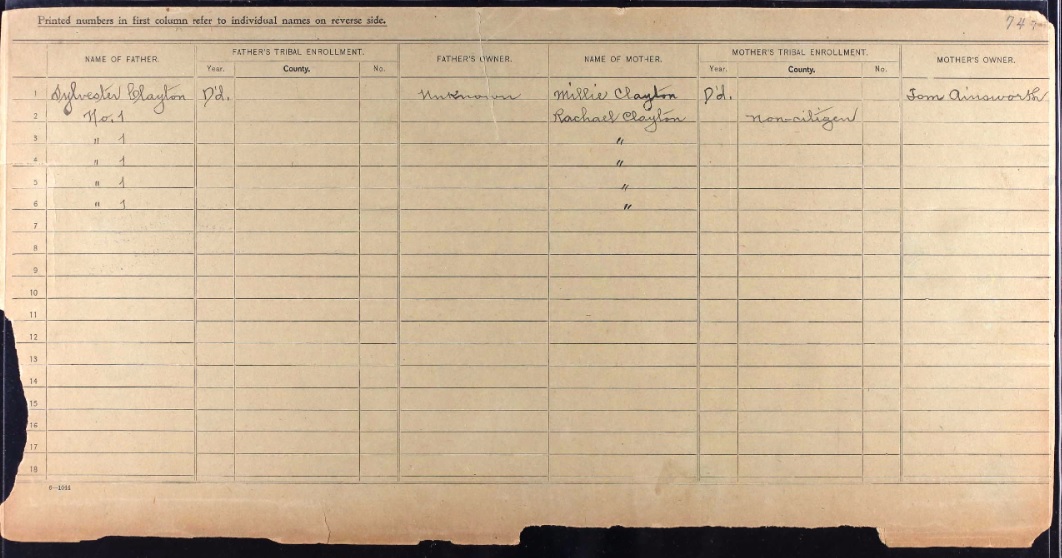
Piner was enrolling his children only, for his wife was not a citizen of the Choctaw Nation. The children were Willie, James, Diamond, Ana and Argutha. Piner was 49 years old at that time, and he and his family had been once enslaved by Thomas Ainsworth before the Civil War.

Piner Clayton's parents were Sylvester Clayton, and Minnie Clayton. Nothing is known about Sylvester Clayton except that he was deceased at the time of the Dawes enrollment. Piner's mother Millie was also deceased by that time,, but it is known that she was also enslaved by Tom Ainsworth.


Reverse side of Enrollment Card

Source: Same as top image above.


The interview for the Clayton file was not an extensive one. Most of the focus in the file appeared to be for the youngest child, Argutha. Argutha's case was added because he was born after the father Piner had initially appeared in front of the Dawes Commission.

National Archives Publication M1301 Application Jacket
Application Jackets Choctaw Freedman #749
Image Obtained from Fold3.com
https://www.fold3.com/image/260/55652625


Included also in the file was a birth affidavit for the youngest child Argutha. (Note that by 1910, the child was referred to in the federal census as "Augustus.")

(Source: Same as previous image)
In an effort to learn more about the family the Federal census of 1900 and 1910 were examined. In 1900 the family was enumerated in Mountain township, in the Choctaw Nation. However, by the time of the 1910 census the family had relocated to Braden. (Braden was and is still called "Braden Bottoms" by those living in what is now LeFlore County, Oklahoma.)

1900 Census Reflecting Clayton Family


1910 Census Reflecting Claytons in Braden Township

The move to the Braden Bottoms could have possibly been due to the Claytons being approved for land allotment and for having selected their land by 1910. The applications for allotment were examined and an extensive files for the Clayton family appeared for Piner and the children. Because Argutha's roll number was out of sequence on the enrollment card (see above) his land allotment application was conducted later, but he too received land as did each of the members of the Clayton household.

Sample of land record of Piner Clayton. Each member of the family excluding Rachel the mother,  
received their own land, and each had a file with the land descriptions and plat map.

The Clayton Family lived for several decades in the eastern Oklahoma community in LeFlore County. Some eventually moved to Oklahoma. This strong family has deep Oklahoma roots that continue to thrive both on Oklahoma soil and places beyond.

*************

(This is the 5th article in a series devoted to sharing families once enslaved in Indian Territory. The focus is on Freedmen from the Five Civilized Tribes and are part of the effort in 2017 to document 52 families in 52 weeks.)

Monday, August 8, 2016

It is Time for Some Walls To Crumble

L-R Angela Walton-Raji, Dick Perry, Tonia Holleman, Colin Kelly
Photo taken in 2006.  Both Dick and Colin are enrolled Chocatws

Six years ago, I had the opportunity to meet descendants of the Choctaw family that held my family in bondage. I appreciate that meeting because it was the slaveholder descendant that reached out to me, and for that I shall always be grateful.

For African American genealogists, we are constantly faced with the challenge of researching our ancestors before freedom, and we often find the lack of direction and easy path of family history to be quite difficult. The difficulty comes because the names of our ancestors are recorded as the property other human beings claimed that that they were destined to be. But those who have ancestors who were enslaved in Indian Territory, there is a greater challenge, because few citizens of the five slave holding tribes even acknowledge that slavery occurred, let alone engage with the descendants of those once held enslaved.

In the larger genealogy community, there are many cases where white slave holder descendants meet and share information from private records with descendants of the enslaved. In many cases, the names of our ancestors and their parents, often are found on old family ledgers, or wills, and letters and private holdings. And many are often willing to share and even come onto African American Facebook groups asking where and how they can share information where slaves are mentioned with people who may be searching.

For me, oin recent years, I have had two opportunities to  a chance to meet slave holder descendants who were from the families that held my ancestors. I met some when the Drennan home was dedicated in Arkansas, and I wrote a blog post about that experience.

But also, in addition to that time, I also have had the chance to meet a descendant of another slave holder from Indian Territory and I also wrote an article about that experience. In fact that meeting was history making---because I believe this to be the first time that a Native American descendant of a Native American slave holder had reached out to a descendant of his ancestor's slaves. I had the opportunity to meet a person who reached out to me, pointing out that he was a member of the Perry clan, and descended from Nail Perry, a name I knew to be associated with my family. Nail Perry was part of the Choctaw family to which my family held in bondage.

Our meeting was wonderfully cordial one, and we have kept in contact and several times over the years since that meeting. I have yet to read of any other descendant of Native Americans, reaching out to a descendant of their ancestor's slaves. Truly that meeting was is one of the few, if not the only meeting from a Native American family reaching out to a descendant of their family's slaves, in a gesture of friendship.

2006 Meeting of Descendant of Choctaw Slaveholder and Descendant of the Enslaved
As I have yet to hear of other meetings, two days ago, I was more than presently surprised to hear from another person, and this time from an unlikely source. This person was from Chickasaw country!

The letter came from a descendant of Jackson Kemp a wealthy Chickasaw slave holder.
Jackson Kemp, Chickasaw Slave holder
Image: Courtesy of Oklahoma Historical Society

Kemp held dozens of slaves in the Panola District of the Chickasaw Nation. He held over sixty people in bondage by the time the 1860 slave census was conducted.

Slave Schedule, Reflecting Slaves held by Jackson KempSource: Ancestry.com. 1860 U.S. Federal Census - Slave Schedules [database on-line]. Provo, UT, USA: Ancestry.com Operations Inc, 2010.Original data: United States of America, Bureau of the Census. Eighth Census of the United States, 1860. Washington, D.C.: National Archives and Records Administration, 1860. M653, 1,438 rolls.

The Chickasaws were extremely conservative and extremely biased towards their former slaves. They were strong Confederate allies and fought for the south during the Civil War. After the war, they refused to adopt their freedmen, and extend citizenship to them, although they signed a treaty in 1866, agreeing to do so. Chickasaw Freedmen were the most discriminated against throughout the post Civil War decades, and many lived in extreme poverty and receive no education, nor rights until way after statehood came. (Statehood was 1907.) Since the Chickasaws refused to acknowledge their former slaves as fellow citizens, their fate was a sorrowful one for years.

But on Sunday I received a very passionate and moving letter from a direct descendant of Jackson Kemp, and I am sharing part of the letter here.

"Nothing I ever do will be enough to make up for what my ancestors did.  There are generations of people whose lives were affected by Jackson Kemp.  It didn't just end when his slaves were freed.  They carried with them the scars that affected their lives and the lives of their descendants.  Even freed, they were treated like they were not human beings.  Even today, they are pleading for their lives to matter.

The letter shared more of the writer's own personal perspective and it was clear that there was sincerity, and there was compassion.

This letter received was perhaps the second time that I have become aware of a descendant of a Native American slave holder reaching out to a descendant of the enslaved people held in bondage. (The first time was when a descendant of Nail Perry of the Choctaw Nation reached out to me.)

Since receiving the email from the Chickasaw person, I have shared the letter with a descendant of the Kemp slaves. Hopefully they will connect and will be able to work together to explore more information and to share their common past. Hopefully in the near future, these Chickasaw Kemps will be able to meet, talk, break bread, and to work together.

Such meetings from Indian country are rare. But they can take place. As I stated above, my first meeting with the Choctaw Perry descendants was six years ago, and hopefully a meeting with the Chickasaw Kemps may occur in the near future.

But such meetings should not occur every six years--they should be commonplace. However, fear has drawn a major line between Indian tribal Freedmen, and the very people with whom they have a shared history.

Fear of Black people, fear of the people once subjugated by their own ancestors, fear of people who have never violated them, has kept Freedmen descendants at a frightful distance, for no reason. There is fear that truly---they don't matter. It does make one wonder when the walls of people who ancestors walked the same trail will be seen as persons with whom they have a shared history. They will find that they have more in common than not in common.

I appreciate the letter from the Chickasaw descendant who has extended an olive branch. I accept it, and hope that others will find some courage within themselves to do the same.

Perhaps it is time for some walls to crumble and for people to meet, talk, break bread and work together.