Monday, February 15, 2021

Honoring I.T. Freedmen Civil War Veterans


Painting Depicting 1st Kansas Colored Infantry
This unit consisted of many men from both Cherokee and Creek Nations
Image accessed from Black Past.org

Among the missing stories fromt Oklahoma and it pre-staehood history are the stories of slavery, the quest for freedom and the stories of the Freedmen. Embedded in the quest for freedom comes the story of men both enslaved and free, who enlisted in the Union Army during the Civil War. This untold Oklahoma story is rich reflecting stories of courageous of these black freedom fighters who joined the battle for freedom. They are honored this week during Freedmen History Month

Almost 200,000 men of African descent served in the American Civil War. Within that large number were men who served in several portions of the Union Army--the United States Colored Troops, the Indian Home Guards and the 1st & 2nd Kansas Colored.

Within these units were men who had a background that distinguishes them from other soldiers. These men had lived in Indian Territory, within Five native tribes. Many had been slaves while in these tribes, and some or their parents had come to the Territory on the forced migration known widely as the Trail of Tears. The tribes from which they came are Cherokee, Choctaw, Chickasaw, Creek and Seminole Nations.

Many of these men have their names inscribed on the Civil War monument in Washington DC. Their participation in the Civil War is not widely known, even by many who descend from them. However, their legacy is a strong one, and as a result they are to be honored throughout this week, of Freedmen History month.

The Regiments in Which They Served

1st Indian Home Guards
2nd Indian Home Guards
3rd Indian Home Guards

1st Kansas Colored Infantry
2nd Kansas Colored Infantry

11th US Colored Infantry
54th US Colored Infantry
79th US Colored Infantry
83rd US Colored Infantry

Battles in Which They Fought

Baxter Springs, October 6, 1863 Kansas 2nd US Kansas Colored Infantry
Boggs Mills, January 11, 1864  Arkansas  11th US Colored Infantry
Cabin Creek, Cherokee Nation July 1-2 1863 and Nov 4,1865  2nd Kansas Colored, & 83rd US Colored Infantry
Clarksville January 18th 1865  79th US Colored Infantry
Cow Creek, Kansas November 14th  1864  54th US Colored Infantry
Ft. Gibson, September 16,1864  79th US Colored Infantry
Horse Head Creek Arkansas February 17, 1864  79th US Colored Infantry
Honey Springs July 17m 1864 1st Kansas Colored Infantry
Island Mound, Missouri October 27th & 29th 1862 1st Kansas Colored Infantry
Jenkins Ferry Arkansas April 30th 1864 83rd US Colored Infantry
Lawrence Kansas July 27th 1869  79th US Colored Infantry
Lotus Steamer (near Dardanelle) Jan 16, 1865 83rd US Colored Infantry
Poison Springs Arkansas  April 18th 1864  1st Kansas Colored Infantry
Prairie D'Ann  April 13th 1864  1st & 2nd Kansas Colored Infantries
Timber Hills, November 19th 1864  1st Kansas Colored Infantry

May the forgotten freedom fighters from Indian Territory long be remembered. Their legacy should no longer be overlooked.


Saturday, February 13, 2021

Remembering Oak Hill Academy & Dawes Academy


Thanks to the work of Robert Flickinger, the history of Oak Hill Academy is known. This school was founded by Presbyterians who lived and worked in the Choctaw Nation. The school was established in the late 1880s when the goal was to bring education to children of  Choctaw Freedmen. The school was noted for the immaculate grounds and the structures of dormitories for both boys and girls. 

Many of the graduates of Oak Hill remained in the area to emerge as leaders. Wiley Homer established a church in the area working with the Presbytery of Kiamitia. 


Wiley Homer with Presbyterian Church in Grant, I.T.
Homer was a notable graduate of Oak Hill Academy

A roster of students who attended has not yet been found, but the work by Flickinger written in 1914 did include some impressive images of several of the students, staff, and also the grounds of the school.  The name was later changed to Elliott Memorial in 1912 and was remembered for many years after that time as Elliott Memorial. A historical marker is located near Valiant Oklahoma dedicated to the memory of the school once known as Oak Hill.


Marker for Elliott Academy - Oak Hill Academy


* * * * *  


Image Source:
The Daily Oklahoman
Oklahoma City, Oklahoma
August 8, 1971

In 1901 a decision was made by a group of Chickasaw Freedmen to establish a literary and industrial school near Berwyn. An appeal was made to the public for assistance in purchasing the property to become Dawes Academy.


The school did not last many years after statehood, and by the 1920s a segregated school system was established throughout Oklahoma, and local public schools were established.  Years later an article appeared in the local newspaper, the Daily Ardmorite about the school in May 1969. Following that article Mrs. Gladys Rhodes wrote a letter to the editor, describing the exact location of Dawes Academy in response. Additional notes about the school were later added to the letter as note, perhaps by the recipients interested in the school's history on the newspaper staff.

Transcription of letter

                                                                                       Sulphur Oklahoma
                                                                                      May 16th 1969

Dear Sir:

In regard to the Reporter's Notebook in the Daily Ardmorite of May 15th, the Dawes Mission School is about three miles north of Berwyn, now Gene Autry, and six miles east of Springer, in later years it was known as Dawes Academy.

A church is still there, known as Calvary Baptist. You ask for this information.

Very Respectfully,

Mrs. Gladys Rhodes
1428 W. Vinita
Sulphur  73086


An image of the letter, followed by a close up image, both appear below.  Also several interesting notations were written upon the letter clearly written in a different handwriting, possibly by newspaper staff.


Letter sent to Daily Ardmorite about Dawes Academy in 1969


Close up of letter sent to the Daily Ardmorite
Gladys Rhodes, Mrs. Dawes AcademytextDate Unknown; (https://gateway.okhistory.org/ark:/67531/metadc1625461/accessed February 13, 2021), The Gateway to Oklahoma History, https://gateway.okhistory.org; crediting Ardmore Public Library.


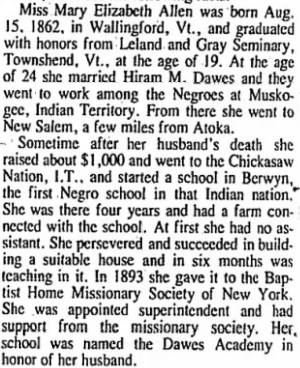
A sketch of the school was found in an old article from the Daily Oklahoman. The article described the history of the old Calvary Baptist Church, and included an image of the old church with attached school.

Over the years various articles about Dawes Academy have appeared in the press. One such article about education in the Territory included a statement written by Attorney B.C. Franklin. 


In the same article from the Daily Oklahoman (cited below image of church) it is revealed that Miss Mary Elizabeth Allen, who married Hiram Dawes, and it was they who migrated to the Territory to work "among the Negroes in Muskogee."  After her husband's death she raised about $1000 and started a school in Berwyn. In 1893 she gave management of the school to the Baptist Home Missionary Society. It is said that the school was named in honor of her husband.  


The Daily Oklahoman
Oklahoma City, Oklahoma
August 8, 1971

Although little else is known about Dawes Academy, hopefully it will not be forgotten as one of the pre-statehood schools for Freedmen of Indian Territory.


Friday, February 12, 2021

Remembering Evangel Mission for Creek Freedmen in Muskogee


Evangel Mission School, Muskogee I.T.

At the top of the old Agency Hill area in Muskogee, one finds the only Freedman school from the 19th century, that is still standing. The school was once known as Evangel Mission School, which was a school and residence for Creek Freedmen. Prior to the establishment of the school in the 1880s, itw as the site of the old Creek Agency, from which the term Agency Hill comes.

Beyond the original article that I wrote about Evangel Mission in 2011, this is simply an effort to place the history of this school in the minds of those who study the African American presence in Muskogee, Oklahoma.

This building that now holds the only still-standing structure built for Oklahoma Freedmen, is now known as the Five Civilized Tribes Museum. Many historical markers and notable aspects of the history of the area are found upon the grounds of the Museum. However, unfortunately, not one item mentioning the school, its founders, nor the students can be found. The black history of this former structure has been omitted.

A few facts about Evangel Mission School

-Established in 1883 by Baptist Missionaries
-Ira A. Cain, President/Superintendent of the School
-Located in the old Muskogee Agency building
-Names and Number of Students and Teachers: unknown to this day.
-Uses of the school building--Dance Hall, Tea Rooms, American Legion
-Current use: Five Civilized Tribes Museum

Hopefully someday more details about the school, the staff, and students will be known, but it is remembered during Freedmen history month. May those with ties to this part of Muskogee history, and Creek Freedmen history bring forth it's story.


Evangel Mission School Today


Five Civilized Tribes Museum


Thursday, February 11, 2021

Remembering the Creek and Seminole College of Boley


Courtesy of Oklahoma Historical Society

Like the other institutions, nothing remains of the old Creek and Seminole College, an educational institution built on five acres of land donated by Lucinda Holloway McCormick. The founder was John Leftwich of Alabama who was strongly influenced by Tuskegee founder, Booker T. Washington.

The school was sustained mostly by donations and endured several years of financial distress. In 1912 a tragic fire struck the school, which resulted in the deaths of 5 of the students. The fire closed the school for several years, but by 1916 the school was removed to Clearview, and the Creek Seminole Baptist college was established there. The school operated till the mid 1920s before closing its doors, never to reopen.

The few short years of the Creek Seminole College were an effort to bring education to Freedmen communities in Oklahoma, a land where the new state law of segregation brought more obstacles to the descendants of Freed people. Though the life of the school was short, its history is remembered here, in an effort to honor institutions that should be a part of the narrative of Oklahoma's Freedmen.


Wednesday, February 10, 2021

Remembering Tushka Lusa Academy for Choctaw Freedmen


Tushka Lusa Academy, Talihini, Choctaw Nation
Courtesy of Eric Standridge

Tushka Lusa was an academy located in Talihina, Choctaw Nation. This was a school built exclusively for Choctaw Freedmen. The school was only a few miles east of the town of Talihina, and the remains of this school, like many other Freedmen schools, lies somewhere beneath the overgrowth and has been lost to time. The name comes from the Choctaw words that mean "black warrior", and it's one of the many forgotten landmarks of Indian Territory. This was the only institute established by the Choctaw Natoin forthe children of their former slaves.

Basic Facts of Tushka Lusa Academy

Location: Talihinia, Choctaw Nation
Superintendent:  Henry Nail (Choctaw Freedman)
Student Population: Approximatly 40 per year
Educational Offered:  Elementary Education (not secondary)
Staff:  Henry Nail, Dora E. Johnson, Julia Coleman

Partial Student List from 1894 (Girls):
Sarah Butler
Mary Butler
Julia Coleman
Jane Garrett
Emma Gross
Sarah Gross
Berda Howell
Mumbra Humbe
Sophia James
Dice Nail
Annie Nail
Amelia Nail
Amanda Peachlyn (sic) (Pitchlynn)
Eliza Riley
Martha Rodgers
TenaShoals
Lucretia Shoals
Emma Thompson


Partial Student Listfrom1894 (Boys):
Miles Burras (sic) Burris
Caesar Eubanks
Ben Nail
lee Nail
Walter Pickens
Mariod Reed
John Richards
John Stanley
Walton Shoat (sic)
Solomon Sexton
Israel Tyms

By the mid 20th century, the school had ceased to exist. The school is now a forgotten landmark, but its history should not be forgotten.

Tuesday, February 9, 2021

Remembering the Cherokee Colored High School


Courtesy of Dr. James McCullaugh, University of Northern Iowa

A few miles northwest of Tahlequah, Oklahoma, somewhere lost overgrowth one might find what may still remain of an area known as  Double Springs, I.T. In that area, there may be a few bricks that may be the remains of the Cherokee Colored High School. Original plans were to place this school in the Bartlesville area, but those plans were changed when white citizens of the Bartlesville area thwarted the plans, wishing to have no Negro school in their area. 

The site was selected in a very remote location away from any city or town. S. W. Ross was interviewed in the 1930s about the school and he summarized the history briefly in the Indian Pioneer Papers:

 
University of Oklahoma Libraries, Western History Collection
Interview with S. W. Ross, October 29, 1937


The building stood empty for a few years except for one caretaker after the school closed. It was then set ablaze and burned to the ground. The school was the one sole school for Cherokee Freedmen, citizens beyond the primary grades. 

A detailed history of the school was written by Dr. James McCullaugh from the University of North Iowa. The journal was published in the 2010 issue of Voices of Indian Territory.

The schools is one of the missing landmarks of Oklahoma Black history. Hopefully its history will not be forgotten.

Monday, February 8, 2021

Freedmen Schools of IndianTerritory

 Every one of the schools that provided education for Freedmen of Indian Territory is gone. Except for one building that is now a museum, not even the foundation remains. Some have historical markers, and some are mere mentions in various books about Oklahoma history.  

In an effort to honor those schools that took many Freedmen families from darkness into the light of literacy, they will be mentioned each day this week.

These schools provided what education there was, and for many became the foundation upon which many families were able to grow and prosper. They are honored here.


Cherokee Colored High School - Double Springs, Cherokee Nation
Creek and Seminole College -  Boley, Creek Nation 
Dawes Academy -  Berwyn, Chickasaw Nation
Evangel Mission -  Muskogee, Creek Nation
Oak Hill Academy - Valiant, Choctaw Nation
Tullahassee Manual Labor School - Tullahassee, Creek Nation
Tushka Lusa Academy - Talihina, Choctaw Nation

Only one of these school buildings is still around, and now houses the Five Civilized Tribes Museum, located in Muskogee, Oklahoma. Two of the schools do have official Oklahoma State markers--both Oak Hill and Tullahassee. Oak Hill Industrial Academy was later changed to Elliott Academy and the marker bears the name of the newer name and not Oak Hill. 

The school in Tullahassee bears the original name of the school--Tullahassee Mission. That reflects the school established for Freedmen The marker does mention that it was later operated as a school for Freedmen.

No other markers reflect the remaining schools for Freedmen. However, these institutions shall not be forgotten, and shall be remembered for foundation and impact that they had as the freed people from these nations moved into a new and challenging future.

*